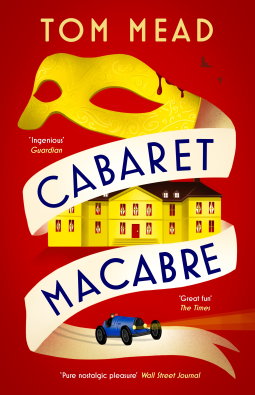
Cabaret Macabre by Tom Mead

After enjoying the first two books in Tom Mead’s Joseph Spector mystery series, Death and the Conjuror and The Murder Wheel, I was pleased to see that he had written a third one. I think this might even be my favourite of the three! If you haven’t read any of them, you could start here if you wanted to; although there are some references to Spector’s earlier cases, there are no spoilers and all three mysteries work perfectly as separate standalones.

It’s December 1938 and retired magician Joseph Spector has been approached by the wife of Sir Giles Drury, a prominent judge, who wants him to identify the sender of some threatening letters. She believes the culprit may be Victor Silvius, who attacked her husband nine years earlier and has been confined in a private sanatorium ever since. Having noted Spector’s involvement in solving the recent Dean case (described in The Murder Wheel), she hopes he will be able to find out who is behind the letters.

Coincidentally, Spector’s friend Inspector Flint of Scotland Yard has had a visit from Caroline Silvius, sister of Victor Silvius. Caroline believes someone is trying to murder her brother and she’s convinced that person is Sir Giles Drury. With Spector and Flint both investigating the same situation from opposite sides, it’s inevitable that their paths will cross. Arriving at Marchbanks, the Drurys’ country estate, during a period of heavy snow, both men are baffled when a member of the family is found dead under very unusual circumstances. Can they solve the mystery before another murder takes place?

I really enjoyed Cabaret Macabre. It’s very cleverly plotted, with not one but two locked room style murders for Flint and Spector to investigate, but unlike the previous book, which I found too complicated, this one was easier for me to follow. That doesn’t mean it was easy to solve, however, because it certainly wasn’t! I had no idea how the murders were carried out or who was responsible for them, even though the clues were all there in the text. Tom Mead really is a master of this type of mystery and it’s easy to see the influence authors like John Dickson Carr and Agatha Christie have had on his work.

The book has a large number of suspects (and also potential victims) including Sir Giles, his wife and their four sons and stepsons, Victor and Caroline Silvius and an assortment of servants at Marchbanks. There’s also another murder case – or was it suicide? – from nine years earlier (the source of the animosity between Victor and Sir Giles), which could provide the key to what’s happening in the present. It’s impressive that Mead manages to pull all of this together without leaving any obvious holes in the plot. What I particularly love about this series, though, is the idea of a former magician becoming an amateur detective and using his special knowledge of illusions and deceptions to solve crimes and assist the police. Although Spector is still something of a mystery himself and reveals very little of his past or his private life, I think he’s a great character and the perfect partner for the more practical, less imaginative Inspector Flint.

If you haven’t tried a Joseph Spector book yet and are a fan of Golden Age mysteries, I do recommend them; this one and the first one, in particular, have quite an authentic 1930s feel, as well as being fun and entertaining. I’m hoping there’ll be more!

Thanks to Head of Zeus for providing a copy of this book for review via NetGalley.

Book 39/50 for the Historical Fiction Reading Challenge 2024

This is book 20/20 of my 20 Books of Summer 2024.

Yes, I have completed my 20 Books of Summer list with nearly a week to go! I’ll be looking back at my 20 books and my experience with this year’s challenge in a special post at the end of the month.

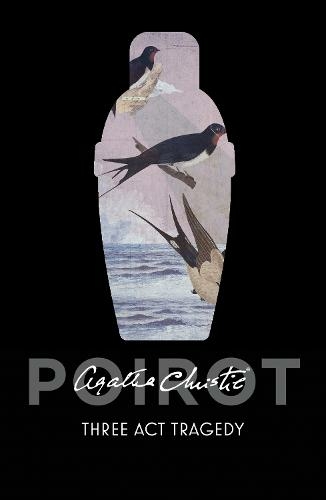
Three Act Tragedy by Agatha Christie

This month for the Read Christie challenge we are reading Christie novels published in the 1930s and I have chosen Three Act Tragedy from 1934. The book was also published in the US as Murder in Three Acts and that’s not the only difference – apparently the motive for one of the murders was also changed for the US edition. I’m not sure if there are any other Christie novels with significant differences between editions or if this is the only one.

Three Act Tragedy is a Poirot mystery but also features one of Christie’s other recurring characters, Mr Satterthwaite, who appears in The Mysterious Mr Quin and Murder in the Mews. At the beginning of the novel, Satterthwaite and Poirot are both attending a dinner party hosted by the stage actor Sir Charles Cartwright at his home in Cornwall. When one of the other guests, the Reverend Babbington, suddenly drops dead after taking a sip of his cocktail, several people suspect murder – yet there are no traces of poison in his glass. Soon afterwards, another death occurs under similar circumstances at a party attended by many of the same guests, but this time the victim is confirmed to have died from nicotine poisoning. Are the two deaths connected and if so, did the same person carry out both murders?

This is another entertaining Christie novel; maybe not one of her strongest plots, but the motive for the first murder is very unusual and I didn’t guess either that one or the motive for the second murder. I did start to suspect who was responsible, but not until much later in the book, so I can’t claim to have solved the mystery. We don’t see very much of Poirot himself as this is one of the books (like Lord Edgware Dies, which I read last month) where he sits at home and waits for other characters to provide him with information, rather than going out to interview suspects and search for clues himself. Instead, the deaths are investigated by Mr Satterthwaite and Sir Charles, with help from Miss Lytton Gore, affectionately known to her friends as Egg.

I would have liked Poirot to have played a bigger part in the story as although I like the elderly Mr Satterthwaite, he’s not very skilled at detecting, and I never really felt fully engaged with either Sir Charles or Egg. There’s an interesting cast of supporting characters, such as Muriel Wills, who writes plays under a male pseudonym, but I felt that some of these weren’t really used to their full potential. This wasn’t a favourite Christie, then, but I did still enjoy it – and it was good to see Poirot sharing a little bit of his personal history in a conversation with Satterthwaite, as he usually reveals very little about himself.

Next month for the Read Christie challenge (and for August and September as well) we are moving on to the 1940s and 1950s. There are plenty of books I still have to read from those decades, but one I definitely have lined up is N or M?, the third in the Tommy and Tuppence series. I’m hoping to make that one a July read.

This is book 5/20 of my 20 Books of Summer 2024.

Lord Edgware Dies by Agatha Christie

This year’s Read Christie challenge has a ‘Through the Decades’ theme and this quarter we’re reading books from the 1930s. My choice for May is Christie’s 1933 Poirot mystery Lord Edgware Dies (published in the US as Thirteen at Dinner).

The novel is narrated by Poirot’s friend, Captain Hastings – a nice surprise as I tend to love the Hastings books and hadn’t realised he was in this one. At the beginning of the book, Poirot and Hastings are visiting the theatre to watch a performance by the American impressionist Carlotta Adams, known for her impersonations of famous people such as the actress Jane Wilkinson. After the show, they are approached by Jane Wilkinson herself, who asks for Poirot’s help in obtaining a divorce from her husband, Lord Edgware. The actress desperately wants to marry the wealthy Duke of Merton and tells Poirot that if Edgware won’t agree to a divorce, she’s just going to have to kill him!

When Lord Edgware is indeed found dead in his own home, having been stabbed in the neck, Jane Wilkinson appears to be the obvious suspect – after all, she was seen entering the house that evening and everyone knew that she wanted her husband dead. However, Edgware had already agreed to a divorce earlier that day, taking away Jane’s motive. And Jane had spent the whole of that evening at a dinner party with twelve other guests, all of whom can provide her with an alibi. Was Jane really in two places at once – or was it Carlotta Adams who entered Lord Edgware’s house in disguise?

This is a very enjoyable Poirot novel with a clever solution, although I don’t think it’s an absolute favourite as I found it a little bit lacking in atmosphere. The whole story takes place in London and we don’t see much of Poirot actually going out in search of clues – instead he sits and waits for the clues to come to him, much to the frustration of Hastings who wishes Poirot would take a more active role in solving the mystery, like their old friend Inspector Japp:

Poirot replied that he preferred to solve it sitting at home.

“But you can’t do that, Poirot.”

“Not entirely, it is true.”

“What I mean is, we are doing nothing! Japp is doing everything.”

“Which suits me admirably.”

“It doesn’t suit me at all. I want you to be doing things.”

“So I am.”

“What are you doing?”

“Waiting.”

Of course, Poirot is the one who correctly identifies the murderer while Japp, as usual, jumps to the wrong conclusions. I also failed to solve the mystery; although I did guess part of the solution very early on, I allowed myself to get distracted by the red herrings, of which there are many!

What I particularly loved about this book was the relationship between Poirot and Hastings and the way they work so well together, with some chance remarks of Hastings’ inadvertently pointing Poirot in the direction of important clues. Having the novel narrated by Hastings means the reader gets to hear Poirot discussing possible theories with him and sharing his thought processes, which I find more enjoyable than the books where we have no idea what Poirot has been thinking until the end. It also means that we only see the various suspects and witnesses from Hastings’ perspective; Jane Wilkinson, for example, presents herself in public as so silly and vacant that we know there must be more to her than meets the eye. Jane is a great character and Jenny Driver, Carlotta Adams’ friend who owns a fashionable London hat shop, was another favourite.

I’m hoping to read another 1930s Christie novel in June, then for July-September we move on to the 40s and 50s!

They Found Him Dead by Georgette Heyer – #1937Club

This week, Simon of Stuck in a Book and Karen of Kaggsy’s Bookish Ramblings are hosting another of their very popular clubs, where we all read and write about books published in the same year. This time it’s 1937 Club and for my first book I’ve turned to a favourite author who can be almost guaranteed to have had at least one title published in any chosen club year. In 1937, she had two and although An Infamous Army, a novel set before and during the Battle of Waterloo, is one I read a few years ago and didn’t particularly enjoy, I’m pleased to say that I had a much better experience with this one.

They Found Him Dead is one of twelve contemporary detective novels written by Heyer. It begins with the family, friends and business associates of Silas Kane assembling at his country house to celebrate his sixtieth birthday. As with many large gatherings, there are various tensions between members of the group, but when Silas is found dead at the bottom of a cliff after going out for his usual evening walk, the police decide that it was just a tragic accident. Only fourteen-year-old Timothy Harte, half-brother of Silas Kane’s nephew Jim, suspects murder – and when Kane’s heir, Clement, is shot in the head several weeks later, it seems that he could have been right.

Superintendent Hannasyde and Sergeant Hemingway arrive from Scotland Yard to investigate and quickly discover that there’s a large number of suspects including several nephews and nieces in the line of inheritance, some of Kane’s business partners and even his elderly mother, a woman in her eighties. However, they first need to decide whether they really are dealing with two murders or just one – and if there have been two, were they both committed by the same person?

I thought this was an entertaining novel, although I did panic at first due to the huge number of people introduced in the opening chapter. I wished I had drawn a family tree to keep them all straight in my mind, but after a few more chapters everything had settled down anyway and the characters and their relationships became more clearly defined. As a mystery it’s not a very clever or original one – in fact, it’s quite formulaic in many ways, with the country house, family party, motives revolving around inheritances and business deals and the Scotland Yard detectives all being very familiar to anyone who has read a lot of Golden Age crime. The murderer is also quite easy to guess, once you’ve picked up on one very obvious clue.

What I really enjoyed about this book was not the plot but the characters. I particularly loved Timothy, who has an active imagination leading him to see drama and conspiracy in every situation and is nicknamed Terrible Timothy by Sergeant Hemingway. He does actually help to solve the mystery, but not in the way he had expected! There’s also a bit of romance (although it’s quite understated and not a big part of the book), with Timothy’s half-brother, Jim Kane, falling in love with Patricia Allison, companion to Silas Kane’s mother. I liked these two characters as well; in general, the characters in this book are a more pleasant bunch than in the other Heyer mysteries I’ve read! A few of them also appear in her 1951 novel, Duplicate Death, which I read before this one and I’m now wishing I’d read them in the correct order!

I still have a lot of Heyer’s mysteries left to read and am looking forward to them. They don’t really compare to Agatha Christie’s when it comes to plotting a crime, concealing clues and creating red herrings, but they’re still fun to read. This was a great start to the 1937 Club for me and I’m also enjoying my second book, which I’ve almost finished and will be reviewing later in the week.

Fear Stalks the Village by Ethel Lina White

The village was beautiful. It was enfolded in a hollow of the Downs, and wrapped up snugly — first, in a floral shawl of gardens, and then, in a great green shawl of fields. Lilies and lavender grew in abundance. Bees clustered over sweet-scented herbs with the hum of a myriad spinning-wheels.

With its Tudor cottages and cobbled streets, the village depicted in Ethel Lina White’s 1932 novel seems at first sight to be an idyllic place to live. There’s no poverty or unemployment, an endless round of tea parties and tennis games, and once settled there, people find that they never want to leave. Joan Brook is a relative newcomer to the village, having arrived to take up a position as companion to Lady d’Arcy, and she has already fallen under its spell.

When a novelist friend from London comes to visit, she entertains herself and Joan by imagining the secret scandals taking place behind closed doors. Perhaps the village doctor is poisoning his wife, she says, and the saintly Miss Asprey is bullying her companion; the Rector is leading a double life, and Miss Julia Corner, President of the local Temperance Society, is a secret drinker. The visit is a brief one and the friend soon returns to London, but when the inhabitants of the village begin to receive anonymous poison pen letters, it seems that the scenarios she had imagined were not so far from the truth after all.

Fear Stalks the Village is an unusual crime novel; although there are several deaths, it is not a murder mystery and the plot revolves entirely around finding out who is writing the spiteful letters threatening to expose the private lives of the villagers. Other reviews compare it to The Moving Finger by Agatha Christie, but as I haven’t read that one yet it reminded me most of Henrietta Clandon’s Good by Stealth. There’s lots of witty, satirical humour and a large cast of strongly drawn characters, all of whom appear at first to be happy, well-adjusted people…until the letters begin to arrive. The question the novel raises is whether the cracks have always been there beneath the surface or whether they have been created by the letters and the suspicion and anxiety they cause.

The mystery is quite a clever one, with some red herrings to throw us off the track, and I didn’t guess who was sending the letters. However, it took me a while to get into this book as the pace is quite slow and, despite the title, I didn’t feel that there was any real sense of fear or menace. Still, this is the second book I’ve read by Ethel Lina White, the first being The Wheel Spins (the book on which Alfred Hitchcock’s The Lady Vanishes is based) and I think it’s my favourite of the two – probably because with the other book I couldn’t help comparing it unfavourably to the film, which I love! I would be happy to try more of her books so let me know if there are any you would recommend.

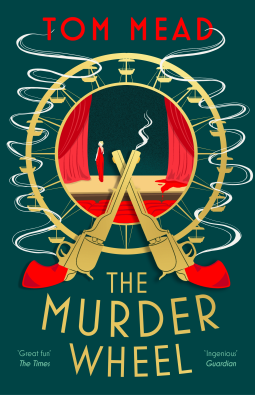
The Murder Wheel by Tom Mead

This is the second book in Tom Mead’s Joseph Spector mystery series, following last year’s wonderful Death and the Conjuror. If you haven’t read the first book yet and want to start with this one it won’t be a problem as the two deal with standalone mysteries.

The Murder Wheel begins in London in 1938 with lawyer Edmund Ibbs visiting a client, Carla Dean, in Holloway Prison. Carla is awaiting trial for the murder of her husband while they were riding on a Ferris Wheel together at the fair. As the only other person in the carriage when a shot was fired at close range – and with her fingerprints all over the alleged murder weapon – suspicion has naturally fallen on Carla. Ibbs’ job is to prove that she is innocent, but it’s going to be a difficult task!

When he’s not investigating crimes, Edmund Ibbs is pursuing a secondary career as an amateur magician and has just received a copy of a highly controversial new book, The Master of Manipulation, which promises to give away all the secrets of the art of magic. After his visit to Carla in prison, Ibbs heads for the Pomegranate Theatre to watch a performance by the great illusionist, Professor Paolini. When another suspicious death occurs during the magic show, Ibbs finds himself in the wrong place at the wrong time and discovers that he is now a suspect in another murder case! Are the crimes connected? Luckily, retired magician Joseph Spector is on hand to solve the mystery.

The Murder Wheel is another entertaining novel, but I didn’t enjoy it quite as much as the first book, mainly because I found it so complicated. There are eventually three separate seemingly impossible crimes to solve and I struggled to keep track of all the different threads of the story. There’s a lot of focus on the murder methods and the intricacies of how each one was committed, and although the solutions do all make sense, I could never have worked them out; I completely failed Mead’s ‘challenge to the reader’ near the end of the book, even though we’re told that the clues have all been provided in the text (and when the solutions are finally revealed, there are footnotes linking back to where each clue first appears).

I do love the partnership between Joseph Spector and Inspector Flint of Scotland Yard; they work together so well because one of them is using traditional methods of detecting such as questioning suspects and searching for evidence, while the other is more concerned with how his knowledge of illusions and sleight of hand can show how the crime was carried out. Magic plays a bigger part in this book than it did in the first one and I enjoyed that aspect of the story; it was interesting to get some insights into the backstage preparations for a magic show and how some of the tricks are performed, although I can see why some of the characters were unhappy with the author of The Master of Manipulation revealing all their secrets!

Tom Mead is a fan of Golden Age detective novels, particularly of the ‘locked room’ or ‘impossible crime’ types, and I think he does a good job overall of capturing the feel of a 1930s mystery – although with this book, I never felt that I really was reading a 1930s mystery, the way I did with the first one. I’m not sure exactly what was different, but that’s another reason why I preferred Death and the Conjuror. Still, I will probably read the third book in this series, assuming there’s going to be one!

Thanks to Head of Zeus for providing a copy of this book for review via NetGalley.

This is book 48/50 for the 2023 Historical Fiction Reading Challenge.

Wonder Cruise by Ursula Bloom

If you’re not lucky enough to be going on a cruise this summer, this 1934 novel by Ursula Bloom is the next best thing! It will give you the opportunity to visit Gibraltar, Marseille, Malta, Naples and Venice, all without leaving your own home. You’ll sail on the Allando in the company of Ann Clements, a thirty-five-year-old single woman who has never been abroad in her life…until now.

At the beginning of the novel, Ann is living in rented rooms in London and working as a secretary, having been left penniless after her father’s death. Her routine rarely changes – long days in a gloomy office, then home to do the ironing and sewing, with only two weeks by the sea with her controlling, bullying older brother Cuthbert to look forward to. She has almost given up hope of having any excitement in her life, until the day she wins a large sum of money in a sweepstake she didn’t even know she had entered. Ignoring Cuthbert’s advice to invest the money in a trust fund for his daughter, Ann decides to spend it on a Mediterranean cruise – and this one decision will change her life forever.

Even while she’s boarding the ship, Ann is having second thoughts. Is she really brave enough to travel alone? Has she brought the right clothes? Surely she’s too old and boring to be having an adventure like this! As the days go by, however, she finds herself doing things she had never imagined herself doing before and for the first time she begins to learn who she really is and what she wants out of life.

I enjoyed this book from beginning to end; Ann is an endearing character and it was lovely to watch her grow in confidence, start to think for herself and leave behind the shy, insecure woman who has grown up under her brother’s thumb. Having been convinced that she would remain a spinster to her dying day, she also meets several men on the cruise who make her wonder whether it’s not too late to fall in love after all. Yet I wouldn’t describe this book as a romance so much as a book about a woman discovering that romance is possible, if that makes sense!

I also loved the descriptions of the places Ann visits, particularly as I’ve been to some of them myself, as well as life on the ship itself, as Ann gets to know her fellow passengers. They are a real mixture of people and although Ann has some preconceived ideas (thanks to Cuthbert’s influence) regarding those who are ‘not her sort’, as part of her transformation she is exposed to new ways of thinking and starts to change her own views.

Wonder Cruise is the first novel I’ve read by Ursula Bloom, but it seems she was very prolific and wrote over 500 books under various pseudonyms, which got her into the Guinness Book of Records in the 1970s! If you’ve read any of them maybe you can help me decide which one I should try next.

This is book 6/20 of my 20 Books of Summer 2023