The Blank Wall by Elisabeth Sanxay Holding

Every time I pick up a Persephone book I’m amazed by the diversity of the books they publish. The Blank Wall, written by the American author Elisabeth Sanxay Holding and originally published in 1947, is completely different to the others I’ve read, in terms of both plot and overall feel.

The Blank Wall is a suspense novel set during World War II. Lucia Holley is living with her two teenage children and her father in their lakeside home, while her husband, Tom, is serving in the navy somewhere in the Pacific. Her daughter, Bee, has been having an affair with an older man who Lucia considers to be entirely unsuitable. Things quickly start to spiral out of control and Lucia finds herself involved in murder, blackmail and a series of other crimes, all of which she attempts to conceal from her family. But as she desperately tries to protect her loved ones and avoid a scandal, could Lucia actually be putting herself and others in danger?

With the story being told from Lucia’s perspective, we are given lots of insights into her thought processes as she tries to cope with the disruption to her previously peaceful life. I could really feel Lucia’s fear and panic as everything seemed to be closing in around her. I didn’t always understand her actions and there were times when I felt frustrated with her because some of her decisions were clearly silly and irrational, but it was an interesting study into the way a 1940s woman of Lucia’s class and background might have reacted. It was easy to see why Lucia felt under so much pressure. She was doing her best to take care of her family during wartime and provide meals for them despite rationing and shortages, as well as trying to solve their personal problems and keep them safe – while continuing to send letters to her husband assuring him that everything at home was fine.

The pages of The Blank Wall are filled with tension and suspense. The plot is exciting and fast-paced and I could never guess what might happen next. But apart from the thrilling plot, the other strength of this book is the skilful way Holding portrays the relationships between Lucia and the other characters, particularly with her daughter Bee, the housekeeper Sybil and one of the blackmailers, Martin Donnelly, with whom she starts to form a surprising friendship. And I haven’t read many stories of the American Home Front during the war, so this was another interesting aspect of the book for me. A great story and one of my favourite Persephones so far.

The Postmistress by Sarah Blake

It’s 1940. Frankie Bard is an American radio reporter working in London for CBS, broadcasting news on the Blitz into American homes. Frankie is right in the heart of the action, spending her nights sheltering from the bombs and her days reporting on homes that have been destroyed, families torn apart and children left orphaned.

Meanwhile on the other side of the Atlantic, we see the effects the war is having on the small town of Franklin, Massachusetts. In Franklin, we meet the postmistress (or actually, postmaster, as she prefers to be called): Iris James, a middle-aged single woman. And we also meet Emma Fitch, the doctor’s wife. When Emma’s husband travels to London to offer his medical skills to the war effort, it sets a chain of events in motion which will affect the lives of all three women.

I seem to have been reading a lot of books about World War II recently – books written during the war, set during the war and about the aftermath of the war. The Postmistress is a book I’ve had my eye on for a while and I was looking forward to reading it. Unfortunately, it turned out not to be one of the better WWII books I’ve read. In fact, it’s probably the most disappointing book I’ve read so far this year and I very nearly gave up on it after a few chapters. Although the writing was very elegant, it felt impersonal somehow and scenes that I’m sure should have made me cry left me unmoved.

The biggest problem I had was that I didn’t feel a real connection to any of the characters. The only one who came alive for me at all was Frankie Bard. I thought the book lacked focus and might have worked better if it had concentrated more on one central character. As it was, I’m not sure The Postmistress was the best title for this book. It implies that the postmistress (i.e. Iris) would be the main focal point of the book, which she wasn’t – this was really Frankie’s story in my opinion – and although Iris does play an important part in the plot, her character’s potential was never fully explored. As for the third main female character, Emma, she seemed very two-dimensional and I never felt that I got to know her at all.

It’s not all bad, though: there were some things that I did like about this book. I enjoyed the section where Frankie was sent to report on the refugee trains departing from Berlin and to attempt to interview some of the Jewish families who were leaving the city. I’m sure she wouldn’t really have found it quite so easy to travel by ferry from England to France in the middle of the war and then to catch a train to Berlin, though! Despite this and a few other inaccuracies (in the author’s note, for example, Sarah Blake admits that the recording equipment Frankie was carrying hadn’t been invented until 1944), I thought this was easily the most compelling part of the novel. This was around 150 pages into the book and was the first time I’d found myself becoming absorbed in the story, which made me glad I hadn’t abandoned it. Sadly though it didn’t continue to hold my attention and I quickly started to lose interest again when the focus returned to Iris and Emma.

I did find it interesting to read about the various ways in which the war was affecting the lives of people in Massachusetts, thousands of miles away from the fighting. We see people worrying about loved ones in Europe, people feeling frightened and expecting a German U-boat to land at any minute, people tuning into the radio every day to hear the latest news and wishing there was some way they could help. Most of the WWII books I’ve read have been from a European perspective so this was something different and I really liked that aspect of the book.

The Postmistress didn’t work for me personally, but I’ve seen a lot of reviews that are much more positive than mine, so clearly other readers have been able to connect with the characters and the story better than I have. I do however think it would make a good book group choice, as it raises some issues which would be perfect for a discussion, such as the importance of truth and whether the truth should always be told – and what happens to the people we hear about on the news after the reporter stops speaking and the radio is turned off.

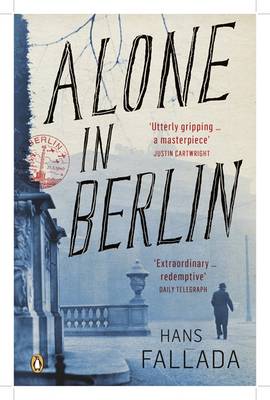
Alone in Berlin by Hans Fallada

“Mother! The Führer has murdered our son. Mother! The Führer will murder your sons too. He will not stop till he has brought sorrow to every home in the world.”

Otto Quangel writes these words on a postcard one Sunday afternoon in 1940, drops it in a crowded building the next day and waits for someone to find it. And in this way, a quiet married couple from Berlin begin their campaign of resistance to World War II.

I’ve been very lucky so far with my reading choices in 2011. Alone in Berlin (published in the US as Every Man Dies Alone) is yet another one that I thoroughly enjoyed. This book has been on my wish list since I noticed it had been translated for the first time and published as a Penguin Classic, and I’m so glad it lived up to my expectations. Not only is it a wonderful story but it’s also important historically as an anti-Nazi novel written by a German and published in 1947, just after the end of World War II.

The book is based on the true story of Otto and Elise Hampel, whom Hans Fallada renamed Otto and Anna Quangel. Fallada was given the Gestapo’s files on the Hampels and was able to draw on this information as part of his research for Alone in Berlin. Before I read this book I knew nothing about the Hampels and their postcard campaign, so I found the plot completely suspenseful, exciting and full of surprises – it was truly unputdownable, the kind of book where I knew as soon as I started reading that I was going to love it.

From the first page we are drawn straight into the action with postwoman Eva Kluge delivering a telegram to Otto and Anna Quangel, informing them that their son has been killed. Meanwhile in the apartment below, the Nazi Persicke family are celebrating the news of the capitulation of France, whilst Frau Rosenthal, the elderly Jewish woman who lives on the fourth floor, is forced to go into hiding after her husband is taken away by the Gestapo.

Devastated by his son’s death and appalled by the Nazi regime, Otto buys some blank postcards and devises a simple scheme which he hopes will raise awareness of Hitler’s atrocities and encourage other German citizens to join the resistance. On the surface, Otto is our hero, the man with the courage to stand up to Hitler, the man who refuses to join the Party although doing so is ruling him out of promotion at work. And yet Otto is not a conventional fictional hero. He comes across as cold and distant and not particularly likeable – but I could understand the reasons for him distancing himself. He was not frightened for himself, but afraid that his actions would endanger anyone associated with him, particularly his beloved Anna who insists on helping him with the postcards despite the risks involved.

The middle section of this book becomes a sort of cat-and-mouse game with Inspector Escherich of the Gestapo attempting to catch the mystery postcard writer. Escherich is a very shrewd and intelligent detective who is able to make clever deductions based on the tiniest clues – almost a brutal, sinister version of Sherlock Holmes – and I was kept in suspense wondering if Otto would give himself away.

But there are so many other things going on in this book. We also meet Enno Kluge, Eva’s husband, whose main ambition is to stay out of the army on health grounds and fill his days with gambling and drinking. Then there’s Trudel Baumann, who was once engaged to the Quangels’ son, and is opposing the war in her own way; Baldur Persicke the Hitler Youth Leader who puts Hitler and the Party before even his own father; and Kuno-Dieter, a teenage boy who flees Berlin for the countryside.

I wasn’t expecting this book to be so easy to read. The writing is clear and direct, getting straight to the point and allowing us to concentrate on the rapidly moving plot. I was concerned that my unfamiliarity with German war-time politics might be a problem, but I needn’t have worried. I had no problem understanding any part of the book. The focus is not on the politics but on the people and their lives. I went through a whole range of emotions while reading this book: fear (for Otto and Anna, for Trudel, for Frau Rosenthal, even at times for Enno); anger (at the Gestapo and the whole system of ‘justice’); and sadness, of course.

Alone in Berlin is a moving and inspirational story about two people standing up for what they know is right. I would highly recommend it if you enjoy reading World War II fiction and would like to view things from a different perspective and also if you enjoy novels that are both gripping and heartbreaking. Don’t let the 600+ pages put you off – I became so absorbed in the story I didn’t even notice the length!

Review: The Night Watch by Sarah Waters

The Night Watch follows the lives of four very different people during and after World War II. There’s Kay, who drove an ambulance during the war, but now, in 1947, there’s something missing from her life and she wanders the streets of London on her own, a lost and lonely figure. There’s Helen, who is feeling insecure in her relationship with the sophisticated Julia. Then there’s Viv, having problems of her own with her boyfriend Reggie, an ex-soldier. And finally, we meet Viv’s brother Duncan, who was in prison during the war and is still haunted by events in his past.

The story quickly becomes so complex and involved that it would be difficult to tell you any more about the plot without spoiling it. What I can tell you about though, is the structure of the book, which was very unusual. The story begins by introducing us to the characters in 1947, after the war has ended, then moves back in time to 1944, and then in the final section goes back further still to 1941. I both liked this structure and disliked it.

I liked it because of the way it led to some surprising revelations about the characters and their histories. I disliked it because so many storylines were left unresolved. I wanted to know what happened; I wanted to know whether Kay, Helen, Viv and Duncan would find happiness. I think this is probably the first Sarah Waters book I’ve read where I really loved and cared about the characters – they all felt so real and believable. But while the book answered some of the questions about the characters’ pasts, I was left with a lot of unanswered questions about their futures.

In comparison to Sarah Waters’ other books, this one feels much more subdued and quiet, with an overall mood of sadness. Apart from relating some of the obvious horrors of war which affected society as a whole, there are some heartbreaking moments in the personal stories of all four main characters (the story that affected me the most was probably Viv’s). I also found it interesting to read about the various jobs that were available to women during the war. With so many of the men away fighting, this was a time when it was deemed acceptable for women to do jobs that would previously have been done by the men. Kay, as I mentioned, was an ambulance driver, and there were other women also doing the same work. Helen and Viv were employed in more conventional office jobs, but were still contributing to the war effort with Helen providing support for people who had lost their homes or were in financial difficulties, and Viv working as a typist for the Ministry of Food.

As I’ve come to expect from Sarah Waters’ books, The Night Watch is both well written and well researched. She manages to incorporate an incredible amount of detail into the book, but the detail never overwhelms the story. I would recommend this to anyone who enjoys reading about life during World War II and the effects of the war on the lives of ordinary people. But if you loved Fingersmith and are looking for more of the same, I should warn you that this book is about as different from Fingersmith as you could imagine!

Recommended.

Review: The Little Stranger by Sarah Waters

This is the third Sarah Waters book I’ve read this year, the other two being Affinity and Fingersmith, and I think this one is my favourite. I seem to be in the minority though, as I’ve seen some very mixed reviews of this book.

The Little Stranger is set in Warwickshire just after the end of World War II. When Dr Faraday is called to Hundreds Hall, home of the Ayres family, to treat their young maid, he can’t help noticing that the house has deteriorated since he was last there as a boy. Striking up a friendship with Mrs Ayres and her daughter Caroline, Dr Faraday begins to spend more and more time at Hundreds – and becomes involved in a series of increasingly strange and terrifying events.

This is a typical haunted house story, yet it was psychologically fascinating, very suspenseful – and genuinely spooky. I always find poltergeist-type phenomena very disturbing to read about and there’s plenty of that in this book, from moving furniture and inexplicable fires, to tapping noises, ringing telephones and mysterious handwriting that appears on the walls. I had to avoid reading this book late at night because I knew it would scare me if I did!

I have said before that I think one area where Sarah Waters really excels is in creating believable and vivid settings for her stories. She has done this to perfection in the two Victorian novels that I’ve read, and does it again here with her portrayal of life in post-war Britain – the class system, the economy, housing, medical care and the introduction of the NHS.

Another thing I loved about this book is that it’s not immediately obvious what’s going on, which allows the reader to be a detective. Is Hundreds Hall really haunted? Is there a rational explanation for the supernatural occurrences? Or is someone playing a cruel trick? And if it is a trick, who is responsible for it? I think I suspected every character at some point in the novel! Then there’s Hundreds itself, which is almost a character in its own right – perhaps the most important ‘character’ in the book. It seems to be symbolic that as the house falls further into neglect and disrepair, the Ayres family themselves begin to fall apart one by one.

I was hoping that by the end of the story everything would become clear. However, after finishing the book I am still no closer to knowing exactly what had happened at Hundreds than I was at the beginning. The final few chapters of the book are very ambiguous and leave the story open to interpretation. It was slightly frustrating not to be given all the answers, but in the end it didn’t really matter because the story was wonderful anyway – and even a few days later I’m still thinking about it and wondering whether I’ve interpreted things correctly.

Unless you really don’t like ghost stories, I would recommend The Little Stranger as a great, spooky read, perfect for the RIP challenge or for Halloween.