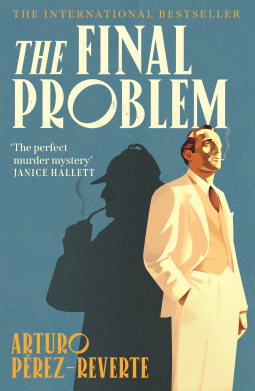
 Translated by Frances Riddle
It’s June 1960 and actor Ormond Basil has found himself trapped on the small island of Utakos, near Corfu. He has been invited to join a film director on his yacht to discuss a new project, but stormy weather means they are unable to leave the island until conditions improve. Luckily, there’s a hotel on Utakos where they and a small group of other guests and staff can take shelter until the storm has passed. However, there are no police on the island, so when one of the guests, British tourist Edith Manders, is found dead under suspicious circumstances, it’s up to the others to investigate until help can arrive.
Because Ormond Basil famously played the part of Sherlock Holmes on screen many times, he’s nominated to lead the investigation. No matter how much he explains that he’s only an actor and not really the great detective, everyone else insists that he must know more about solving mysteries than they do. And despite his protests, he does seem to know what he’s doing. With one of the other guests, Spanish crime author Paco Foxá, as his Watson, Basil begins to look for clues and question the suspects – but can he find the killer before another death takes place?
You may have guessed that Ormond Basil is closely based on the real life actor Basil Rathbone, who is for many people the quintessential Sherlock Holmes. I’ve talked before about not liking the current trend for using real people as detectives, but this is slightly different as the character is semi-fictional which gives Pérez-Reverte more scope to have him say and do things that the real Basil may not have done. He’s so obviously supposed to be Basil Rathbone, though, that it seems a bit pointless to pretend that he’s not. Either just calling him Rathbone or creating a completely fictional character would have worked better for me.
The novel is well plotted and the locked room mystery has a solution which is clever without being overly complex. With only a small number of suspects due to the setting, I thought I had guessed who the murderer was, but I was wrong and there was a nice twist towards the end that I hadn’t seen coming. For all Basil’s insistence that he’s not the real Sherlock Holmes, he does turn out to be an excellent detective, with powers of observation and deduction almost as good as the character he played for all those years!
However, I felt that there was far too much name-dropping of other famous actors and directors Basil had worked with, and too many long discussions between Basil and Foxá on the subject of Sherlock Holmes, in which both of them quote constantly from the books and adaptations. This all became a bit tedious and detracted from the mystery. I had a similar problem with the other Pérez-Reverte novel I’ve read, The Dumas Club, in which we’re bombarded with references to Alexandre Dumas’ books, so maybe this is just the way he writes.
I’m not sure if The Final Problem is going to be left as a standalone or if it’s intended as the start of a series; I don’t know if I would want to read any further adventures for Ormond Basil, but I did enjoy this one overall because of the interesting murder mystery. This edition of the novel is available from Atlantic Books, translated into English from the original Spanish by Frances Riddle. As Atlantic Books is an independent publisher, I’m counting this towards Read Indies, hosted this month by Karen of Kaggsy’s Bookish Ramblings.






 She Reads Novels