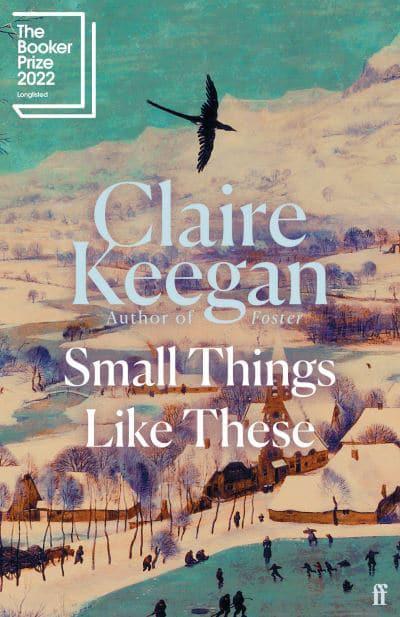
Small Things Like These by Claire Keegan – #NovNov22

I hadn’t really considered reading this book until my post on the HWA Crown Awards for Historical Fiction, when several of you commented that you had read and loved it. Around the same time, it was shortlisted for the Booker Prize and again I saw a lot of praise for it, so when I saw how short it was (128 pages in the edition pictured here) I thought I would give it a try for this year’s Novellas in November.

Small Things Like These is set in a small town in Ireland during the winter of 1985. The weather has turned cold and frosty and Bill Furlong, coal and timber merchant, finds his deliveries very much in demand, with customers desperate to heat their homes. Seeing how his friends and neighbours are struggling, Bill knows how lucky he is to have his own business and to be happily married with five lovely children.

Just before Christmas, Bill delivers coal to the local convent and discovers a girl locked in the coal shed, worrying about her hungry baby. Bill is left greatly disturbed by this encounter, particularly as he himself was the child of a single mother and if it hadn’t been for the kindness of his mother’s employer who helped to care for them both, they might also have been sent to a convent. His wife, Eileen, advises him not to get involved, but Bill continues to feel uneasy about the girls working in the convent laundry and the way the nuns are treating them. He knows he will eventually have to make a decision – but what will it be?

This is a quiet but powerful story, with the details of daily life in a small Irish community beautifully described. It didn’t feel like the 1980s to me, though – if I hadn’t known I would have thought it was set at least a few decades earlier. Maybe that was intentional, as some stories really are timeless. Considering how short the book is, Bill’s character is fully developed and his emotional dilemma is portrayed in depth.

Before reading this book, I had never read anything about the Magdalene Laundries, which were run by convents and were really homes for unmarried mothers and ‘fallen women’. There were allegations of women being beaten, punished and treated as slaves and although the last of these laundries closed in 1996, the Irish government didn’t issue an apology until 2013. Through Bill Furlong’s story Keegan explores the question of complicity and whether by staying silent when we know something is wrong we can be held partly responsible. This aspect of the book reminds me of A History of Loneliness by John Boyne, which looks at another scandal within the Catholic Church.

Not for the first time, though, I’ve come to the end of a hugely popular book feeling that although I liked it and found a lot to admire, I didn’t manage to love it the way everyone else did. In this case I think I just wanted a little bit more. It ended quite abruptly just as I was getting really interested in it and I would have liked to have known what happened to the characters next. I’m sure other readers will have thought it was the perfect length and ended in exactly the right place! Still, I’m looking forward to reading more by Claire Keegan and will think about reading Foster for next year’s Novellas in November.
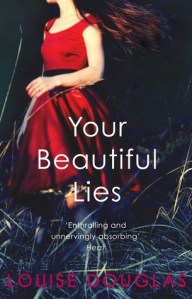
Your Beautiful Lies by Louise Douglas

Your Beautiful Lies It’s 1984 and British families and communities are being torn apart by a miners’ strike. While miners clash with the police and tensions grow between the government and the mining unions, in the small Yorkshire town of Matlow Annie Howarth is facing trouble of a different kind. Her former boyfriend, Tom Greenaway, has just been released from prison after serving a ten-year sentence for manslaughter. Meeting Tom again after such a long separation, Annie finds that she still has feelings for him – and that she’s not at all convinced he was guilty of the crime of which he was accused.

A lot of things have changed during those years apart, though. Annie is now married to police chief William Howarth and they have a young daughter, Lizzie. Leaving William for Tom could mean losing Lizzie, as well as the expensive house and comfortable lifestyle William’s salary provides. When a woman is murdered on the moors near the Howarths’ home, suspicion falls on Tom again and this time Annie must try to separate the truth from the ‘beautiful lies’.

This is the third Louise Douglas novel I’ve read and while I didn’t love it as much as The Secrets Between Us or In Her Shadow, I still enjoyed it. The backdrop of the miners’ strike is not a setting that I’ve seen used in fiction very often and yet it was a hugely important time in British history from both a social and political perspective. By making Annie’s husband a policeman and her father a miner, the author shows how loyalties were divided not just within towns and villages but within families too.

The story also has a strong mystery element, with the police investigating the murder on the moors and the question of who Annie can and can’t trust, but this is where I thought the book was less successful in comparison with The Secrets Between Us and In Her Shadow. It’s a very atmospheric novel (the bleakness and claustrophobia of Annie’s life is perfectly portrayed) but I found it less suspenseful than the previous two books and had my suspicions as to the likely identity of the murderer long before the answer was revealed. The ending was not entirely surprising, but very abrupt and not entirely satisfying either!

I didn’t like Annie very much – it seemed to me that she was being unnecessarily reckless and irresponsible – but I did think Douglas did a good job of depicting the boredom and loneliness of her daily existence and the reasons why her marriage to William was not a happy one. Because we see everything through Annie’s eyes, however, we can never be sure that we’re getting a fair and balanced picture of either of the men in her life. I think the only characters I did actually like were Annie’s brother, Johnnie, who remains cheerful and optimistic despite having some terrible things happen to him over the course of the novel, and William’s mother, Ethel, struggling with dementia but still aware that something isn’t quite right in the Howarth household.

I’ve been very impressed with all three of the Louise Douglas books that I’ve read, despite the few problems I had with this one. They are difficult to classify as belonging to a particular genre, being a mixture of crime, romance, suspense and domestic drama, but it’s a mixture that I love and that’s why I’m already looking forward to her next book, whatever that may be!

I received a copy of this book for review via NetGalley.

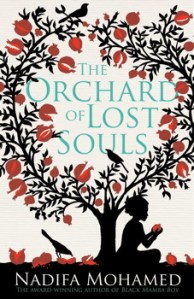
The Orchard of Lost Souls by Nadifa Mohamed

The Orchard of Lost Souls In 2013, Nadifa Mohamed was named one of Granta’s “Best Young British Novelists”. This is her second novel, set in Somalia in the 1980s as rebel forces clash with the military dictatorship and the country heads towards civil war. The events of this turbulent period are seen through the eyes of three female characters:

* Deqo, a nine-year-old orphan who grew up in a refugee camp and has now found herself homeless and alone in the city of Hargeisa.
* Kawsar, a widow mourning the death of her daughter, who becomes confined to her bed after a violent beating at the police station.
* Filsan, a soldier sent to Hargeisa from the capital city of Mogadishu and feeling homesick for the life she has left behind.

During a military parade at a stadium in Hargeisa, the paths of these three women briefly cross before they are separated again and go on to have very different experiences of this troubled time in Somalia’s history.

I don’t think I’ve ever read a book set in Somalia before and I knew nothing about the causes of the civil war or the situation in Hargeisa, so reading The Orchard of Lost Souls meant I had an opportunity to learn something new. Telling the story from three different perspectives allows the author to explore different aspects of the war; through Deqo and Kawsar we see what it was like for people living in and around Hargeisa, trying to survive from one day to the next, while Filsan’s story gives us some insights into the military regime. As you can probably guess, many of the things the women experience are traumatic and brutal, though I won’t go into any details here.

As well as being educational, this is also a compelling story (or stories, as there are really three of them in this one novel) and I was interested in all three characters, although I thought Filsan was much more difficult to like than either Deqo or Kawsar. However, I did have some problems with the structure of the novel, especially at the beginning. For the first fifty pages of the book, the viewpoint switches rapidly between each of the three women which I found very overwhelming and confusing. I was relieved to discover that this didn’t continue all the way through the book! The opening section was followed by three longer sections concentrating on one character at a time, so I was able to get to know each of them separately before they eventually meet again near the end of the novel.

I can see why Nadifa Mohamed has won awards for her writing because she clearly has a lot of talent and her descriptions of Somalia are beautiful. I’ll leave you with one of my favourite passages, where Filsan remembers the streets of Mogadishu:

In the centre of the city where the alleys narrow at points to the width of a man’s shoulder blades, you can walk as if in a dream, never certain of what might appear after the next bend: a bare-chested man with a silver swordfish slung over his thin black back, a shoal of children reciting Quran from their wooden slates, a girl milking a white, lyre-horned cow. The place has enchantment, mystery, it moves backward and forward in time with every turn of the feet; it is fitting that it lies beside an ocean over which its soul can breathe, rather than being hemmed in by mountains like a jinn in a bottle.