Love is a light you can see only when you reach for it. You hold it in your hand and, for as long as the flame glows, it warms you.
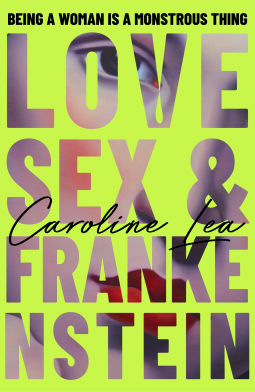 I’ve read three of Caroline Lea’s previous books, all of which I found interesting, so I was looking forward to reading her new novel about the life of Mary Shelley – although I have to admit, if I hadn’t already known I liked Lea’s work, the cover and title of this one would have probably put me off. I’m glad that didn’t happen because I really enjoyed it; it’s probably my favourite of her books so far.
The main focus of the novel is the events of 1816 – known as the Year Without a Summer due to the unusual weather caused by a volcanic eruption the year before. It’s also the year that Mary Godwin and her lover, Percy Shelley, travel to Geneva with their baby son and Mary’s stepsister, Claire Clairmont. Not for the first time, Shelley’s debts have brought the bailiffs to their door and, tired of constantly moving around London to avoid them, Claire has seized the opportunity to persuade Mary and Percy to come to Switzerland with her to visit Lord Byron. Claire is convinced that Byron loves her and claims that he has been begging her to go and spend the summer with him at Lake Geneva but Mary, who is familiar with Byron’s reputation, thinks she’s deluded. However, in their desperation to escape the bailiffs, she and Shelley agree to Claire’s plan.
As they arrive at their hotel in Geneva, the foggy, oppressive weather mirrors Mary’s mood. She and Shelley seem to do nothing but argue and with no sign of Byron, Claire has turned her attentions to Mary’s lover, making no secret of what she is doing. When Byron finally does appear and the party start to spend time with him and his companion, John Polidori, at his rented home, the Villa Diodati, Mary hopes things will improve. However, the dynamics between the four of them only grow more tense and strained and Mary thinks of taking baby Willmouse and running away. Then, during a storm one evening, they gather to read ghost stories and, unimpressed, Byron issues a challenge: they should each write one of their own and see whose is best. Now Mary has something to focus on and during this difficult, emotional time, her famous novel, Frankenstein, begins to take shape.
Despite the title, the writing of Frankenstein forms only a small part of the book; instead Lea concentrates on exploring Mary’s state of mind in the period immediately before and during the creation of the novel. There’s some jumping around between timelines in the first half of the book as Lea tries to fill the reader in on Mary’s background, her childhood and the beginning of her relationship with Shelley, and I found it slightly difficult to keep track of things, but this became less of a problem later in the book when I had settled into the story.
Having read several other novels about the Shelleys and Lord Byron, I was interested to see how Lea’s portrayal of the characters would compare. As our protagonist, Mary is a complex woman but also a contradictory one. She has the strength and determination to repeatedly defy convention to be with the man she loves – the already married Shelley – while at the same time she feels trapped in her relationship with him and unable to escape. Shelley seems to love her in his own way, but is insensitive towards her and expects her just to accept his various infidelities. Mary’s relationship with Claire is equally difficult, continually switching between resentment and affection. As seen through Mary’s eyes, Claire doesn’t come across well at all in this book, flirting openly with Shelley in front of her sister then complaining when Mary later does the same with Byron. (For a more sympathetic view of Claire, try Clairmont by Lesley McDowell.) The portrayal of Byron is also largely very negative – he treats Claire appallingly, although we see a more tender side of him in his interactions with Mary.
This is definitely not a book with likeable characters, then, but the fact that they are all, like Mary, complex and contradictory is what makes them feel human and believable. It’s also beautifully written and I enjoyed reading it, despite not really learning much about Frankenstein!
Thanks to Michael Joseph for providing a copy of this book for review via NetGalley.






 She Reads Novels