Review: The Mysteries of Glass by Sue Gee

It’s the winter of 1860. Following the death of his father, the young Richard Allen takes his first position as curate in an isolated Herefordshire parish. At first Richard is eager to do well in his new post – but then he falls in love and finds that his faith is put to the test.

The Mysteries of Glass was nominated for an Orange Prize back in 2005 and I can see why, because Sue Gee’s writing is beautiful. I have rarely read a book with such a strong sense of time and place. The book is set in an isolated village in 19th century England and the rural Victorian setting felt entirely believable.

The opening chapters perfectly evoked a winter atmosphere. Although I was reading this book in July, I could still picture the cold, wintry landscape, the snowy fields, the frozen paths leading to Richard Allen’s lonely house, the skating party on the lake. Later in the book, as time passed, I could feel the temperatures rise and the seasons change.

Unfortunately, I had one or two problems with this book. I found it very, very slow – I had to force myself to read at a slower pace than I normally would because I felt I was starting to skim over the words without really absorbing them. After the first few chapters, in which very little actually seemed to happen, I had to make a decision whether or not to continue reading. I was glad that I persevered with it, though. I don’t like abandoning books and this one was so well written and had such a haunting, dreamlike atmosphere that I really wanted to love it.

The characters were realistic and well-drawn, from Alice Birley, the crossing-keeper’s solemn little girl to Edith Clare, the mysterious woman who lives in the woods. However, I thought some of the characters who were potentially the most interesting were very underused, such as Richard’s strong, hot-tempered sister Verity.

Another problem I had was that the religious aspects of the book were a bit too much for me. Knowing that the story was about a curate, I was prepared for this to some extent but I wasn’t really expecting the church scenes to be quite so dominant. If you don’t like that type of thing, you should be aware that it forms a very large part of the book and that the central theme of the story is the portrayal of a man’s inner turmoil as he tries to reconcile his feelings and emotions with his faith and his belief in God.

If this book sounds as if it might interest you at all, then please do give it a try as I definitely seem to be in the minority! The Mysteries of Glass wasn’t a bad book by any means – it didn’t appeal to me but maybe it will appeal to you.
Review: A Pair of Blue Eyes by Thomas Hardy

These eyes were blue; blue as autumn distance – blue as the blue we see between the retreating mouldings of hills and woody slopes on a sunny September morning. A misty and shady blue, that had no beginning or surface, and was looked into rather than at.

I’m loving Thomas Hardy more and more with every book of his that I read. A Pair of Blue Eyes was one of his earliest books, originally serialised in Tinsley’s Magazine from September 1872 to July 1873. Although this is not generally noted as being one of his better novels and is certainly one of his least well known, there was something about it that appealed to me – and I would even say that of all the classics I’ve read so far this year, this might be my favourite.

A Pair of Blue Eyes is the story of Elfride Swancourt, a vicar’s daughter living in a remote corner of England, who is forced to choose between two very different men. One of these, Stephen Smith, is a young architect whom she meets when he is sent by his employer to survey the church buildings. At first, the vicar approves of Stephen and encourages his daughter to spend time with him. It soon emerges, however, that Stephen has been hiding an important secret from the Swancourts; something that could put his relationship with Elfride in jeopardy. Later in the book, another man arrives at Endelstow Vicarage – Henry Knight, an essayist and reviewer from London – and Elfride has to make a difficult decision.

As you might expect with this being a Hardy book, nothing goes smoothly for any of the characters. I would describe A Pair of Blue Eyes as being similar in some ways to the later Tess of the d’Urbervilles, though not as dark and bleak – and not quite as tragic either. Although I didn’t find Elfride particularly likeable, I thought she was an interesting character. Her lonely, secluded life gives her a childlike innocence and vulnerability and at one point Hardy draws a comparison with Miranda from Shakespeare’s The Tempest – both characters have little knowledge of men and a male visitor is a big event (and Elfride even plays chess with Stephen Smith and Henry Knight as Miranda did with Ferdinand in The Tempest). Of the two men, Stephen was the only one I had any real sympathy for. Knight, although another interesting character, annoyed me almost as much as Angel Clare in Tess annoyed me.

The descriptions of scenery in this book are stunningly beautiful and bring the setting vividly to life. If you’re familiar with Hardy you’ll know that he sets most of his works in the fictional region of Wessex in the southwest of England. This story actually takes place in Off-Wessex or Lyonesse, which equates to Cornwall. I had no problem at all in picturing the lonely vicarage, the windswept hills, and the dark cliffs towering over the sea below. Speaking of cliffs, it is thought that the term ‘cliffhanger’ originates from a scene in this book, though I’m not going to say any more about it than that!

Another interesting aspect of this book is that it’s loosely based on Hardy’s relationship with his first wife, Emma Gifford. Unfortunately I don’t know enough about Hardy to have picked up on all the allusions and references to events in his own life. I would like to eventually read a biography as I think it would help my understanding of both this book and his work as a whole.

I found A Pair of Blue Eyes very easy to read. I thought the pacing and flow of the story were perfect and the pages flew by in a weekend. It’s so sad that this book has been ignored and underrated to the point where, until not long ago, I hadn’t even heard of it. Maybe it won’t appeal to everyone and it might not be the best introduction to his work, but I loved it and would highly recommend it to all Hardy fans.

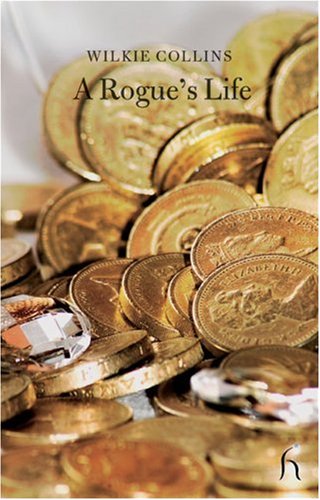
Review: A Rogue’s Life by Wilkie Collins

Frank Softly is a Rogue. Refusing to follow in his father’s footsteps and become a doctor, he has tried out a number of different careers since leaving school – and failed at them all. However, he remains optimistic and sees each failure as an opportunity to make a fresh start. Even when he is sent to a debtors’ prison he simply asks himself, “What of that? Who am I that I should object to being in prison, when so many of the royal personages and illustrious characters of history have been there before me?”

While working as a forger of old paintings, Frank meets Alicia Dulcifer in an art gallery and immediately falls in love. Unfortunately even this relationship seems likely to fail, because Alicia is the daughter of the sinister Dr. Dulcifer – a man who lives in a house with bars on the windows, never receives visitors and conducts mysterious experiments in his laboratory. Frank becomes determined to discover Dr. Dulcifer’s secret, at all costs.

As in many Victorian novels, there’s also an inheritance involved: Frank’s sister Annabella will only receive her three thousand pounds if Frank outlives their grandmother Lady Malkinshaw. This leads to some amusing situations as Annabella’s greedy husband desperately tries to prevent Frank from dying!

This was one of Wilkie Collins’ first books to be published (in 1856) and I could tell it was the work of a young, inexperienced writer – the plot was less developed than in his later books and the characters (apart from the Rogue himself) were less memorable. However, his enthusiasm shines through on every page, making this a fun, light-hearted read – but with plenty of suspense and excitement too. Although Frank Softly is dishonest, irresponsible, reckless – and definitely a rogue – he tells his story with so much humour and energy that you can’t help liking him.

Rather changeable this life of mine, was it not? Before I was twenty-five years of age, I had tried doctoring, caricaturing, portrait-painting, old picture-making, and Institution-managing…Surely, Shakespeare must have had me prophetically in his eye, when he wrote about ‘one man in his time playing many parts’. What a character I should have made for him, if he had only been alive now!

While I don’t think I would recommend this as a first introduction to his work, if you have enjoyed any of Collins’ other books there’s no reason why you shouldn’t enjoy this one too. And the short length of this book – only 150 pages – makes it a quick, fast-paced read, so anyone who has had trouble getting into one of his longer novels may find this one easier to read.

I’m going to leave you with Wilkie’s own thoughts on this novel, taken from the author’s preface:

The Rogue may surely claim two merits, at least, in the eyes of the new generation – he is never serious for two moments together; and ‘he doesn’t take long to read’.

Review: Snow Flower and the Secret Fan by Lisa See

This book was recommended to me after I read Wild Swans by Jung Chang earlier this year and as I had heard a lot of good things about it, I decided to give it a try.

Lily is a Chinese girl born in Hunan Province in 1823, the daughter of a poor farmer. When she is six years old, the local matchmaker has an exciting announcement to make: if Lily’s feet are bound properly they will be the perfect size and shape, allowing her to marry well and improve the fortunes of herself and her family.

As well as arranging marriages for young girls, another job of the professional matchmaker is to find them a laotong or ‘old same’ – a special friend whose personal circumstances match in a number of different ways (e.g. same birthday, same number of siblings). Snow Flower and the Secret Fan tells the story of the lifelong friendship between Lily and her ‘old same’ Snow Flower.

If you haven’t read this book yet, I should warn you that the chapter on footbinding goes into a lot of detail, describing exactly what it involves and how much suffering the girl is forced to endure – all because small feet were considered the ideal and a girl with large feet would be virtually unmarriageable. One of the worst things about the whole process in my opinion was that it was usually carried out by the child’s mother – I just can’t imagine a mother inflicting so much pain and suffering on her daughter and even risking the girl dying from infection. If you can manage to get through this chapter though, there are plenty of other Chinese customs and traditions to learn about.

For example, did you know that Chinese women had a secret language of their own known as nu shu? This came about because women were discouraged from learning standard Chinese writing, so invented their own writing system which they then tried to keep hidden from the men. Throughout the book, Lily and Snow Flower communicate by writing messages to each other on a silk fan, using nu shu.

I also found the custom of the laotong fascinating. Most young Chinese girls had a group of ‘sworn sisters’, who would be her closest friends only until the day she married. Lily, however, was chosen to have a laotong – a girl who would remain her best friend throughout her entire life.

I thought it was sad that women were considered to be worthless and their only value to society was as a potential mother of sons. If a woman only gave birth to girls she was no use to her family. Here Lily and Snow Flower are discussing the possibility that they will both give birth to daughters.

Snow Flower smoothed her hands over her belly and in a small voice reminded me that girls are but worthless branches unable to carry on their fathers’ lines.
“They will not be useless to us,” I said. “Could we not make a laotong match for them now – before they are born?”
“Lily, we are worthless,” Snow Flower sat up. I could see her face in the moonlight. “You know that, don’t you?”

While I wouldn’t say I loved this book, I did enjoy learning about a culture so completely different to my own and I would welcome any suggestions for more historical fiction novels set in China.

Review: A House to Let by Charles Dickens, Wilkie Collins, Elizabeth Gaskell and Adelaide Anne Procter

A House to Let, at less than 100 pages, is a collaboration between four 19th century authors which originally appeared as the Christmas edition of Charles Dickens’ weekly magazine, Household Words, in 1858.

The book is divided into six sections; the first, Over the Way, and the sixth, Let at Last, are joint efforts by Charles Dickens and Wilkie Collins, and provide the framework for the story. The other four sections are individual contributions from Elizabeth Gaskell, Charles Dickens, Adelaide Anne Procter and Wilkie Collins, in that order.

Over the Way introduces us to Sophonisba, an elderly woman who has never married but has two men vying for her attentions – one is her old admirer Jabez Jarber; the other is her servant, Trottle. When Sophonisba’s doctor advises a change of air and scene, she leaves her home in Tunbridge Wells and moves into new lodgings in London, where she immediately becomes obsessed with the house opposite – a house which has been vacant for many years and is permanently ‘to let’. Determined to discover why the house has remained empty for so long – and convinced she has seen an eye staring out from one of the windows – she asks Jarber and Trottle to investigate.

Over the Way and Let at Last are credited to both Dickens and Collins, but there’s no way to tell exactly which parts were contributed by which writer. The other four chapters, though, are each written in the distinctive style of their respective authors and each tell the story of a previous occupant of the house to let.

The chapter I liked the least was actually the one written solely by Dickens, Going Into Society. The story of a showman and a circus dwarf called Mr Chops, it was just too weird for me and was also quite difficult to read as it was written in dialect. It’s probably significant that I found the two Dickens/Collins collaborations much easier to read than this solo effort, as I’ve always thought Collins was a lot more readable than Dickens.

Three Evenings in the House, the contribution by Adelaide Anne Procter, whose work I was previously unfamiliar with, is in the form of a narrative poem. I’m not a big lover of poetry but luckily for me this was only thirteen pages long and quite easy to understand. Other than providing some variety though, I don’t think this chapter really added much to the story.

The Manchester Marriage
by Elizabeth Gaskell stands out as an excellent piece of writing: a tragic story of Alice Wilson, who is widowed when her husband is lost at sea. After marrying again, she and her new husband move into the house to let where further tragedy awaits them. This is good enough to work as a stand-alone short story (and according to the Biographical Notes, it was actually published separately in its own right). This and the Wilkie Collins contribution, Trottle’s Report, were my favourite chapters. Trottle’s Report is a typical Collins story, with unusual, quirky characters, a mysterious secret, and a slightly dark and gothic feel.

After exploring the histories of the various tenants of the house, the mystery is finally solved in the final chapter, Let at Last, which neatly ties up all the loose ends of the story.

If you like any of these four authors or Victorian fiction in general, then A House to Let is definitely worth reading. It also provides a good introduction to Dickens, Collins, Procter and Gaskell without having to commit yourself to one of their longer works.

Classics/Pages: 97/Publisher: Hesperus Press/Year: 2004 (originally published 1858)/Source: Library book

Review: Affinity by Sarah Waters

This is the story of two women, both prisoners in their own different ways and drawn together by a special bond – their ‘affinity’.

Margaret Prior is a single woman of twenty nine who, following the death of her father, begins visiting London’s Millbank Prison as a Lady Visitor. Lady Visitors were women who voluntarily visited prisoners with the aim of befriending them and giving them comfort during the time of their imprisonment. However, Margaret is in need of some friendship and comfort herself. From her very first visit, she finds herself strangely drawn to Selina Dawes, a young spiritualist imprisoned for assault after one of her spiritualism sessions goes badly wrong, leaving a woman dead and a girl traumatised.  Selina blames her ‘control spirit’, Peter Quick, for what happened, but is she telling the truth?

The book is told in the form of diary entries – Margaret’s longer sections being interspersed with Selina’s shorter ones. Margaret’s diary entries are very bleak and miserable, as she is trying to cope not only with the loss of her father, but also with her feelings for both Selina and her sister-in-law Helen, the expectations of her domineering mother, and the sense of being ‘left behind’ that she experiences when her younger sister gets married and leaves home. Although I found it difficult to like Margaret, I did have a lot of sympathy for her – she had been labelled a ‘spinster’ and was bound by the conventions of the time, preventing her from studying and leading the kind of life she wanted to lead.  I really wanted her to find happiness with Selina.

Selina’s sections of the story are very vague and confusing and I didn’t fully understand them until I went back and read them again after reaching the end of the book. Her entries chronicle the events leading up to the death of Mrs Brink at the seance, and allow us to watch the development of Selina’s spiritualist abilities and the first appearances of the spirit Peter Quick.  Throughout the story, the reader is made to wonder whether Selina really has the powers she claims to have or if Margaret is the victim of an elaborate hoax.

I enjoyed learning about life in a Victorian prison, as it’s not something I’ve read about in so much detail before. Waters does a wonderful job of conveying the oppressive atmosphere of Millbank, with its labyrinthine corridors and gloomy wards.

I haven’t read all of Sarah Waters’ books yet so I can’t really say where Affinity stands in comparison to her others, but I thought it was an excellent book – suspenseful, moving and with some passages that were genuinely spooky.

Recommended

Review: Agnes Grey by Anne Bronte

After reading The Tenant of Wildfell Hall earlier this year, I wanted to read Anne Bronte’s other book, Agnes Grey.  I approached it with trepidation having read some quite negative reviews of it.  However, I was pleased to find that I enjoyed the book.  Although I didn’t think it was as good as The Tenant and it didn’t have the feel of a must-read classic like Jane Eyre or Wuthering Heights, there was still a lot to like about Agnes Grey.

The plot is simple, plain and linear.  It’s the story of a young woman in 19th century England who goes out to work as a governess when her family fall on hard times. Unfortunately Tom, Mary Ann and Fanny Bloomfield are three of the most badly-behaved children imaginable. When her short, unhappy time with the Bloomfields comes to an end, Agnes finds another situation with two older pupils, Rosalie and Matilda Murray. This second position is not much better than the first – the Murray girls are selfish and thoughtless and the only thing that makes Agnes’s life bearable is her friendship with Mr Weston, the village curate.

Agnes Grey has an autobiographical feel because Anne Bronte herself had worked as a governess and was able to draw on her own personal experiences to show how servants were often treated with cruelty and contempt by their employers. I could sympathise with Agnes as I would soon have lost my patience with the spoilt Bloomfield children and the self-centred, inconsiderate Murrays. I also thought it was unfair that the parents expected Agnes to control their children without actually giving her any real authority over them. It was such a difficult position to be in.  However, I found it slightly disappointing that Agnes seemed prepared to just accept things the way they were and not do anything to change the situation.  The book was more about tolerance and perseverance than about taking action to try to make things better.

Another of the book’s themes is the importance of morality, virtuousness and goodness, qualities in which the Bloomfield and Murray families seem to be sadly lacking, leading Agnes to feel isolated and miserable.  However, I think many readers will find Agnes too self-righteous and superior, so if you prefer your heroines to be flawed and imperfect this probably isn’t the book for you!  Reading about the day to day life of a governess is not particularly exciting or dramatic, but I still found the book enjoyable and interesting – and at under 200 pages a very quick read compared to many of the other Bronte books.

Recommended

Classic/Publisher: OUP (Oxford World’s Classics)/Year: 1998 (originally published in 1847)/Source: Library book