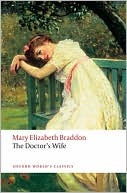
Review: The Doctor’s Wife by Mary Elizabeth Braddon

Isabel Sleaford lives in a dream world filled with characters from novels by Dickens, Scott and Thackeray. She longs to break away from her boring existence as a children’s governess and live the exciting life of one of the heroines in her favourite books. When parish doctor George Gilbert proposes to her, she accepts but quickly finds that her marriage isn’t providing the drama and adventure she’s been dreaming of. George is a good man, but he’s practical, down to earth – and boring, at least in Isabel’s opinion. After meeting Roland Lansdell, the squire of Mordred Priory, she becomes even more discontented. Roland is romantic, poetic and imaginative – in other words, he’s everything that George isn’t…

This is the second Mary Elizabeth Braddon book I’ve read – the first was the book that she’s best known for today, the sensation novel Lady Audley’s Secret. Apparently The Doctor’s Wife was Braddon’s attempt at writing a more serious, literary novel, with a plot inspired by Gustave Flaubert’s Madame Bovary. The Doctor’s Wife is not very ‘sensational’ – apart from maybe the final few chapters – and although it’s interesting and compelling in a different way, if you’re expecting something similar to Lady Audley you might be slightly disappointed. At one point in the book, Braddon even tells us “this is not a sensation novel!”

The focus of The Doctor’s Wife is the development of Isabel Gilbert from a sentimental girl with her head permanently in the clouds into a sensible and mature woman. I didn’t like Isabel much at all, though I’m not really sure if I was supposed to. Throughout most of the book she was just so silly and immature – wishing that she would catch a terrible illness or some other tragedy would befall her, just so she could have some excitement in her life – although as several of the other characters pointed out, she wasn’t a bad person, just childish and foolish. It was sad that her own romantic notions and ideals were preventing her from having any chance of happiness.

I thought some of the minor characters were much more interesting and I would have liked them to have played a bigger part in the story. I particularly loved Sigismund Smith, who was a friend of both George and Isabel, and a ‘sensation author’ – probably a parody of Mary Elizabeth Braddon herself. Sigismund (whose real name is Sam) is a writer of ‘penny numbers’ – cheap, serialised adventure stories. His enthusiasm for his work and his unusual methods of researching his novels provide most of the humour in the book.

Due to Isabel’s reading, almost every page contains allusions to characters and events from various novels, plays and poems – most of which I haven’t read – so I found myself constantly having to turn to the notes at the back of the book (until I decided I could follow the story well enough without understanding all the references to Edith Dombey and Ernest Maltravers).

Overall, this was another great book from Mary Elizabeth Braddon, although not quite what I was expecting.

Highly Recommended

Genre: Classics/Pages: 431/Publisher: Oxford University Press/Year: 2008 – originally published 1864/Source: My own copy purchased new

Review: In a Far Country by Linda Holeman

Linda Holeman really deserves to be better known. Her books seem to be difficult to find outside the UK and Canada which is sad because she’s such a good writer. Last year I read The Moonlit Cage and enjoyed it so much I couldn’t wait to read another of her historical fiction novels. In a Far Country is part of a trilogy with The Linnet Bird and The Moonlit Cage, but they are all stand-alone books and can be read in any order.

In a Far Country is set in British-ruled India in the late 19th century and tells the story of Pree Fincastle, the daughter of two British missionaries living on an isolated mission near Lahore. Left alone and penniless after her parents’ tragic deaths, Pree sets off to look for her childhood friend, Kai, the only person she can turn to for help.

I found this book difficult to get into at first. Holeman spent a lot of time setting the scene and introducing us to Pree and her parents, so that the story didn’t really begin until around 150 pages into the book. From this point onwards, though, the pace picked up and I was hooked. I really liked the character of Pree. Since the book is told in the first person from her point of view, we get to experience all her emotions as she grows up at the lonely, impoverished mission house and as her life is turned upside down by the deaths of her parents.

The only criticism I have of both this book and The Moonlit Cage is that I just don’t feel enough connection to the male characters. I think Linda Holeman writes female characters much better than she does male. I found that Kai remained cold and aloof throughout the entire book and considering Pree loved and trusted him enough to turn to him when she was in trouble, I didn’t feel much warmth, passion or humour coming from him at all. This was almost exactly the same reaction I had to David Ingram in The Moonlit Cage.

However, one of Holeman’s strengths is in her wonderfully evocative and colourful descriptions of the places she’s writing about. She chooses just the right words to convey the sights, sounds and smells of India. If you had never read a book set in India before, this would probably be a good introduction.

Despite the length of this book, it was surprisingly quick to read. Perfect if you’re looking for a big, heartbreaking historical fiction novel to lose yourself in for a few days.

Highly Recommended

Genre: Historical Fiction/Pages: 640/Publisher: Headline Review/Year: 2008/Source: My own copy bought used

A Short Story for Wednesday: The Signal-Man by Charles Dickens

The Signal-Man by Charles Dickens (1866)

After recently reading Drood by Dan Simmons which described Charles Dickens’ involvement in the Staplehurst Rail Disaster, I decided to read Dickens’ short story, The Signal-Man. Although it doesn’t directly reference the Staplehurst incident, The Signal-Man was written the following year so was almost certainly influenced by his experience.

Whilst taking a walk one evening, the unnamed narrator discovers an isolated railway station and makes the acquaintance of the lonely signalman. The signalman tells him of a ghostly figure that he has previously witnessed on two occasions standing below the danger light in the entrance to the tunnel. On both occasions, the ghost’s appearance has been followed by tragedy. Now the spectre has appeared again and the signalman is convinced that another disaster is imminent…

This is the first of Charles Dickens’ short stories that I’ve ever read and having read some of his full-length novels, I was surprised by how quick and easy The Signal-Man was to read. Although the outcome of the story was very predictable, Dickens creates a wonderfully eerie and foreboding atmosphere. Highly recommended if you’re in the mood for a classic ghost story.

“His post was in as solitary and dismal a place as ever I saw…So little sunlight ever found its way to this spot, that it had an earthy, deadly smell; and so much cold wind rushed through it, that it struck chill to me, as if I had left the natural world.”

Read The Signal-Man online

* Clayton Tunnel picture – in the public domain

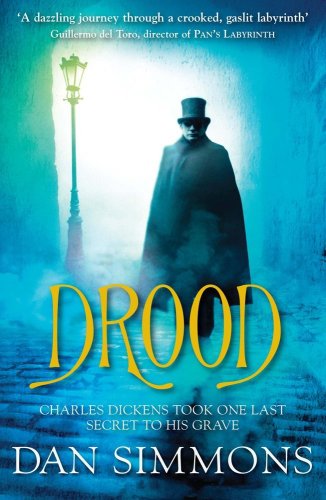
Review: Drood by Dan Simmons

I think I liked the idea of this book more than the book itself. A gothic mystery/horror story set in Victorian London, featuring Charles Dickens and narrated by Wilkie Collins sounded like exactly the kind of book I would enjoy. Unfortunately it didn’t quite live up to its fascinating premise and I was left with mixed feelings about it.

Drood is told in the form of a memoir written by Wilkie Collins (a close friend and collaborator of Charles Dickens, as well as being the author of The Woman in White, The Moonstone and many other novels and plays) and addressed to an unknown reader in the future – that is, to us.

The story begins with the Staplehurst Rail Disaster of 1865, when the train on which Charles Dickens is travelling crashes, sending most of the carriages plummeting over a viaduct into the riverbed below. Luckily Dickens is in one of the few carriages that doesn’t fall. As he helps to rescue people from the wreckage, he encounters a mysterious figure dressed in a black cape who introduces himself only as ‘Drood’. In the days following the train crash, Dickens becomes obsessed with finding Drood and discovering his true identity. With the reluctant help of Wilkie Collins, Dickens begins a search for Drood which leads them through the dark alleys and underground catacombs of London.

Interspersed with the Drood storyline are long passages in which we learn about the family life and living arrangements of both Dickens and Collins, how much they earned for their various novels, their walking tour of Cumberland in 1857, the details of Wilkie’s laudanum addiction, the story of the Swiss chalet given to Dickens by his friend Charles Fechter, Dickens’ interest in mesmerism and every other piece of biographical information you could possibly want to know. Simmons also incorporates some genuine historical letters and quotes which adds some authenticity to the book. I can see why some readers might find this boring, but I enjoyed these sections – I thought the descriptions of Dickens’ reading tours were particularly fascinating.

Simmons has attempted to imitate Wilkie Collins’ narrative style (including the Victorian habit of talking directly to the reader) but I felt that he didn’t get it quite right. He also uses a lot of words and phrases that just sound either too modern or too American to me (the real Collins or Dickens would have walked on the pavement rather than the sidewalk, for example). This is only a small complaint though, as overall, Dear Reader, I thought his style was quite convincing.

I do like the way the book takes us through the process of researching and writing The Moonstone. However, some important plot points are given away so if you haven’t already read The Moonstone and think you might want to, then I would suggest you read it before you begin Drood. It might also be a good idea to read The Mystery of Edwin Drood first (I didn’t and kept wishing I had). Another thing I liked about the book was the way Simmons deliberately tries to confuse and mislead the reader – at several points in the novel we are made to wonder whether something we’ve just read is real or an illusion.

This journey through the cemeteries, opium dens and underground sewers of London is a good atmospheric read for a cold dark night, but I was slightly disappointed by it and despite reading all 775 pages I still can’t decide whether I enjoyed it or not! However, it will almost certainly leave you wanting to learn more about Dickens and Collins and their works, which can only be a good thing. If you like this type of book I would also recommend The Quincunx by Charles Palliser – another book set in Victorian England and written in a 19th century style.

Before I come to the end of this review I would just like to say a few words in defence of poor Wilkie Collins, who happens to be one of my favourite authors. Simmons clearly doesn’t rate Wilkie as a writer (I saw an interview where he described him as ‘mediocre’) and in Drood, the character is portrayed as a not very talented, second-rate author who is consumed with jealousy of the more successful Dickens and becomes increasingly bitter and unlikeable as the book goes on. I admit I’m biased because I’ve absolutely loved every Wilkie Collins book I’ve read; he was a much better writer than Drood suggests and definitely not mediocre, at least in my opinion!

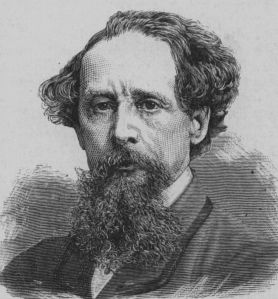
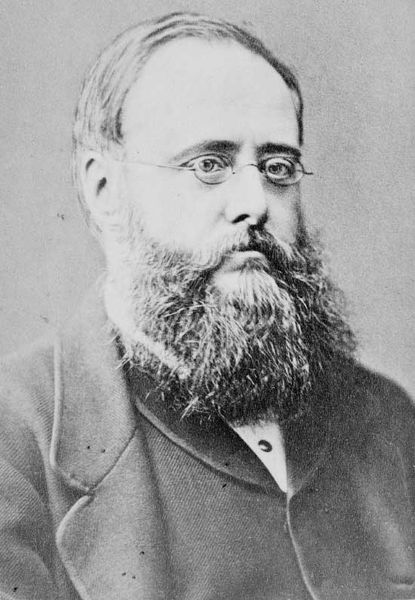
*Pictures of Charles Dickens (top) and Wilkie Collins (bottom) both in the public domain

Genre: Historical Fiction/Horror/Pages: 775/Publisher: Quercus Fiction/Year: 2009/Source: My own copy bought new

A Short Story for Saturday: The Artist of the Beautiful by Nathaniel Hawthorne

The Artist of the Beautiful by Nathaniel Hawthorne (1844)

Owen Warland is a young watchmaker who devotes his life to the creation of a beautiful mechanical butterfly which he presents to his friend Annie as a wedding gift. Annie and her family are not artists and they are unable to appreciate the beauty of Owen’s butterfly or to understand why he wasted so much time making it when he could have been doing something more useful. Each character in the story represents a different side of human nature and it’s interesting to see how Owen’s butterfly reacts differently to each of them.

This is a beautifully written story with the message that not everything in life needs to have a purpose – some things are worth doing just for the sake of doing them. Despite being ridiculed by the other townspeople, Owen doesn’t let other people’s opinions stop him in his pursuit of spiritual happiness.

“Yes, Annie; it may well be said to possess life, for it has absorbed my own being into itself; and in the secret of that butterfly, and in its beauty – which is not merely outward, but deep as its whole system – is represented the intellect, the imagination, the sensibility, the soul of an Artist of the Beautiful!”

Read The Artist of the Beautiful online here

* Butterfly picture by Galawebdesign used under a Creative Commons Attribution 3.0 Unported license.

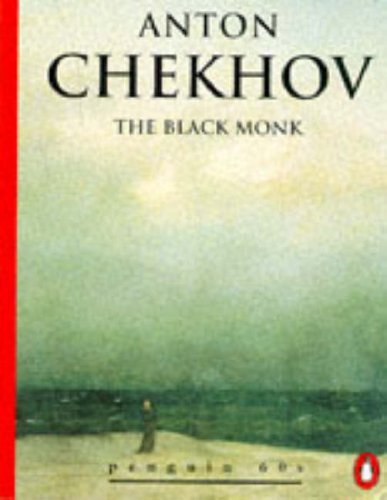
A Short Story for Saturday: The Black Monk by Anton Chekhov

The Black Monk by Anton Chekhov (1894)

Where do we draw the line between genius and madness? Anton Chekhov explores this question in The Black Monk – the story of a young man called Andrei Kovrin who suffers from an undisclosed mental illness which causes him to believe he is being visited by a monk dressed in black. Even when he becomes aware that the monk is only a hallucination, he is not concerned because his visions make him feel happy and full of energy and creativity. Eventually though, his family begin to worry about his sanity…

This is a fascinating, unusual story which I found easy to read but difficult to fully understand. Chekhov’s poetic writing creates an eerie, disturbing atmosphere appropriate to Kovrin’s descent into mental illness.

“Once or twice a week, in the park or in the house, he met the black monk and had long conversations with him, but this did not alarm him, but, on the contrary, delighted him, as he was now firmly persuaded that such apparitions only visited the elect few who rise up above their fellows and devote themselves to the service of the idea.”

Read The Black Monk online here

Review: Alice I Have Been by Melanie Benjamin

I had been reading so many good reviews of Alice I Have Been that when I won a copy from The Book Whisperer I couldn’t wait to read it and see if it deserved its reputation. I’m happy to say that it did.

Before I read this book, I knew Alice Liddell was the girl who inspired Alice’s Adventures in Wonderland, but that was all I knew about her. I also knew that Lewis Carroll’s real name was Charles Lutwidge Dodgson and that he was an Oxford mathematics professor, but that was all I knew about him. Alice I Have Been is the story of how Alice’s relationship with Dodgson and the book he wrote changed her life forever.

The 19th century is one of my favourite historical periods and it was interesting to read about Alice’s life as the daughter of the Dean of Christ Church, mixing with the upper classes of Victorian society. Mr Dodgson was a friend of the Liddell family, who enjoyed visiting the three little girls – Ina, Alice and Edith – and taking photographs of them. The relationship between Alice and Dodgson was slightly disturbing, but the overall impression I got of him was of a shy, lonely man who felt more comfortable with children than with adults – and didn’t want those children to grow up. When Alice was eleven, an incident occurred that caused a rift between Dodgson and the Liddells – in real life, this is a mystery that has never been solved. Melanie Benjamin gives one possible explanation but states in her author’s note that this is her own interpretation and not necessarily the truth, leaving us to wonder exactly what really did happen.

I had no idea Alice Liddell had such an eventful adult life or that she was romantically involved (though maybe not to the extent the book suggests) with Queen Victoria’s youngest son, Prince Leopold – until hints of the scandal in her past came back to haunt her.

This book is a clever mixture of fact and fiction. I always think a sign of a good historical fiction novel is when it inspires you to find out more about the people you’ve been reading about. There’s a lot of information about Charles Dodgson available online, including some of his photographs (a few of which are reproduced in the book). It was interesting to read about seven year-old Alice posing for Dodgson as a gypsy girl, then being able to look at the actual picture itself. I also wanted to find out more about John Ruskin, who is portrayed quite negatively in the book.

Now I want to go and read Alice in Wonderland again to see if I feel differently about it now that I know the story behind it.

Recommended

Genre: Historical Fiction/Pages: 345/Publisher: Random House/Year: 2010/Source: Won in giveaway