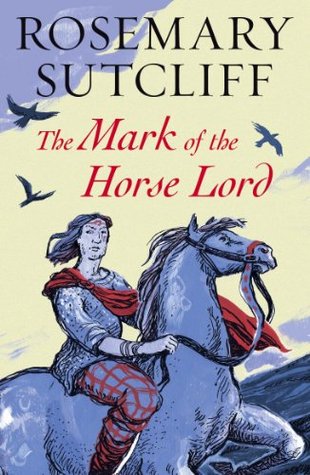
 This is the second book I’ve read for this week’s 1965 Club, hosted by Simon from Stuck in a Book and Karen from Kaggsy’s Bookish Ramblings. Like my first, Over Sea, Under Stone by Susan Cooper, Rosemary Sutcliff’s The Mark of the Horse Lord is described as a book for younger readers, although it doesn’t really feel like one. I have previously read two of Sutcliff’s adult books (The Rider of the White Horse and Blood and Sand) and I found this one just as beautifully written and with just as much to offer an adult reader.
The story is set during the time of the Roman Empire and our hero, the gladiator Phaedrus, is the son of a Greek wine merchant and his slave. The novel opens with Phaedrus, a slave himself, winning the Wooden Foil (and therefore his freedom from slavery) when he is victorious in a fight in the arena of Corstopitum, a town on the great wall built by Hadrian in what is now the north of England. His freedom is short-lived, however, when he is imprisoned after getting into trouble while out celebrating in the town, but this time he is rescued by a group of men who have noticed that he closely resembles their king and are hoping to persuade him to take part in a conspiracy.
Soon Phaedrus is heading north into what we now call Scotland, a land which at this time is home to both the Caledones (Picts) and the Dalriadain (Scots). The plan is for Phaedrus to impersonate Midir of the Dalriadain, who has been usurped by the Caledonian Queen Liadhan and blinded to prevent him from trying to rule. As he travels to the Antonine Wall and beyond, Phaedrus educates himself on the history and culture of his new people and comes to understand the significance of his new role as Horse Lord. But will he manage to convince everyone that he really is Midir – and who will win the upcoming battle between the Dalriads and the Caledones?
There was so much to enjoy about this book. I loved the descriptions of the Roman settlements along Hadrian’s Wall, including Corstopitum or Corbridge, as it is now known (I can recommend a visit to Corbridge Roman Town, run by English Heritage, if you’re ever in the area), and the contrast with the tribes in the north, where Roman rule hasn’t reached. I also found it fascinating to read about the differences in culture between the patriarchal Dalriads, whom Sutcliff tells us have ‘become a Sun People, worshipping a male God’ and the matriarchal Caledones who ‘had held to the earlier worship of the Great Mother’.
The plot was good enough to hold my interest to the end and made me think of other imposter stories I’ve read (such as The Great Impersonation and, in particular, The Prisoner of Zenda), but the setting, the time period and the themes it explores make it different and original. Also, without wanting to spoil anything, I thought the ending was perfect – both powerful and poignant. And yet, there was still something that prevented me from enjoying this book as much as I would have liked to. I’m not sure why, but I sometimes seem to struggle with books set in more ancient periods of history; I often don’t engage with the characters and storylines as thoroughly as I do when a book is set in slightly later periods. I’ve no idea why that should be, especially when an author writes as well as Rosemary Sutcliff does!
 Katrina from Pining for the West has also reviewed The Mark of the Horse Lord for 1965 Club, if you would like to read a Scottish perspective on the book.
 She Reads Novels