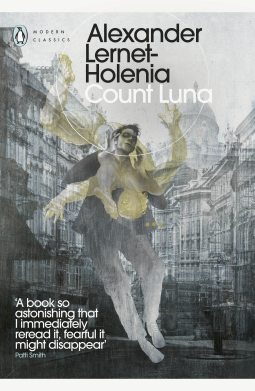
 Translated by Jane B. Greene
What a strange book this is! I enjoyed it, but I’m not sure I fully understood everything the author was trying to say. It’s the first book I’ve read by Alexander Lernet-Holenia and I’m definitely now interested in reading more.
Count Luna was first published in German in 1955 (Lernet-Holenia was an Austrian author) and appeared in an English translation by Jane B. Greene a year later. It has recently been published in a new edition by Penguin Classics.
The novel begins with Alexander Jessiersky, an Austrian aristocrat, entering the Catacombs of Praetextatus in Rome, apparently in search of two French priests believed to have vanished somewhere in the underground passageways. When Jessiersky himself also fails to emerge from the catacombs, his disappearance is reported to the police, who link him with a series of incidents which occurred in Austria and are still under investigation. The rest of the book is presented as an account of Jessiersky’s life leading up to the disappearance, based on reports by the Italian and Austrian authorities.
We learn that at the start of World War II, Jessiersky is the head of a large Viennese transport company. When the company tries to purchase some land belonging to Count Luna, who refuses to sell, the board of directors come up with a plan to confiscate the land and have Luna sent to a Nazi concentration camp. Jessiersky himself is not involved in this, but does nothing to prevent it from happening – and so, when the war is over, he begins to worry that Luna has survived the camp and is coming back to take his revenge.
On one level, Count Luna could be described as a psychological thriller; told mainly from Jessiersky’s perspective, there’s a growing sense of paranoia and fear as he becomes convinced that Count Luna is following him around Vienna, watching from the shadows, breaking into his house and even trying to poison his children. Whether any of these things are true or only exist in Jessiersky’s imagination I’ll leave you to discover for yourself. The atmosphere becomes very dark and the feeling of tension increases as the novel heads towards its conclusion and Jessiersky enters the catacombs – and from this point the story becomes quite bizarre and even more nightmarish.
At 160 pages, Count Luna is a short novel, but took longer than I expected to read as there are some long, detailed digressions into subjects such as the lineage of the Jessiersky family, which need some concentration from the reader (and don’t really add a lot to the story as a whole). Apart from the references to the war, it felt more like a book written in the 19th century than one written in the 1950s. The war is a crucial part of the story, however, and I’ve seen reviews suggesting that Lernet-Holenia was drawing parallels between Jessiersky’s guilt over Luna’s fate and Austria’s own post-war guilt, which does make a lot of sense. I also think the name Luna (the moon) is no coincidence, as Jessiersky discovers that trying to escape from Luna – and therefore from his guilt – is as useless as trying to escape from the moon.
Although I didn’t love this book as much as I thought I was going to at the beginning, I did find it completely fascinating and it left me with a lot to think about.
Thanks to Penguin Classics for providing a copy of this book for review via NetGalley.
 She Reads Novels