Welcome to Thornwalk, home of the last Wynford Gilberts – Lydia, Hugo, Annabel, Jeremy and Rosalind. The downfall of this great family was once the subject of much tawdry gossip and many a sensational headline, and perhaps you hold in your heart some remnant, some echo of this. If so, I ask you to let it go, and here, with me, meet them all anew.
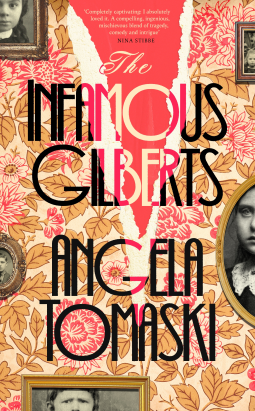 The Infamous Gilberts is an English country house novel with a difference. It begins in 2002 with the news that Thornwalk House, a crumbling mansion in Somerset, is being sold to a hotel chain. Before the hotel people arrive and all traces of the family who once lived there are removed forever, an old family friend, Maximus, takes the reader by the hand and leads us through the house, room by room, looking for clues and secrets left behind that reveal who the Gilberts really were. Each chapter is headed by a different item – The Burn on the Library Rug, Dancing Slippers, A Tuft of Wool, etc – and Maximus goes on to tell us the significance of that item and the story behind it.
I found this book very difficult to get into because the writing style felt so forced and artificial. The narrator speaks directly to the reader, as in the quote I provided above, referring to us as ‘you’ and telling us to climb the staircase, open the door, switch on the light and so on. This made it hard to become immersed in the story and form any kind of connection with the characters. I came close to abandoning the book but instead put it aside for a few days and tried again later. This time I persevered and eventually the narrative style became less annoying and intrusive. As the five Gilbert children, whom I found indistinguishable when they were younger, grew into adults, they also developed as characters and I started to find the story much more compelling.
Beginning in the 1920s and ending in the early 21st century, the book follows the lives of the Gilbert siblings who, in the absence of their father, are raised at Thornwalk by a mother who is struggling to cope and largely leaves them to their own devices. As a result, all five become adults who are damaged or troubled in some way. Hugo, the eldest son, goes away to fight in the Second World War and returns deeply affected by his experiences. Depressed, paranoid and increasingly unstable, he starts to take his frustration out on the people around him. His younger brother Jeremy, on the other hand, is rejected by the army on health grounds and is left with a feeling of inadequacy that leads to him leaving home and spending the rest of his adult life moving from country to country, never really settling down.
As for the three sisters, the youngest, Rosalind, becomes an actress and her shocking actions make her the most infamous of all the Gilberts. Then there’s Lydia, who causes another family scandal by falling in love with her tutor as a teenager and after being forced to end the relationship never seems happy or content ever again. Finally, Annabel suffers from an unspecified mental illness and is considered ‘mad’, but in many ways she is the most shrewd and sensible member of the family. Annabel is also the only one I actually liked; apart from Jeremy, whom we barely see, I found the others so unpleasant it was very difficult to have any sympathy for them.
As you can probably tell, this is a very dark book with some disturbing storylines. I’m not sure why the blurb describes it as hilarious, because I didn’t think it was very funny at all, but maybe that’s just me. I didn’t really understand the role of Maximus in the story either; he tells us that he’s a close friend of the family, particularly Hugo, but almost never interacts with them or features in any of the accounts he gives us of their lives. It seemed that he was there purely because the unusual style and structure of the book required someone to be the narrator rather than because he had any other significance.
I think some readers will enjoy this book and some will struggle with it – although somehow I did both! If anyone else has read it, I would love to hear what you thought.
Thanks to Penguin UK/Fig Tree for providing a copy of this book for review via NetGalley.
 She Reads Novels