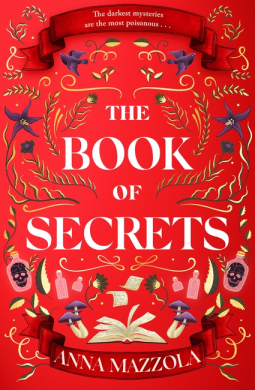
The Book of Secrets by Anna Mazzola

Anna Mazzola’s new novel – her fifth and the fourth that I’ve read – is set in Italy and takes as its inspiration the real life story of a group of women accused of selling poison in 17th century Rome.

It’s 1659 and Stefano Bracchi, a junior magistrate at the Papal Court, has been commissioned by the governor of Rome to investigate some unusual deaths that have taken place in the city. The plague that recently swept through Rome took many lives, but this is something different. These deaths are all men and for some unexplained reason, the bodies haven’t gone through the normal process of decay.

Meanwhile, Anna is trapped in an abusive marriage and searching for a way of escape. Her maid introduces her to a woman who says she can help, but the sort of help she provides is not quite what Anna was expecting! As Stefano begins to close in on the people responsible for the mysterious deaths, Anna finds herself caught in his net, but will he be able to prove that she has done anything wrong?

The Book of Secrets is written from the alternating perspectives of Stefano, Anna and a third character – Girolama, a Sicilian woman with a knowledge of herbs, potions and fortune telling, who is said to possess the ‘book of secrets’ of the title. Because we see the story unfold through all three of these characters, there’s very little mystery involved in the book; we know what Girolama and her friends are doing to help the women of Rome, we know how Anna deals with her violent husband and we know how Stefano’s investigation is progressing. However, what I found interesting about this book was not so much the plot as the characters and the way each of them reacts to the situation in which they find themselves.

Our sympathies are naturally with Anna, a desperate woman who takes the only way out she feels is open to her, while Girolama is a more morally ambiguous character – she has the best intentions and her work does a lot of good, but at the same time she seems largely unconcerned that her actions may occasionally cause harm to innocent people. The Rome of 1659 is a male-dominated society and many of the women in the book are victims of men, but Stefano Bracchi is another nuanced character; as he begins to round up Anna, Girolama and their associates for interrogation at the Tor di Nona prison, he becomes torn between compassion for their suffering and the desire to keep his superiors happy for the sake of his career.

Before starting this book, I knew nothing about Girolama Spana and the case this novel is based on. Although Anna Mazzola hasn’t stuck to the historical facts and has invented or expanded parts of the story, she does explain her choices in her author’s note at the end of the book. The Clockwork Girl is still my favourite of her novels, but this is another fascinating one.

Thanks to Orion for providing a copy of this book for review via NetGalley.

Book 12/50 for the Historical Fiction Reading Challenge 2024

The Clockwork Girl by Anna Mazzola

The Clockwork Girl is Anna Mazzola’s third novel and, I think, her best so far. Not only is the cover beautiful, the setting is also wonderfully dark and atmospheric and the story is fascinating.

The year is 1750 and Madeleine Chastel, daughter of a Parisian brothel owner, is about to start a new job as a maid in the household of Dr Reinhart, a Swiss clockmaker. Madeleine is pleased to have an opportunity to escape from her mother’s clutches, but this particular job is not one she has chosen for herself – she has been forced to take it by the chief of police, who wants her to spy on Dr Reinhart and report back on any suspicious activities she witnesses. But although Madeleine soon becomes convinced that the police are correct and something strange is going on in the Reinhart household, she finds that she is growing fond of the clockmaker’s daughter, Veronique, and is reluctant to betray her new friend.

The novel is written from the perspectives of three different characters: Madeleine is one, Veronique is another and the third is Jeanne Poisson, better known as Madame de Pompadour, mistress of King Louis XV. I found the choice of narrators very effective as it means we are given insights into every level of Parisian society – the working class, the bourgeoisie or middle class, and the aristocracy. Our story takes place several decades before the French Revolution would begin, but you can see the foundations being laid here as tensions start to simmer. The various locations in which the novel is set are vividly described, with sharp contrasts between the dark, dirty streets where the poor people live in squalor and the luxury and opulence of the royal palaces of Versailles and the Louvre.

Although The Clockwork Girl is a work of fiction, it is inspired by several real historical events. First, the disappearance of children from the streets of Paris in 1750, a scandal known as ‘The Vanishing Children of Paris’. And secondly, the technological advances during the 18th century in the creation of automata – clockwork dolls, animals and other machines with moving parts. Anna Mazzola weaves both of these things into the plot and the result is an engaging and unusual novel that I thoroughly enjoyed reading.

If this book doesn’t appeal, you may prefer Anna Mazzola’s first book, The Unseeing, based on a true crime (the Edgware Road Murder) or The Story Keeper, a novel set on the Isle of Skye. I enjoyed both of them.

Thanks to Orion for providing a copy of this book for review via NetGalley.

This is book 9/50 read for the Historical Fiction Reading Challenge 2022.

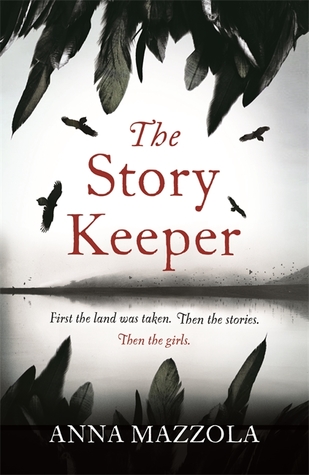
The Story Keeper by Anna Mazzola

This is Anna Mazzola’s second novel, following her debut, The Unseeing, which I read last year. There are some similarities between the two – they are both set in the 19th century and they are both inspired by true crimes – but the stories are very different and, of the two, I found this new one much more enjoyable.

It’s 1857 and Audrey Hart is desperate to get away from London following a traumatic experience at the orphanage where she has been volunteering. Audrey’s mother, who disappeared while out walking many years earlier, had an interest in folklore, so when Audrey sees a job advertised for a collector of folk tales on the Isle of Skye, she applies at once. After arriving on the island and meeting her new employer, Miss Buchanan, she becomes aware that her task is going to be much more difficult than she had expected…

During the recent Highland Clearances, many of the crofters have been forced to leave Skye, taking their stories with them, and those who remain are reluctant to speak to Audrey. Some of this reluctance could simply be due to the fact that Audrey is from England and therefore an outsider, but she senses that there is more to it than that – the islanders seem to be afraid to share their stories and to have them written down. Then Audrey finds the body of a girl washed up on the beach – and when another girl also goes missing, she begins to wonder whether the people of Skye are right to be afraid.

The Story Keeper is a wonderfully atmospheric novel set in a small, remote Scottish community where people’s daily lives are influenced by the old superstitions and traditions in which they still believe. Throughout the novel, as one strange occurrence follows another, we are kept wondering whether there are supernatural forces at work on Skye or whether there is another explanation for what is happening. It all feels quite sinister, and genuinely eerie in places. Some of the superstitions and beliefs Audrey encounters are dark, disturbing and even dangerous. The novel reminded me in that respect of The Good People by Hannah Kent.

As well as the mystery unfolding on the Isle of Skye, there are also hints of other mysteries in Audrey’s past. Why did she leave her home in London without telling her father and stepmother where she was going? What really happened while she was visiting the orphanage? And what was the true story behind her mother’s disappearance, all those years ago? These things are all explained, but the truth only emerges very slowly, meaning that there is plenty of suspense from the beginning of the book until the end.

If I have a criticism, it is that some of the developments towards the end of the book, especially where one particular character is concerned, feel a bit too dramatic and far-fetched. I liked the final twist, though, as it was something I hadn’t worked out for myself. I also enjoyed the fairy tale extracts at the start of some of the chapters and the lines from the poem Kilmeny by James Hogg, which I had to look up and read in its entirety after finishing the book.

Although I couldn’t help thinking The Story Keeper would have been better suited to a cold, dark winter’s night, I still enjoyed reading it during our current summer heatwave and I’m looking forward to whatever Anna Mazzola writes next.

Thanks to Headline for providing a copy of this book for review.

This is book 5/20 of my 20 Books of Summer. I am doing slightly better with this than it seems – I just need to catch up with writing my reviews!

The Unseeing by Anna Mazzola

the-unseeingIt’s Christmas 1836 and Hannah Brown is looking forward to her wedding to James Greenacre. However, the marriage will never take place; instead, Hannah is brutally murdered and in the weeks that follow, the parts of her dismembered body are discovered in various locations around London. Her fiancé, Greenacre, is arrested and found guilty – but although he admits to disposing of the body, he claims that Hannah was already dead when he found her. This makes no difference to the judge and jury and Greenacre is sentenced to hang, along with his mistress, Sarah Gale, who is accused of concealing the murder.

Sarah had been living with Greenacre as his housekeeper before being asked to leave so he could marry Hannah. She insists that she knew nothing about the murder and Greenacre also denies that she had any involvement, but this is not enough to save her. As she sits in a cell in Newgate Prison, Sarah’s only hope is the petition she has submitted asking for clemency. The lawyer appointed by the Home Secretary to look again at Sarah’s case is Edmund Fleetwood, young, idealistic and principled. After speaking to Sarah and hearing her talk about her life, Edmund is convinced that she should be freed, but how can he prove it? And is it possible that he is becoming too emotionally involved in the case to be able to see the facts clearly?

Anna Mazzola’s debut novel, The Unseeing, is based on a true crime; the Edgware Road Murder, as it became known, really did take place and James Greenacre really was found guilty and was sentenced to death. Sarah Gale was also arrested, but I won’t tell you what her eventual fate would be. I didn’t know and that meant I was kept in suspense wondering what would happen to her. It’s important to remember, though, that this is fiction and not everything in the book is taken from historical fact – which could explain why some of the developments towards the end of the novel didn’t completely convince me.

Edmund Fleetwood, who plays such a major role in the novel, is a fictional character and the author has created a fictional story for him running alongside Sarah’s. I thought the two stories worked well together – I did like Edmund and I shared his frustration as Sarah repeatedly refused to provide any information which could have helped her defence – but there were times when I felt I was being distracted from the central plot and I just wanted to get back to Sarah in the Newgate. The portrayal of prison life is one of the novel’s strong points and reminded me of other prison-based historical novels such as Antonia Hodgson’s The Devil in the Marshalsea and Sarah Waters’ Affinity.

The most interesting aspect of the book, though, is the exploration of what it meant to be a woman accused of a crime in the 19th century: the unfairness of the law, the way in which evidence against a woman was considered, the possible bias that could arise from a verdict being reached by an all-male jury, and whether the punishments handed out were in proportion to the crime. The fact that many of these women had children – like Sarah’s little boy, George – added another complication. Sarah is lucky enough to have a sister, Rosina, who takes care of George while she is in prison, but what will happen to him if the worst happens and she can never come home?

The Unseeing is an interesting blend of fact and fiction; I did enjoy it, but I felt that there wasn’t enough to make this book stand out from others of its type. I couldn’t quite love it, but I liked it and will be looking out for more from Anna Mazzola.

Thanks to Sourcebooks Landmark for providing a review copy via NetGalley.