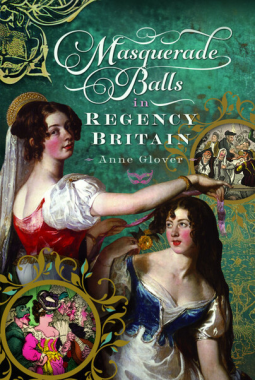
 Having read a lot of fiction set in the Regency period, the masquerade ball is something I’ve come across often. It tends to be the setting for some of the novels’ pivotal moments, with masked characters free to behave in ways they normally wouldn’t and mistaking each other’s identities, leading to unexpected romances, accidental interactions with the wrong person and other surprises that are only revealed when the masks come off! This new book by Anne Glover looks at the facts behind the fiction, exploring the real history of the masquerade ball.
The book begins with a discussion of the popular venues used for masquerades. Not surprisingly, the focus is overwhelmingly on London, where masquerades were regularly held at the Argyll Rooms and the Pantheon, as well as outdoor events at the Ranelagh Gardens and Vauxhall Gardens. However, Glover does acknowledge the popularity of masquerade balls in seaside resorts like Margate and Brighton, in other large cities around Britain and Ireland and in other countries such as India. She also looks at private masquerades, where a wealthy person would open their own home to family and friends. The balls would all have different characteristics depending on the size and style of the venue, the ticket price and the class of guests they were trying to attract (the Argyll Rooms required a subscription, whereas the Pantheon was open to anyone who could afford a ticket).
Glover then devotes separate chapters to each individual aspect of the masquerade ball. I found the chapter on lighting particularly interesting. She explains that although we may imagine masquerades as dark, dimly-lit affairs, it was actually important for them to be brightly lit – to help guests stay awake as the balls often started at ten or eleven at night and went on until dawn; to make it safer for people wearing masks to move around; and for the host to show that they could afford to light hundreds of lamps. The Pantheon was said to have 10,000 variegated lamps arranged in different designs. The rooms would be decorated with transparencies – pictures painted on paper, silk or linen and illuminated from behind – and artificial flowers, while pictures and designs would be chalked onto the dance floors, again with the practical purpose of stopping dancers from slipping.
The types of dances popular during the Regency are discussed, along with additional entertainments which started to be added as masquerade balls became more ambitious, including fireworks, lotteries and performances by dancers, singers and acrobats. Then of course, there’s the food – the formal ‘supper’, which often took place at one or two o’clock in the morning, versus the idea of a buffet or refreshments available throughout the entire event which became more popular as we moved into the Victorian era. Costumes are the subject of another chapter. People who wore the ‘domino’ (a simple hooded cloak with a mask) were often looked down on by other guests for not making enough effort; character costumes based on figures from history or literature were preferred, and this leads into a discussion of cultural appropriation and symbols of national identity.
Although masquerade balls could be attended by people from various walks of life, they were obviously aimed mainly at the very rich and privileged and as I read, I couldn’t help thinking about all the working class people who were excluded from entertainments like these – and all the money that was spent on something only lasting one night. I suppose at least the balls created plenty of work for costume makers, artists, musicians and performers, cooks and caterers!
I found this book interesting, but I thought the style and structure made it a bit too dry and scholarly for the general reader. I’m sure it would be of great help as a reference book for someone writing a Regency novel, though. Anne Glover has clearly carried out a huge amount of research and gone into an incredible amount of detail in each chapter, but I would have preferred something that was more fun to read. Still, I did learn a lot from it and coincidentally, the very next novel I picked up after finishing it happened to feature a masquerade ball!
Thanks to Pen & Sword History for providing a copy of this book for review via NetGalley.
 She Reads Novels