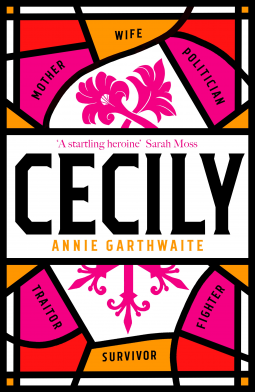
 Since reading Annie Garthwaite’s first novel, Cecily, about the life of Cecily Neville, Duchess of York, I have been looking out for a sequel. As the first book ended in 1461 and Cecily lived until 1495, I knew there was more than enough material for a second novel – and here it is, after a three year wait!
Cecily was set during the reign of Henry VI and the early stages of the Wars of the Roses, describing how Cecily’s husband, the Duke of York, led an army against the king and was killed at the Battle of Wakefield. A few months later, Cecily and York’s son, Edward, was more successful, defeating the king’s forces at the Battle of Towton and being crowned Edward IV. The King’s Mother picks up the story as Edward begins his reign and Cecily enters a new phase of her life as mother to the king and therefore one of the most powerful women in England.
This is a complex period of history and I would find it difficult to give a summary of the plot. You may already be familiar with the key points anyway – Edward IV’s unpopular marriage to Elizabeth Woodville; the various threats to his reign and the battles of Barnet and Tewkesbury; his death, leading to the accession of his younger brother, Richard III; and finally, Richard’s defeat by the future Henry VII at the Battle of Bosworth, marking the start of the Tudor dynasty. This entire turbulent period is seen only from the perspective of Cecily, which is slightly limiting as Cecily is rarely at the heart of the action herself and often has to learn about major developments from letters or messengers. However, the story is never boring and moves along at a steady pace, holding my interest until the end even though I’ve read about this period many times before.
Cecily is shown as a controlling force behind Edward’s throne in the early days of his reign, advising him on what to say and do, but her influence over him gradually fades. She concentrates instead on building alliances, arranging marriages and doing whatever else she can to keep the kingdom and her family secure, taking her title of King’s Mother very seriously. The cover of the novel states ‘There can only be one’ and it’s true that Cecily is not the only candidate for this position. She forms an uneasy friendship with Margaret Beaufort, mother of the young Henry Tudor, deciding to trust her even while knowing that Margaret will do whatever it takes to further her own son’s claim to the throne. Then there’s Elizabeth Woodville, Edward’s wife, who also expects her eldest son to inherit the throne. Cecily makes it clear that she disapproves of the marriage and dislikes Elizabeth, but she accepts that Elizabeth is queen whether she likes it or not and does what is necessary to protect the Woodvilles – at least while Edward is still alive!
Elizabeth herself is not shown in a sympathetic light at all and comes across as immature, whiny and spiteful, which is disappointing as other characters are given more nuance. I thought Cecily’s relationship with her middle son, George, Duke of Clarence, was particularly well done, capturing Cecily’s mixed feelings about him – the love of a mother for her son mingled with anger and frustration as George, along with his cousin Warwick, betrays Edward over and over again.
One of the interesting things about reading a lot of books about the same period of history is wondering how the author will tackle some of the controversies and mysteries of the period. One of these is Edward’s alleged pre-contract of marriage to Eleanor Talbot, signed before he married Elizabeth. Some historians believe this was fabricated by Richard III in order to invalidate Edward and Elizabeth’s marriage and declare their children illegitimate; in this book, Annie Garthwaite assumes that the pre-contract did exist and was known to Cecily, who tried to cover it up. Another controversy, of course, is the disappearance of the Princes in the Tower. I won’t tell you how Garthwaite approaches this, but authors do usually have to choose one side or the other and this is definitely more of a pro-Ricardian novel.
Richard’s entire reign is covered in the final 20% of the book, which does feel a bit rushed considering how eventful that period was. I think there would have been enough material for a third novel, which would have allowed for more depth. I felt that we never really got to know Richard’s wife, Anne Neville, for example, which took away some of the emotional impact from the later stages of the book. Still, I really enjoyed The King’s Mother. Start with Cecily if you can, but they are both excellent novels and reminded me yet again of what a fascinating period of history this is!
Thanks to Viking for providing a copy of this book for review via NetGalley.

This is book 10/20 of my 20 Books of Summer 2024.

Book 28/50 for the Historical Fiction Reading Challenge 2024

 She Reads Novels