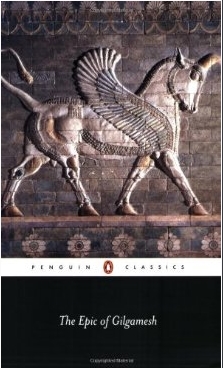
When I signed up for the Really Old Classics Challenge I had no idea what to read, as I’m completely new to ‘really old classics’. I finally picked The Epic of Gilgamesh, which proved to be the perfect choice because I loved it!
The Epic of Gilgamesh is one of the earliest known pieces of literature in the world. It was written on a set of clay tablets from ancient Mesopotamia which were discovered by the archaeologist Hormuzd Rassam in the 19th century and are thought to date from around 2000 BC. It’s fascinating to think that something written so long ago has survived and is still being read today.
The epic tells the story of Gilgamesh, a powerful Sumerian king who is feared by his subjects. The gods respond to the pleas of the people by sending a wild man called Enkidu to be Gilgamesh’s equal. The first half of the epic shows how Gilgamesh and Enkidu form a close friendship and have some great adventures together, including a journey into a cedar forest to slay the monster Humbaba. Later, when Enkidu dies, the devastated Gilgamesh sets out in search of the secrets of immortality.
There have been several different translations of The Epic of Gilgamesh but the one I read was the Penguin Classics version translated by Andrew George. I’m not sure how this would compare to the other translations that are available (this is in verse form and I know that some of the others are in prose, for example); I might try reading a different one at some point in the future to find out.
The story is very repetitive with some verses being repeated two or three times in quick succession, with only a few words being changed each time. I actually really liked this structure, as it produced an almost hypnotic effect, as well as helping to emphasise the points that were being made. I was surprised at how easy it was to read and understand, despite some missing words and disjointed sentences (the Epic of Gilgamesh does not exist in its entirety – the various translators have had to piece it together from the surviving fragments of text). Some parts of the story feel very familiar, such as when Gilgamesh, during his quest for immortality, meets Utnapishtim who tells him about a great flood. This is obviously very similar to the biblical story of Noah.
There are lots of references to Sumerian gods and place names, which I am not familiar with at all, but the book has a lot of helpful extras including a glossary, character list and map. There’s also an introduction which helps to explain the historical context of the epic and describes how the tablets were discovered.
The Epic of Gilgamesh is relatively short in comparison to many other ‘really old classics’, but despite its shortness, it gives us a lot to think about. One thing we can learn from the epic is that although the world has changed in many ways over the last four thousand years, there are some things that are still the same: for example, friendship, love, grief at losing a loved one, fear of death, and every other human emotion you can think of.
Recommended

 She Reads Novels