 At the beginning of The Prisoner of Zenda, twenty-nine-year-old English gentleman Rudolf Rassendyll is leading a quiet, comfortable life in London, not working or doing anything at all, to the annoyance of his sister-in-law, Rose. To keep her happy, Rudolf agrees to accept a position working for the ambassador Sir Jacob Borrodaile, but finding himself with some free time before he starts his new job, he decides to visit the small European country of Ruritania to see the coronation of their new King.
Ruritania is almost, but not quite, a fantasy world. You won’t find it on a map – it’s a fictitious kingdom located somewhere in central Europe – and although there are no magical creatures, wizards, monsters or dragons, it is still a place where strange and unexpected things can and do happen. Soon after arriving there, Rassendyll meets his exact double – the man who is about to be crowned King of Ruritania, whose name also happens to be Rudolf. The likeness is explained by the fact that the two Rudolfs are distant cousins and both have the long, sharp, straight nose and dark-red hair that appear every few generations.
On the eve of his coronation, the King is drugged by his villainous half-brother, Black Michael, the Duke of Strelsau, who is hoping to steal both the King’s throne and the woman he is going to marry, the beautiful Princess Flavia. With the King unconscious and unable to appear at the coronation, his attendants persuade Rassendyll to impersonate the King at the ceremony. The coronation goes ahead as planned, but Rudolf’s impersonation doesn’t end there – the real King has been kidnapped and imprisoned in a castle in the town of Zenda. Rassendyll must continue to take his place until he is rescued, but things become more and more dangerous for Rudolf as he finds himself caught in the plots and schemes of Black Michael and his henchman Rupert of Hentzau. And as if life wasn’t already complicated enough, he also begins to fall in love with Princess Flavia…
I put this book on my list for the Classics Club, intending to read it at some point in the next few years, but I didn’t really know what it was about and was in no hurry to get to it. Then I read Lisa’s review and it sounded so exactly like the kind of book I would love that I was inspired to move it straight to the top of my list. Having somehow managed to go through life without seeing any of the film versions, I didn’t know anything about the plot, though as I read the book parts of it did feel familiar, maybe because it has been the inspiration for so many other adventure stories.
The Prisoner of Zenda was written near the end of the Victorian period, in 1894, though I found it a lot lighter and easier to read than most Victorian novels. It’s also a very short novel (only around 200 pages in the edition I read) but the kingdom of Ruritania, with its woods, castles and palaces, and the people who inhabit it are well developed and unforgettable. One of my favourite characters was Rupert, so I was pleased to discover there is a sequel, Rupert of Hentzau, which I’m looking forward to reading.
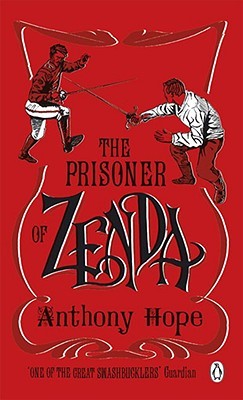
“One of the great swashbucklers” it says on the cover of the Penguin Classics edition of this book, and I would agree, although I did prefer Scaramouche by Rafael Sabatini and The Scarlet Pimpernel by Baroness Orczy, both of which I read this year and loved. 2012 seems to be turning into the year of the swashbuckler for me, doesn’t it? I did still enjoy this one though; it was entertaining, fast-paced and a lot of fun to read. I recommend saving it for a dull, dreary afternoon when you want nothing more than to be whisked away to a world of action, adventure, kings, princesses, evil brothers, mistaken identities, swordfights, romance, castles, kidnappings and daring escapes!
 She Reads Novels