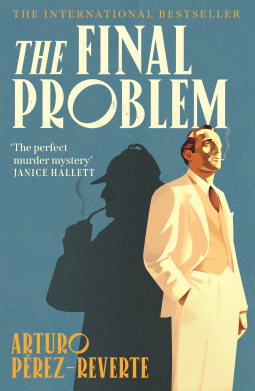
The Final Problem by Arturo Pérez-Reverte – #ReadIndies

Translated by Frances Riddle

It’s June 1960 and actor Ormond Basil has found himself trapped on the small island of Utakos, near Corfu. He has been invited to join a film director on his yacht to discuss a new project, but stormy weather means they are unable to leave the island until conditions improve. Luckily, there’s a hotel on Utakos where they and a small group of other guests and staff can take shelter until the storm has passed. However, there are no police on the island, so when one of the guests, British tourist Edith Manders, is found dead under suspicious circumstances, it’s up to the others to investigate until help can arrive.

Because Ormond Basil famously played the part of Sherlock Holmes on screen many times, he’s nominated to lead the investigation. No matter how much he explains that he’s only an actor and not really the great detective, everyone else insists that he must know more about solving mysteries than they do. And despite his protests, he does seem to know what he’s doing. With one of the other guests, Spanish crime author Paco Foxá, as his Watson, Basil begins to look for clues and question the suspects – but can he find the killer before another death takes place?

You may have guessed that Ormond Basil is closely based on the real life actor Basil Rathbone, who is for many people the quintessential Sherlock Holmes. I’ve talked before about not liking the current trend for using real people as detectives, but this is slightly different as the character is semi-fictional which gives Pérez-Reverte more scope to have him say and do things that the real Basil may not have done. He’s so obviously supposed to be Basil Rathbone, though, that it seems a bit pointless to pretend that he’s not. Either just calling him Rathbone or creating a completely fictional character would have worked better for me.

The novel is well plotted and the locked room mystery has a solution which is clever without being overly complex. With only a small number of suspects due to the setting, I thought I had guessed who the murderer was, but I was wrong and there was a nice twist towards the end that I hadn’t seen coming. For all Basil’s insistence that he’s not the real Sherlock Holmes, he does turn out to be an excellent detective, with powers of observation and deduction almost as good as the character he played for all those years!

However, I felt that there was far too much name-dropping of other famous actors and directors Basil had worked with, and too many long discussions between Basil and Foxá on the subject of Sherlock Holmes, in which both of them quote constantly from the books and adaptations. This all became a bit tedious and detracted from the mystery. I had a similar problem with the other Pérez-Reverte novel I’ve read, The Dumas Club, in which we’re bombarded with references to Alexandre Dumas’ books, so maybe this is just the way he writes.

I’m not sure if The Final Problem is going to be left as a standalone or if it’s intended as the start of a series; I don’t know if I would want to read any further adventures for Ormond Basil, but I did enjoy this one overall because of the interesting murder mystery. This edition of the novel is available from Atlantic Books, translated into English from the original Spanish by Frances Riddle. As Atlantic Books is an independent publisher, I’m counting this towards Read Indies, hosted this month by Karen of Kaggsy’s Bookish Ramblings.

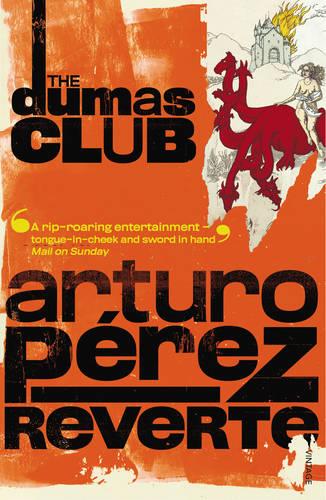
The Dumas Club by Arturo Pérez-Reverte

Translated by Sonia Soto

For Spanish and Portuguese Lit Month, hosted by Stu of Winstonsdad’s Blog, I decided to read a book that sounded perfect for me. A bibliomystery set in the world of antiquarian booksellers, paying tribute to Alexandre Dumas, whose novels I love. What could go wrong?

The Dumas Club (or The Club Dumas – it has appeared under both titles) was originally published in Spanish in 1993 and translated into English three years later by Sonia Soto. You may have watched the 1999 film adaptation The Ninth Gate, starring Johnny Depp; I don’t think I’ve seen it, but apparently it’s very different from the book and completely removes the Dumas connection, which seems strange but maybe they thought there was too much going on and couldn’t include everything.

Lucas Corso is a ‘book detective’ who hunts down rare or valuable books on behalf of his clients. Corso has found that unscrupulous dealers and collectors are prepared to pay large sums of money for the books and don’t really care whether the methods he has used to get hold of them are particularly legal or ethical. In The Dumas Club, we follow Corso as he travels across Europe on two separate missions. The first concerns an early draft of a chapter from Alexandre Dumas’ The Three Musketeers. The chapter, titled Anjou Wine, appears to be written at least partly in Dumas’ own handwriting and Corso’s job is to prove its authenticity.

His second task is more complex and involves a very different kind of book: The Book of the Nine Doors of the Kingdom of Shadows, published by Aristide Torchia in 1666. This rare and sinister book is thought to contain the key to summoning the Devil and Torchia was burned at the stake shortly after its publication. Only one copy is thought to have survived. Corso’s client, Varo Borja, owns a copy of the book which he believes may be a forgery and he wants Corso to examine two other copies, one in Portugal and one in France, to determine which is genuine and which are fakes.

Setting out on his journey, Corso begins to encounter some mysterious strangers who remind him of characters from books. For example, he is pursued by a man with a scar who resembles Rochefort, the ‘Man from Meung’, from The Three Musketeers and he also crosses paths with a young woman who introduces herself as Irene Adler after the character from the Sherlock Holmes stories. Corso is unsure whether these people are interested in The Anjou Wine, The Nine Doors or both, so he must try to keep the manuscripts out of their hands until he has solved the two mysteries.

The Dumas Club is an unusual novel and there were lots of things I liked about it. As a Dumas fan, I enjoyed all the references to The Three Musketeers and other titles; it’s not really essential to be familiar with Dumas, but you’ll definitely get more out of the book if you are. Pérez-Reverte includes a lot of unnecessary information, though, such as a full bibliography of all Dumas’ works inserted into the middle of a chapter. This info-dumping continues throughout the book, as well as lots of long digressions into printing and binding techniques and discussions of first editions, illustrations and rare collections. Some of it is quite fascinating and I think people who love books as physical objects more than for the words they contain will find it particularly interesting, but it doesn’t make for a very quick or easy read.

Although I enjoyed following the Anjou Wine thread of the story, Corso’s second mission revolving around The Nine Doors and the occult was of less interest to me and reminded me too much of The Da Vinci Code. It didn’t help that I didn’t like Lucas Corso at all and found most of the other characters equally unpleasant. Still, the ending is clever and we are given answers to both of the mysteries, so I think my feelings about this book are probably slightly more positive than negative. Another of Pérez-Reverte’s novels was recommended to me a few years ago – Captain Alatriste – and wonder if I would get on better with that one.