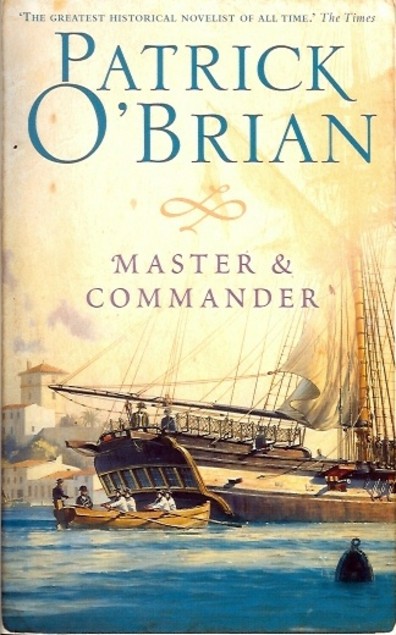
 I do not usually like books set at sea. However hard I try, I just can’t seem to keep track of the nautical terms and as soon as I see words like ‘mainsail’, ‘fo’c’sle’ or ‘bosun’ my brain just seems to switch off. As a fan of historical fiction, I have been unable to avoid this entirely – after all, until the 20th century the only way to cross the sea was by ship and many historical fiction novels do involve a sea voyage or two – but the thought of reading a book where seafaring forms a major part of the plot is always quite daunting for me. For this reason I’ve resisted reading the Aubrey/Maturin series for a long time, despite it being described as one of the best historical series ever written, but a couple of weeks ago I decided it was time I gave Master and Commander a try.
The story begins in Port Mahon, Minorca, with Jack Aubrey and Stephen Maturin meeting for the first time at a concert in the Governor’s House. After an initial disagreement that almost results in a duel, Aubrey and Maturin discover a shared passion for music and a friendship begins to develop. Jack Aubrey has just been given his first command of the sloop, HMS Sophie, and after discovering that Stephen is a physician, he invites his new friend to join him as ship’s surgeon. With Britain at war with France (it’s the year 1800), life at sea is both dangerous and exciting and as the Sophie cruises the Mediterranean she becomes engaged in a series of sea battles and encounters with enemy ships.
I loved Patrick O’Brian’s writing style from the beginning, but as soon as the Sophie set sail all my fears about naval novels were realised. I did try – there’s a useful diagram at the front of the book and of course there’s always the option of looking up unfamiliar words and finding pictures of ships online (if, like me, you don’t know the difference between a brig and a frigate and have always thought a settee was something you sat on) – but in the end I decided not to worry about it and luckily, there were still plenty of things for a landlubber like me to enjoy, not least the wonderful characters. Too often characters in historical fiction are depicted as having modern sensibilities and come across as twentieth century people dropped into a historical background – that was thankfully not the case with this book; they felt realistic and believable. O’Brian’s prose and dialogue is completely appropriate for the time period and the same is true of the behaviour and thought processes of the characters.
I liked both of the main characters and the contrast between their very different personalities and am looking forward to getting to know them better over the course of the series. At the moment Stephen Maturin is my favourite; I also appreciated the fact that he doesn’t have much more knowledge of seafaring matters than I do and has to have even the most basic naval facts explained to him by other members of the crew. It was good to know that someone else shared my bewilderment of the nautical world and I loved the way even at moments of high drama at sea, he was more excited about spotting a rare bird or fish.
Master and Commander doesn’t have a lot of plot, being of a more episodic nature, but I finished the book with a better understanding of what conditions were like onboard a ship in the Napoleonic era and what daily life involved for a sailor in the Royal Navy. It seems that not being able to follow all of the terminology or the more intricate points of the various naval manoeuvres was not the problem I was afraid it would be. I didn’t instantly fall in love with this series, but I still enjoyed my first introduction to Aubrey and Maturin and I’m sure I’ll be reading the next one very soon!
 She Reads Novels