Maureen Peters (1935-2008) was a Welsh historical novelist and yet another forgotten author whose work is being reissued for a modern audience by Endeavour Press. It seems that Peters was very prolific, writing over one hundred books under several different pseudonyms; most of them were fictional biographies of historical royalty, but she also wrote romances, Gothic novels, family sagas and mysteries. Having now had the opportunity to read two of her books I thought I would combine my thoughts on both of them into one post.
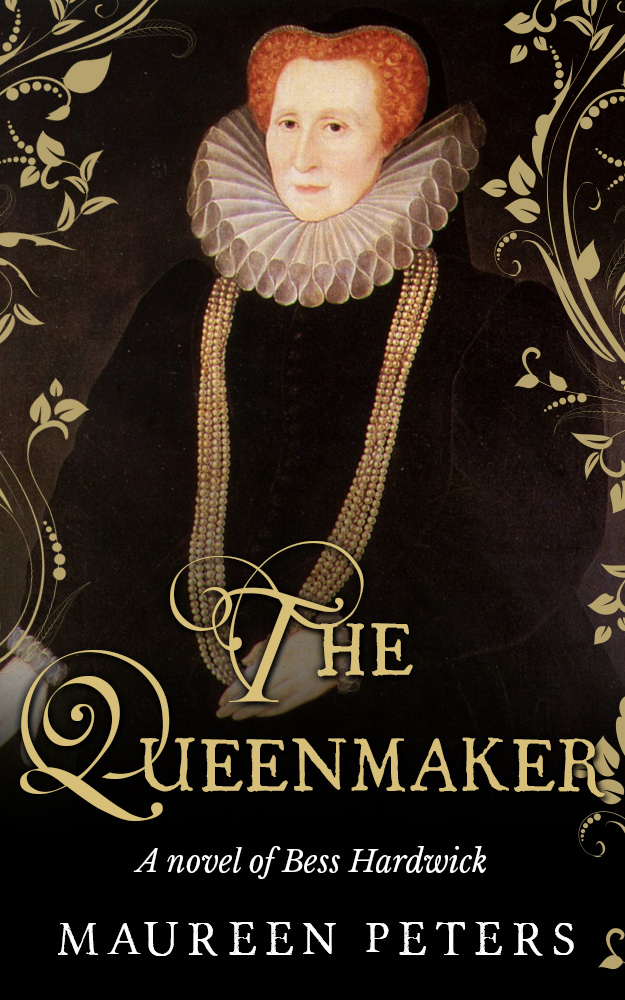 The first book I’m going to talk about, The Queenmaker (1975), tells the story of Bess Hardwick, one of the richest and most notable women of the Elizabethan court, responsible for the building of great houses such as Chatsworth and Hardwick Hall. Born in Derbyshire, Bess is married at an early age to Robert Barlow, the heir of a neighbouring family, and finds herself a widow within a year. She will marry three more times over the course of her life and with each marriage her wealth increases and her position in society advances. She becomes a friend of Elizabeth I (the queen acts as godmother to her first son), and also has the opportunity to get to know Mary, Queen of Scots during her captivity in England.
With power and influence, though, comes the threat of danger. When Bess arranges a marriage for her daughter with Charles Stuart (son of the Countess of Lennox, Henry VIII’s niece), the family instantly come under suspicion because the child of this marriage, a little girl called Arbella, has Tudor blood and therefore a claim to the crown. As the years go by and Arbella grows into a woman, Bess becomes more and more convinced that her granddaughter will be named heir to the throne and that she – Bess Hardwick – will go down in history as a queenmaker.
Before reading this book I knew very little about Bess; I had come across her name several times in books set at Elizabeth’s court, but I couldn’t have told you any details of her personal life or her accomplishments. Because so much in this novel was new to me, I found it quite an enjoyable read. Obviously I knew that Bess wouldn’t achieve her ambition and Arbella wouldn’t become queen, but I was still interested to see how the story would unfold. However, I thought this book was too short to be completely satisfying. Trying to give an account of an entire life in under 200 pages means leaving big gaps in the story and jumping forward by several years at the start of every chapter. A longer novel would have allowed characters and events to be explored more thoroughly.
 The Virgin Queen (1972) is another quick and fairly entertaining read which, as the title suggests, focuses on the life of Elizabeth I herself this time. Our narrator is Tomasin Drew, Elizabeth’s friend and companion, who first meets the future queen when Elizabeth is still a young girl living in the household of her stepmother, Katherine Parr. Tomasin remains with the queen for more than fifty years, offering support and friendship throughout the key moments of her life and reign.
Elizabeth is portrayed as a spirited, flirtatious and capricious woman, if not a very likeable one: a strong character, who jumps out of the pages of this novel, unlike Tomasin who stays in the background. Tomasin’s role is as an observer, reporting and commenting on events for the reader; her own personal story is left undeveloped, putting the spotlight firmly on Elizabeth. As with The Queenmaker, though, the approach Maureen Peters takes is disappointingly simplistic. This is another very short novel – too short to look at Elizabeth’s life in any real depth – and there’s nothing new here for those of us who have read about Elizabeth I many times before.
I think both The Virgin Queen and The Queenmaker might be good choices for younger readers or those who simply want a quick introduction to the Elizabethan period (while being aware that not everything in these books will be completely accurate – I spotted at least a few statements for which there is no historical proof, such as Anne Boleyn having six fingers on one hand). I haven’t ruled out reading more of Maureen Peters’ novels, but I’m not in any hurry to do so while there are so many other authors still to discover.
I received copies of both of the above novels via NetGalley for review.
 She Reads Novels