Sanctuary by Robert Edric

Sanctuary Set in Haworth, West Yorkshire, in 1848, this is the story of a frustrated, unhappy young man whose life has been a series of disappointments, rejections and unfulfilled promise. In poor health, with no job and mounting debts, he has returned to the family parsonage where he remains completely dependent on his father, the only person who still sees his potential. To make things worse, his three sisters have succeeded where he has failed, having had some of their poems and stories published (under male pseudonyms). Disillusioned and miserable, he turns to alcohol for comfort.

The young man’s name, as you may have guessed by now, is Branwell Brontë and his sisters are Charlotte, Emily and Anne. Sanctuary is a fictional account of the final months of Branwell’s life leading up to his death in September 1848 at the age of thirty-one. Branwell himself is the narrator of the story, giving us some insight into his state of mind as he tries to come to terms with seeing the success of his sisters while his own literary ambitions come to nothing.

As a fan of the Brontë sisters I have always been intrigued by Branwell and the possible influence he may have had on their work. Earlier this year I read Daphne du Maurier’s biography, The Infernal World of Branwell Brontë, which I thought was quite a sympathetic portrayal. It was much more difficult to have any sympathy for the Branwell we meet in Sanctuary; he spends the whole book feeling sorry for himself and wallowing in self-pity without making any attempt to change things. However, I didn’t need to like Branwell to appreciate that his character was well written, complex and believable. As a portrait of an intelligent, talented man who had wasted his potential and thrown away opportunities through his own self-destructive behaviour, it was very convincing.

Unfortunately, none of the other characters in the book were as well developed as Branwell. Charlotte, Anne and Emily all felt like the same person rather than three strong, separate personalities, which was very disappointing (especially when compared with their portrayal in Jude Morgan’s excellent The Taste of Sorrow). For the same reason, I thought it was hard to distinguish between Branwell’s friends, several of whom appeared in the story and, like his sisters, felt bland and lifeless. On a more positive note, I did like the setting – we learn a lot about life in a small Yorkshire community in the middle of the 19th century.

Because of my love for the Brontës, I found this an interesting and worthwhile read, even though the slow pace and weak secondary characters meant that I didn’t particularly enjoy it. I like the sound of some of Robert Edric’s previous novels, though, so I would consider reading another one at some point.

I received a copy of Sanctuary for review via NetGalley.
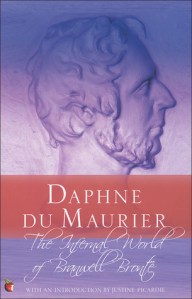
The Infernal World of Branwell Brontë by Daphne du Maurier

The Infernal World of Branwell Bronte I’ve been interested in reading this book since I read Daphne by Justine Picardie in 2011. In Daphne, among other storylines, the fictional du Maurier is researching a biography of Branwell Brontë, hoping to find evidence of his talent and the possibility that he may have contributed to his sisters’ famous novels. This book, The Infernal World of Branwell Brontë, published in 1960, is the result of that research.

Even without reading Justine Picardie’s novel, I would have known du Maurier was a fan of the Brontës as their influence is obvious in some of Daphne’s own novels, particularly Rebecca and Jamaica Inn. I can understand why she may have been fascinated by Branwell, whom she probably saw as a tragic and misunderstood figure. His story is certainly quite a sad one, though a lot of his problems were self-inflicted. As the only boy in a family of girls his father had high hopes for him (to the Victorians it was probably unthinkable that a brother would be outshone by three of his sisters, but with the Brontës that was exactly what happened) and du Maurier suggests that this put him under a lot of pressure to succeed.

As a child, Branwell, like Charlotte, Emily and Anne, was bright and imaginative. He and Charlotte worked together on a set of stories set in the imaginary world of Angria, while Anne and Emily created the fictional land of Gondal. His future seemed full of promise, but as he grew older everything he did seemed to end unhappily. Unlike his sisters he was not sent to school (possibly because his father thought he was too sensitive) and plans for him to study painting at the Royal Academy never came to anything. He tried repeatedly to have some of his poems accepted by Blackwood’s Magazine and was ignored every time; du Maurier tells us that he even wrote to William Wordsworth but didn’t receive a reply. After being dismissed from his job as a clerk at the railway station and then his next job as a tutor (where he possibly had an affair with his employer’s wife), he descended into alcohol and opium addictions and died in 1848 aged thirty-one.

This doesn’t feel like a particularly academic biography and I’m sure there will be more up to date information about Branwell that has come to light since 1960, so I can’t really comment on its accuracy. Du Maurier was a novelist first and foremost and I get the impression her main concern was to capture the essence of Branwell’s character and explore the reasons why he failed where his sisters succeeded and why all his hopes and dreams came to nothing. She also spends a lot of time discussing and analysing Branwell’s work. I was surprised that so many examples of his writing have survived – a lot of his poems are included in this book and some of his prose and letters.

Du Maurier clearly has a lot of sympathy for Branwell, which is not surprising as she has obviously set out to try to restore his reputation and help him gain the recognition he never had during his lifetime. I always think it helps when you can tell that a biographer is genuinely interested in the person he or she is writing about! However, even with du Maurier’s enthusiasm for her subject she never tries to claim that Branwell’s writing was something it wasn’t and she comes to the conclusion that although he did have some talent, his poems were nothing special. His biggest contribution to the literary world may have been the influence he had on the writing of his three sisters.

Daphne du Maurier is one of my favourite authors, but this is the first of her non-fiction books I have read. Since I also love all three Brontë sisters (Wuthering Heights and Jane Eyre are two of my favourite Victorian novels with The Tenant of Wildfell Hall not far behind) this seemed a good choice to begin with. I did find it interesting and the style of the writing is not too different from du Maurier’s novels. I’m not sure how much appeal it would have to people who don’t share my interest in both du Maurier and the Brontës, but for those of you who do want to know more about Branwell and the other Brontës, I definitely think it’s worth reading. I would also highly recommend Jude Morgan’s novel The Taste of Sorrow – it’s a fictional account of the Brontë family (including Branwell and the two older sisters who died as children) but it sticks very closely to the known facts.