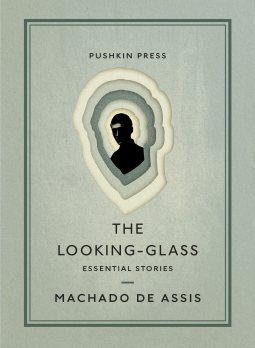
The Looking-Glass by Machado de Assis (tr. Daniel Hahn)

Thanks to the Pushkin Press Essential Stories series I’ve had the opportunity to explore the short stories of Herman Melville (a new author for me) and Fyodor Dostoevsky (an author I’d read before but only in full-length novel form). This latest collection has introduced me to another new author, the Brazilian writer Machado de Assis, who lived from 1839-1908. This book contains ten of his stories, translated from Portuguese into English by Daniel Hahn.

When trying a new author for the first time, you never really know what to expect, but since Joaquim Maria Machado de Assis (usually just referred to by his surnames) is described as one of Brazil’s greatest authors I thought he would surely be worth reading, even if the stories turned out not to be to my taste. Fortunately, I did find most of them quite enjoyable, providing lots of insights into the various sides of human nature. Although the stories were written more than a hundred years ago and on the other side of the world from me, they were still relatable because, of course, human beings aren’t really all that different, no matter where or when they lived.

The longest story in the book, which could probably be considered a novella, is The Alienist, in which Simão Bacamarte, a physician, opens an asylum in the town of Itaguaí. Bacamarte has a genuine interest in the new science of psychology and begins committing patients to the asylum so that he can study their symptoms. However, the numbers being admitted rapidly start to increase as it becomes clear that sane people are being sent there as well. Once most of the population of the town has been locked up and the others begin to rebel, Bacamarte is forced to reconsider his criteria for deciding who is sane and who is not, with surprising results!

Another story, The Stick, follows the story of Damião, a young man who escapes from a seminary and is afraid to return home because he’s convinced his father will send him back. Instead, he seeks the help of Rita, his godfather’s lover, who lets him stay in her house until the situation is resolved. Rita is a teacher of lacework and embroidery and has several young girls working for her. Damião discovers that one of them, a black slave called Lucrécia, is being badly treated and he must decide whether to intervene. I found this story interesting because Machado himself was the mixed-race grandson of freed slaves – and slavery was not abolished in Brazil until 1888.

Apart from The Canon, which describes a noun and an adjective searching for each other inside a man’s brain (too bizarre for me), I found most of the other stories intriguing in different ways. The Fortune-Teller, The Tale of the Cabriolet and Midnight Mass were some I particularly enjoyed. However, although I don’t usually include ‘trigger warnings’ in my reviews, I should mention that in The Secret Cause there are some graphic descriptions of animal cruelty which aren’t very pleasant to read!

At the end of the book, I was interested to read Daniel Hahn’s note on the translation where he explains why he deliberately tried to retain the 19th century feel of the original writing, even though this wasn’t necessarily the easiest option for a translator. I think this was the right decision – it worked for me and I found this collection a good introduction to the work of Machado de Assis.

Thanks to Pushkin Press for providing a copy of this book for review via NetGalley.
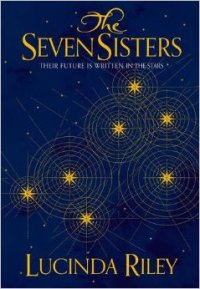
The Seven Sisters by Lucinda Riley

The Seven Sisters This is the first in a planned series of seven novels based around the legends of the Seven Sisters star constellation. Each novel follows the story of one of six sisters, all born to different parents and adopted as babies by a man the girls call ‘Pa Salt’. Pa Salt has named his adopted daughters after the stars in the constellation: Maia, Alycone (Ally), Asterope (Star), Celaeno (CeCe), Taygete (Tiggy) and Electra. There is no seventh sister, which has made me very curious about the seventh book in the series!

This first novel introduces us to Maia d’Apliese, the eldest of the six girls. Growing up on Pa Salt’s estate, Atlantis, by Lake Geneva in Switzerland, Maia and her sisters have been loved and cared for by their adoptive father and his housekeeper, Marina, but know almost nothing about their own origins. When Pa Salt dies suddenly, the sisters – all now adults with lives and careers of their own – gather at Atlantis to remember the man who had been a father to them all. To their surprise, they discover that Pa Salt has left each of them an envelope containing clues to their heritage and pointing them in the direction of their place of birth.

Maia is surprised to find that her own life began in Rio de Janeiro, and with no reason to remain in Switzerland, she sets off to Brazil to research her roots. With the help of the Brazilian novelist, Floriano Quintelas, Maia begins to uncover the story of a young woman called Izabela who lived in Rio during the 1920s and played a part in the creation of the statue of Christ the Redeemer. As she learns more about Izabela, Maia begins to gain the confidence to move on with her own life and seize her own chance of happiness before it’s too late.

The Seven Sisters is a big book with over 600 pages in the hardback edition I read, but I never felt that it was too long. I was drawn into both main characters’ stories, so I didn’t really notice the length of the book. The experiences of Maia and Izabela are very different in some ways – Maia, in 2007, has freedom and opportunites that Izabela could only dream of – but there are also some similarities between their two stories. Both women are hiding secrets, both have made mistakes and both have lost someone close to them. Of the two characters, I preferred Maia, but both storylines interested me.

I also liked the setting – or settings, as there is more than one! Some of the 1920s chapters are set in Paris where Izabela spends some time among the Bohemian artists and writers in Montparnasse, but my favourites were the sections set in Rio. I know very little about Brazil and its history, so I enjoyed going back in time and learning about the construction of Christ the Redeemer, as well as the modern day chapters in which Maia sees some of the city’s famous sights.

I really love the concept of this series; it’s ambitious and something different. After I finished the book I took the time to explore Lucinda Riley’s Seven Sisters website, where she explains some of the mythology behind the Seven Sisters, or Pleiades, constellation. I discovered that she had also woven some anagrams and mythological allusions into the story too, which I hadn’t noticed while I was reading the book but will look out for in future novels now that I’m aware of it! I’m already looking forward to the second in the series, which will be Ally’s story. Ally’s personality seems to be very different from Maia’s and I can’t wait to get to know her better.

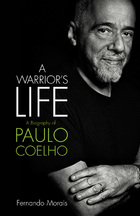
Review: A Warrior’s Life: A Biography of Paulo Coelho by Fernando Morais

Biographies are difficult to review – no matter how good the biographer’s writing might be, the success of the book really depends on how interesting the subject of the biography is. Fortunately for Fernando Morais and the reader, Paulo Coelho has evidently had a far more eventful life than the average person. The first half of the book, which dealt with Coelho’s early life, was fascinating although I found I started to lose interest nearer the end.

Paulo Coelho was born in Rio de Janeiro, Brazil, in 1947. As a teenager he was a rebel who performed badly at school and was constantly getting into trouble, insisting that all he wanted to do was read and write. His parents, not knowing what else to do with him, sent him to a psychiatric clinic where he was given electroshock therapy. Paulo later began experimenting with drugs and became involved in black magic. In 1974, he was arrested and imprisoned after being accused of subversive activities against the Brazilian government. His life reached a turning point in 1986, when he went on a pilgrimage to Santiago de Compostela, a journey that inspired one of his first major books, The Pilgrimage. Today, Coelho is one of the world’s most popular authors and has sold over 100 million copies worldwide.

Many biographers (particularly the authors of unauthorised biographies) allow their own opinions and speculations to get in the way of the facts – Fernando Morais does not do this. The book was written with the full cooperation of Paulo Coelho and Morais writes in a professional, factual style. He was given full access to Coelho’s diaries which date back to his teenage years, though he repeatedly points out that Coelho tended to fantasize in his diary entries and therefore we can’t place too much reliance on them. However, the inclusion of the diary entries, along with other fragments of Coelho’s writing, gives us a better insight into his mind.

Morais looks at every stage of Coelho’s life in so much depth it’s obvious that he spent a lot of time researching the book thoroughly. He provides a complete list of all the people he interviewed during his research including some of Paulo’s friends, family members and former girfriends. Some of Coelho’s fans may be disappointed and disillusioned as he is often portrayed in a bad light, but as the biography was published with Coelho’s blessing, he was obviously happy for us to read about the negative aspects of his character as well as the positive.

A Warrior’s Life was an interesting book to read, despite the fact that before beginning it I knew almost nothing about Paulo Coelho. I received a review copy from LibraryThing Early Reviewers and was glad to have an opportunity to read a biography I would probably never have read otherwise.

Genre: Non-Fiction (Biography)/Pages: 496/Publisher: Harper Collins/Year: 2009/Source: Received from LibraryThing Early Reviewers