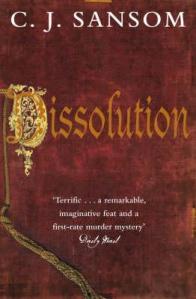
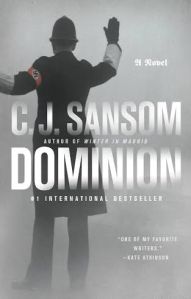
 Reading C J Sansom’s alternate history novel Dominion a few months ago reminded me that I still hadn’t read any of his Shardlake books, despite meaning to for years. I noticed last week that my library had the whole series available as ebooks, so it seemed as good a time as any to get started with the first one, Dissolution.
Dissolution is set in the winter of 1537, just after the death of Henry VIII’s third wife, Jane Seymour. Having broken away from the Catholic church and declared himself Supreme Head of the Church of England, the King, with the help of Thomas Cromwell, has begun the process of dissolution of the country’s monasteries. After the closure of some of the smaller religious houses in the north led to rebellion, Cromwell is now taking a different approach and is sending commissioners to the larger monasteries to offer pensions to the monks in the hope that they will voluntarily surrender – or if not, to search for signs of fraud, corruption or other legal reasons to close them down.
At the monastery of Scarnsea, on the coast of Sussex, disaster strikes when one of Cromwell’s commissioners, Robin Singleton, is found brutally murdered in the monastery kitchen. Cromwell sends another of his men, the lawyer Matthew Shardlake, to investigate the mystery of Singleton’s death and discover what has been happening at the monastery. Accompanied by his assistant Mark Poer, Shardlake sets out for Scarnsea but what he learns when he arrives there convinces him that the commissioner had been about to make an important discovery before he was killed.
As a murder mystery, there’s everything here that you would expect: the detective and his sidekick, the isolated house (monastery in this case) cut off from the rest of the world, the small group of suspects each with their own secrets and motives, and the usual string of clues and red herrings. But what made this book stand out for me among other historical mysteries was the fascinating setting and detailed portrayal of monastic life. There are some obvious similarities with Umberto Eco’s The Name of the Rose, although this is an easier read – and set in a completely different time period, of course.
I have read other novels that focus on the dissolution of the monasteries (books such as The Crown by Nancy Bilyeau, for example) but usually from the point of view of the monks and nuns whose way of life has been destroyed. This book is narrated by Shardlake himself and it’s interesting to see dissolution from his perspective, as a dedicated reformer. Shardlake gradually becomes disillusioned with Henry and Cromwell, but for a long time he tries to justify what they are doing and it is only towards the end of the book that he allows himself to have doubts. Something I haven’t mentioned yet is that Shardlake is a hunchback and has spent his life trying to overcome prejudice and rejection. The fact that he has had to deal with a disability in a time much more unenlightened than our own adds another dimension to his personality.
Having taken so long to get round to reading this book, I’m pleased that I did enjoy it! I correctly named the murderer quite early in the story, but while I would like to pretend that I had cleverly managed to solve the mystery I have to admit it was really just a guess. This didn’t spoil the rest of the story at all, though – I had to wait until almost the end of the book to find out if I was right and even after Singleton’s killer was eventually revealed, there were still one or two other developments that took me by surprise! I will definitely be continuing the series with the second book, Dark Fire – but probably not immediately.

 She Reads Novels