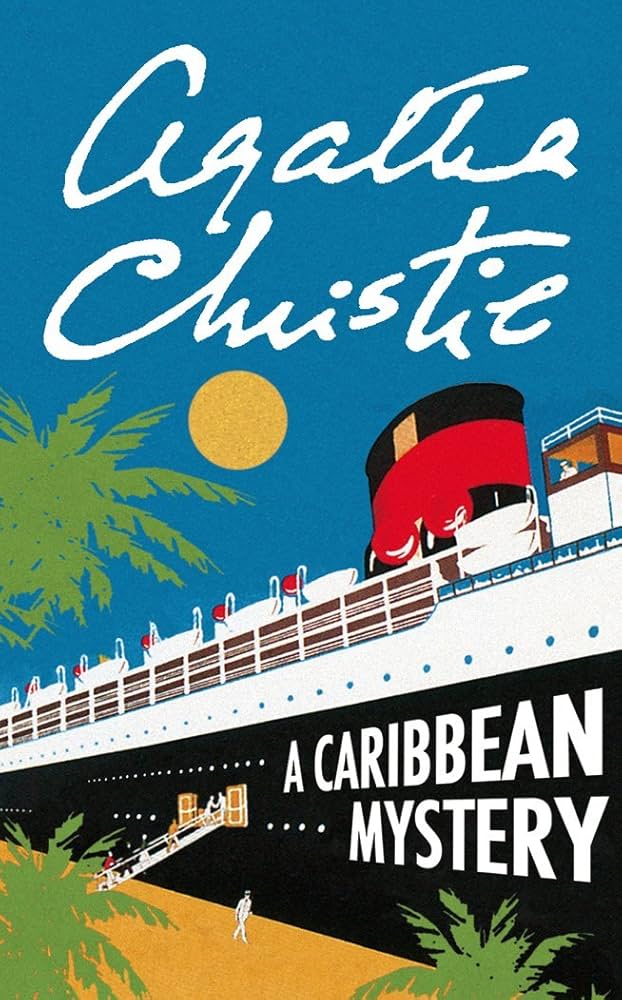
A Caribbean Mystery by Agatha Christie

This month for the Read Christie 2025 challenge, the theme is ‘amateurs’ and although I’ve read the suggested title, Crooked House, quite recently, there were some alternatives that I haven’t already read – including this one, A Caribbean Mystery. Published in 1964, it’s one of the later entries in the Miss Marple series and not one that had really appealed to me; Miss Marple belongs in St Mary Mead and it seemed incongruous to put her in a Caribbean setting! Now that I’ve read it, though, I can say that although it’s maybe not one of my absolute favourite Christie novels, I did really enjoy it.

You may be wondering why Miss Marple is in the Caribbean. Well, it seems she has been ill and her nephew Raymond has paid for her to spend some time recuperating in the sun on the island of St Honoré. Miss Marple is grateful, of course, and is enjoying the warmth and the scenery, but she’s also beginning to feel bored – every day is the same as the one before and nothing ever really seems to happen! This all changes when she falls into conversation with Major Palgrave, an elderly man staying at her hotel, who tells her a story about a man who got away with murder several times. He asks her if she wants to see a picture of a murderer but as he begins to dig out the snapshot, he suddenly stops abruptly and changes the subject as other people approach.

The next day, Major Palgrave is found dead in his room. High blood pressure is blamed, but Miss Marple is convinced he’s been murdered and that there’s some connection with the photo he was about to show her. To add to her suspicions, the photo now seems to have disappeared from the Major’s belongings. It seems likely that the murderer is one of the other guests, but which one? The most likely suspects seem to be the Dysons, Greg and Lucky, and their friends Edward and Evelyn Hillingdon, two nature loving couples who often travel together and who had been walking up the beach towards Major Palgrave as he told Miss Marple his story. But there are others who can’t be ruled out, including the Kendals, who own the hotel; Canon Prescott and his sister; and Mr Rafiel, an old man confined to a wheelchair, visiting the island with his masseur and his secretary.

I found this a very enjoyable mystery; it’s not one of Christie’s more complex plots but there’s some clever misdirection to send the reader along the wrong track. The first murder takes place early in the novel and the story continues to unfold at a steady pace after that, so it held my interest from beginning to end. Miss Marple also plays a big role, in contrast to some of the other books where we see very little of her. This time, she’s present for the entire novel, interacting with the suspects and victims and sharing her thoughts and deductions with the people she believes she can trust. As usual, people underestimate Miss Marple, dismissing her as a ‘fluffy old lady’, but in time some of them come to see that there’s far more to her than meets the eye!

Some of the characters in this book reappear or are referred to again in the later novel Nemesis, published in 1971. I read that one a few years ago, so it was nice to see how those characters were originally introduced and how Miss Marple gained her nickname ‘Nemesis’. I should probably have read the two books in the correct order as it also meant that I could quickly discount those two recurring characters as serious suspects, but it didn’t really matter. Now I’m looking forward to reading Christie’s memoir Come, Tell Me How You Live for Read Christie in July!

Book 4/20 for 20 Books of Summer 2025.
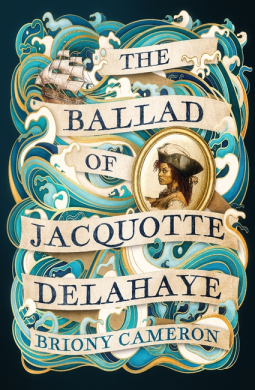
The Ballad of Jacquotte Delahaye by Briony Cameron

The Ballad of Jacquotte Delahaye is an unusual novel because it’s based on the ‘true story’ of someone who may or may not have actually existed! One of a very small number of 17th century female pirates, Jacquotte Delahaye is not mentioned in any contemporary sources and appears in writing, possibly for the first time, in the 1940s in stories by Léon Treich, a French fiction writer. However, she has become part of pirate folklore and although her existence hasn’t been proved, it hasn’t been disproved either. In this new novel, Briony Cameron has taken the few ‘facts’ about Jacquotte that have found their way into the legends – such as her place of birth and the colour of her hair (red, leading to the nickname Back from the Dead Red) – and imagined a story around them.

At the beginning of the book, twenty-year-old Jacquotte is living in the town of Yáquimo, Santo Domingo, in 1655. As the daughter of a Frenchman exiled to the Caribbean for treason, all Jacquotte knows about her mother is that she was a free black woman who died after giving birth to her younger brother. When her father is implicated in another treasonous plot, Jacquotte’s world falls apart and she is forced to flee the island. Her life of piracy begins when she is captured by the brutal Captain Blackhand and finds herself an indentured servant aboard his ship, but eventually Jacquotte will become a pirate captain in her own right, with her own ship and crew to command.

There’s also a romantic element to the novel, with Jacquotte falling in love with Teresa, wife of the Governor of Yáquimo, but this was one of my least favourite aspects of the book. They seemed to rush into things very quickly, with no time for the reader to see their feelings for each other developing and I felt that the relationship lacked emotional depth. In fact, apart from Jacquotte herself, I thought all of the characters in the book lacked depth – the good characters were very good and the bad ones were very bad, with little in between. I would describe this as much more of a plot-driven book. Although it takes a while to get started, once Jacquotte is at sea there’s lots of action, with sea battles, fight scenes and all the swashbuckling adventure you would expect from a pirate novel.

Sadly, despite the fascinating protagonist, I wasn’t very impressed with this book. I did enjoy the first section, which describes Jacquotte’s life in Yáquimo and the events that lead to her becoming a pirate, but as I read on I felt I was reading the author’s fantasy of how she would have liked 17th century society to have been, rather than how it actually was. I don’t think many people in the 1650s had such progressive ideas on race, gender and sexuality, however nice it is to imagine that they did! If you’re not too bothered about historical accuracy and just want to read an entertaining story, then you’ll probably enjoy The Ballad of Jacquotte Delahaye, but it wasn’t really for me. On a more positive note, I liked the descriptions of the various ports Jacquotte and her crew visit as they sail around Hispaniola, Jamaica and Tortuga, which is the closest I’ll get to visiting the Caribbean this summer!

Thanks to Piatkus for providing a copy of this book for review via NetGalley.

Book 20/50 for the Historical Fiction Reading Challenge 2024

This is book 2/20 of my 20 Books of Summer 2024.

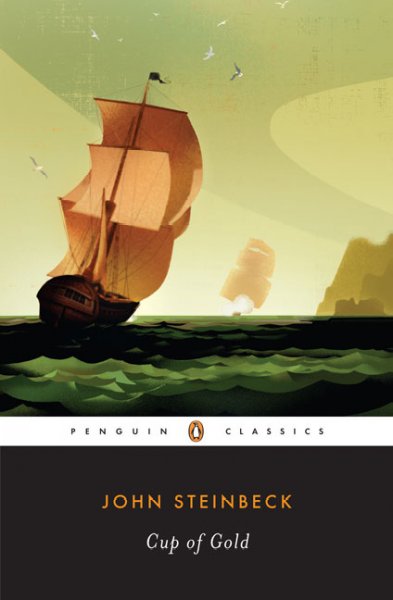
Cup of Gold by John Steinbeck – #1929Club

It’s always interesting, when an author has become famous for books written later in their career, to go back to the very beginning and read their earliest work. Cup of Gold, John Steinbeck’s first novel, was published in 1929 and is my second choice for this week’s 1929 Club hosted by Simon and Karen.

I’ve previously only read two of Steinbeck’s books (East of Eden and The Pearl) and hadn’t even heard of this one until I started to look at options for 1929 Club. I was intrigued because it sounded so completely different from his other books – not the sort of plot or genre I would have associated with Steinbeck at all. It’s also a short novel (just over 200 pages) so I could easily fit it into my busy October reading schedule!

Cup of Gold opens in 17th century Wales where a fifteen-year-old boy, Henry Morgan, lives on a farm with his parents and his grandmother, Gwenliana, who claims to have second sight. Growing up in a remote part of the Welsh countryside, Henry is growing restless to leave home and see more of the world. When Dafydd, an old farmhand who left many years earlier to go to sea, returns to the farm to tell the family of his adventures, Henry becomes determined to do the same. His mother, who still considers him a child, tells him not to be ridiculous, but his father accepts that this is something his son must do and sends him off with his blessing.

Before leaving, Henry consults the wise, white-bearded poet known as Merlin, who lives alone with his red-eared dog in the hills above the Morgans’ valley. Merlin makes the following observation, words Henry will remember for the rest of his life:

“You are a little boy. You want the moon to drink from as a golden cup; and so, it is very likely that you will become a great man – if only you remain a little child. All the world’s great have been little boys who wanted the moon; running and climbing, they sometimes caught a firefly. But if one grow to a man’s mind, that mind must see that it cannot have the moon and would not want it if it could – and so, it catches no fireflies.”

Arriving in Cardiff – the first time he has seen a large town – Henry secures passage on a ship to Barbados, where he finds himself indentured to a plantation owner. This is not what Henry had been hoping for, but he knows it will only be for a few years and then he’ll be free again to achieve his dream of becoming a buccaneer and making his fortune.

If the name Henry Morgan is familiar to you, then you’ve probably already guessed that this is the story of the notorious pirate of the Caribbean, a real historical figure (and the inspiration for Captain Morgan rum). In fact, the full title of the novel is Cup of Gold: A Life of Sir Henry Morgan, Buccaneer, with Occasional Reference to History. ‘Occasional reference’ is not an exaggeration because it seems that very little of Steinbeck’s account has anything to do with historical fact – although, to be fair, there are lots of gaps in our knowledge of Morgan’s early life and career so plenty of scope for an author to use their imagination. It’s unclear whether I should even be referring to Morgan as a pirate; many sources describe him as a privateer, although the only difference I can see is that one is declared ‘legal’ by the government who stands to gain from their raiding and pillaging and the other isn’t.

The ’cup of gold’ of the title, which Merlin compares to reaching for the moon, refers to two things – Panama, which Henry sees as the ultimate prize just waiting to be captured from the Spanish, and a beautiful woman known as La Santa Roja (the Red Saint). Henry’s yearning for both of these is what drives him – and the narrative – forward. Yet I found this book to be neither the swashbuckling adventure novel nor the romance I’ve seen it described as and it’s certainly not as much fun as Georgette Heyer’s Beauvallet or Rafael Sabatini’s Captain Blood. It’s a more serious novel than either of those and never loses sight of its central themes: the quest for happiness and the question of whether we can ever be truly content with what we have or will go on searching for something that’s always out of reach. However, I discovered that I didn’t really care about Henry’s happiness as I found it so difficult to relate to somebody who deliberately set out on a life of piracy and committed so many terrible acts! That was a bit of a problem with so much of the story told from Henry’s perspective.

This is a beautifully written novel, though, and the sections set in Wales – or Cambria, as Steinbeck usually calls it – feel mystical and dreamlike. The inclusion of Merlin in the plot is intriguing: are we supposed to believe that he is really the legendary magician, alive in the 17th century, or is he just an eccentric old man who believes he is Merlin? Either way, Arthurian legend is obviously something that interested Steinbeck and he would later go on to write The Acts of King Arthur and His Noble Knights, which was posthumously published in 1976.

I wouldn’t describe this as a must-read classic, but it’s worth reading if the subject or setting appeal or if you’re interested in experiencing the work of a famous author at the very start of his career.

I’m also counting this as book #57 for the Historical Fiction Reading Challenge 2022.