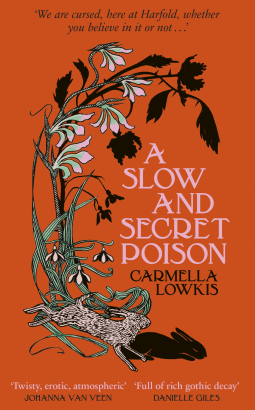
 It’s 1925 and Vee Morgan is on her way to Harfold Manor in Wiltshire to take up the position of gardener. She knows she’s lucky to get the job; although she loves being outdoors and was a Land Girl on a farm during the war, she has no horticultural qualifications and no references, not to mention that women gardeners are not at all common and not exactly in high demand. After arriving at her new workplace, however, she learns that none of the local men wanted the job and are reluctant to come anywhere near Harfold Manor and its strange inhabitant, Lady Arabella Lascy.
Arabella, alone in the world apart from her estate manager and cousin, Maurice Reacher, believes she and her family have been cursed. First her parents died, then all four of her brothers, each within three years of the one before, leaving only Arabella to inherit the family estate. Now another three years have passed and Arabella is convinced that she will be the next victim. But are the Lascys really under a curse or is there a more human explanation for what has been happening?
A Slow and Secret Poison is the second novel by Carmella Lowkis; I had mixed feelings about her first, Spitting Gold, a retelling of a Charles Perrault fairy tale, but I found this one more enjoyable. Vee interested me from the beginning – she’s a very flawed heroine, as we discover as the story unfolds and secrets from her past come to light – but I liked her as a character and I thought her practical, no-nonsense personality provided a good counterpart to the reclusive, fanciful Arabella. I was intrigued to learn from the author’s note at the end of the book that the character of Arabella was inspired by Stephen Tennant, one of the Bright Young Things of the 1920s.
The book has a lot of Gothic elements: the crumbling old house and its eccentric owner, the supposed Lascy family curse, sightings of a mythical hare and, of course, the poisonings hinted at in the title. I was reminded very much of Laura Purcell’s books, although this one isn’t as dark as those. I did find some of the secrets and twists quite easy to predict and some parts of the plot felt a little bit implausible (particularly regarding property ownership, which becomes an important part of the story later on), but otherwise it was a quick, entertaining read.
Thanks to Doubleday for providing a copy of this book for review via NetGalley.


 She Reads Novels