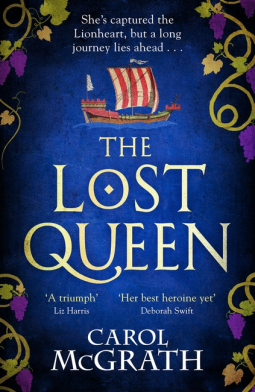
The Lost Queen by Carol McGrath

Berengaria of Navarre is one of the Queens of England I know least about and I’m sure I’m not alone in that as so little has been written about her. I’ve read novels in which she appears briefly as a secondary character, but with the exception of Martha Rofheart’s Lionheart, nothing where she takes a more central role. In The Lost Queen, Carol McGrath builds Berengaria’s story around the small amount of factual information we have about her, taking us through the early days of her marriage to King Richard I and her time spent in the Holy Land, where she accompanied Richard on the Third Crusade.

Like the other McGrath books I’ve read, there’s also a fictional heroine whose story takes place alongside the real historical one. In this case, it’s Lady Avelina of Middleton, whose husband William has disappeared after leaving for Outremer three years earlier to claim his father’s estate. William’s half-brother, Walter, is insisting that William must have become caught up in the Crusades and killed in battle, but Avelina suspects that Walter simply has his eye on herself and Middleton. Avelina is determined to prove that her husband is still alive and sets off to look for him, attaching herself to a party of nuns who are travelling to Jerusalem in search of a religious relic to bring back to their abbey.

During the journey, Avelina’s path crosses with Berengaria’s, who is on her way to her wedding with Richard. Richard’s mother, Eleanor of Aquitaine, escorts Berengaria as far as Sicily, then Eleanor’s daughter Joanna accompanies her from there to Cyprus and then the Holy Land. Avelina and the nuns join them along the way and a friendship forms between Avelina and the new queen.

Berengaria is known as the only English queen never to visit England (although it’s now thought that she may have done after Richard’s death). This means that, apart from a few chapters involving Avelina, most of the novel is set elsewhere in Europe and the Middle East. I particularly enjoyed the descriptions of all the adventures the characters have on the journey: crossing the Alps in the middle of winter; surviving assassination attempts; being shipwrecked off the coast of Cyprus and held prisoner.

As I know so little about Berengaria I can’t really comment on the accuracy of the novel. McGrath does include an author’s note, in which she explains some of her decisions and how she worked with the available information to create the story. We do know that Berengaria never had children, for example, but McGrath suggests that she may have been pregnant with Richard’s child and had a miscarriage. The Avelina chapters of the book obviously allow for a lot more invention and imagination and there are also a few sections here and there narrated by other characters such as Blondel, the troubadour, or Ursula, one of Berengaria’s ladies. I can understand why these perspectives were included, as they fill in some of the gaps, showing us things that Berengaria and Avelina don’t witness for themselves, but I didn’t feel they really added much to the story and we don’t spend enough time with these characters to form any kind of emotional connection.

The book ends before the death of Richard I and I was sorry that we didn’t continue with Berengaria’s later years as it would have been interesting to see how she dealt with being a widow and queen dowager. However, even less is known about that period of Berengaria’s life, so maybe it was the right decision for the book to end when it did. I’ll be looking out for news on which historical figure Carol McGrath is writing about next!

Thanks to Headline Accent for providing a copy of this book for review via NetGalley.

Book 48/50 for the Historical Fiction Reading Challenge 2024
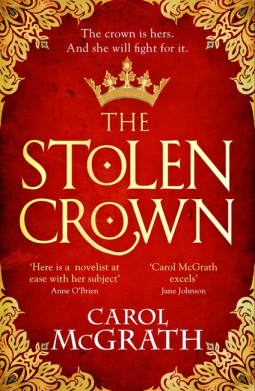
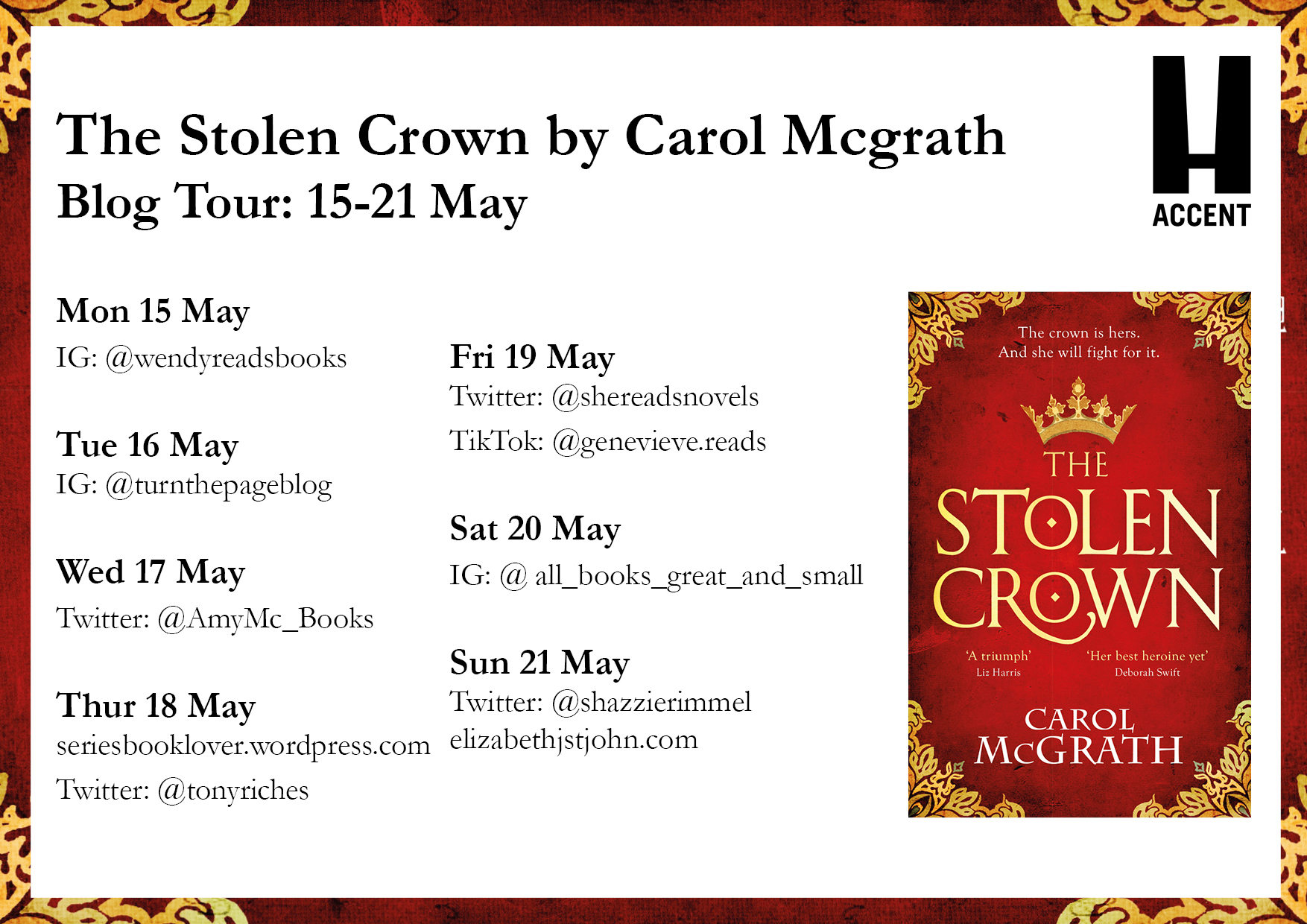
The Stolen Crown by Carol McGrath

When Henry I of England dies in 1135 leaving no legitimate male children, he names his daughter, Maud, as heir to the throne. Through her marriage to the late Holy Roman Emperor, the Empress Maud, as she still calls herself, is used to wielding power, yet she is unable to gain the support of the nobility and clergy of England and the throne is taken instead by her cousin, Stephen of Blois. Maud, however, refuses to give up her claim and so a battle begins between the cousins that will become known as ‘the Anarchy’ – a period of civil war lasting for almost two decades.

Carol McGrath’s new novel, The Stolen Crown, tells Maud’s story, exploring her marriage to Geoffrey of Anjou, the years of conflict with Stephen and her relationships with her half-brother Robert of Gloucester and with Brien FitzCount, her most loyal supporter. Although Maud (sometimes known as Matilda) was never actually crowned Queen of England and was referred to instead as ‘Lady of the English’, she left an important legacy as the eldest of her three sons with Geoffrey would go on to become Henry II, the first of the great House of Plantagenet.

The novel is written largely from Maud’s own perspective and she is portrayed as a strong, courageous and determined woman, but also one who makes mistakes, ignores advice and acts impulsively at times – in other words, a believable human being who comes to life on the page. We follow Maud throughout her adult life, beginning with her marriage to Geoffrey, a husband she didn’t choose and didn’t want, but with whom she eventually settles down to start a family in Anjou. When Stephen seizes the throne, Maud leaves her husband and children behind to travel to England and fight for what she believes is rightfully hers. Some sections of the book are also written from the point of view of Maud’s illegitimate half-brother Robert, which was a good decision as it allows us to see Maud through the eyes of someone else close to her, as well as filling in the gaps when Maud is not directly involved in the action. I’ve always liked Robert when I’ve come across him in historical fiction and it’s interesting to think of the sort of king he would have made had he been a legitimate heir.

I knew from the other Carol McGrath books I’ve read (The Silken Rose, The Damask Rose and The Stone Rose, a trilogy of novels about three queens who were labelled ‘she-wolves’) that she also likes to include fictional characters in her stories. In this book, we meet Alice, a young woman from a family of entertainers – musicians, jugglers and puppeteers. Alice has a storyline of her own, including a romance with a young knight, Sir Jacques, but she also fits seamlessly into Maud’s story, spying and carrying messages between the Empress and Brien FitzCount. Although I found Maud much more interesting to read about, Alice’s inclusion in the book gives us an insight into medieval life away from the royal courts.

The Anarchy is a fascinating part of English history, often overshadowed by later conflicts such as the Civil War and the Wars of the Roses, so I’m pleased that McGrath has chosen to give some attention to this period and to Maud. I’m looking forward to seeing who and what she writes about next.

Thanks to Headline for providing a copy of this book for review via NetGalley.

This is book 19/50 read for the 2023 Historical Fiction Reading Challenge.

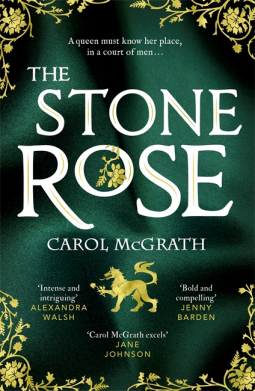
The Stone Rose by Carol McGrath

The Stone Rose is the final book in Carol McGrath’s She-Wolves Trilogy, but don’t worry if you haven’t read the first two – each one stands alone and tells the story (in fictional form) of a different medieval queen of England. In The Silken Rose we met Eleanor of Provence and in The Damask Rose Eleanor of Castile; now, in this latest novel, it’s the turn of Isabella of France. Isabella was the daughter of Philip IV of France and the wife of Edward II of England, but also a powerful and influential woman in her own right. The Stone Rose explores Isabella’s story both from her own perspective and through the eyes of Agnes, a female stonemason who designs Isabella’s tomb.

Isabella is only fifteen years old when the novel opens in 1311, and much as she tries to love her husband – at least at first – she is already becoming aware that Edward is perhaps not the best person to be ruling the country. He is too easily led by his favourites, particularly the handsome young Piers Gaveston, ignoring the advice of older, more experienced noblemen, and spends his time thatching roofs and digging ditches like a peasant rather than taking part in more courtly pursuits. Worse, he seems determined to send England into a series of battles with the Scots that nobody really has the heart for.

As the years go by, the pleasant and relatively harmless Piers is replaced by a new favourite, the scheming, ambitious Hugh Despenser the Younger, and Isabella begins to fear for her own position, especially when she starts to suspect that Edward loves Despenser more than he loves her. As tensions grow at court and across England, Isabella returns to France to visit her family – and here she meets Roger Mortimer, an English baron who has recently escaped from imprisonment in the Tower of London and shares her hatred of Hugh Despenser.

I won’t say much more about the plot, as if you’re familiar with the history you’ll already know what Isabella does next – and if you’re not, you’ll probably prefer to find out for yourself when you read the book. As far as I could tell, Carol McGrath sticks quite closely to the known facts, except where it’s necessary to use her imagination to help bring the characters to life and fill in gaps in the story or where there is some historical controversy, for example regarding the eventual fate of Edward II.

Despite Isabella’s “she-wolf” nickname (one which has also been applied to several other unpopular queens) I found her a sympathetic character here. It was sad to see her marriage gradually disintegrate as Edward spends more and more time with his favourites, falling completely under their power and refusing to listen to other points of view. I also found it interesting to read about Isabella’s interactions with the other women at court, particularly the three de Clare sisters, one of whom – Eleanor – is the wife of Hugh Despenser. Because of Isabella’s conflict with Eleanor’s husband, the two women can never be friends, but they are forced to spend long periods of time together over the years and their relationship, as you can imagine, is a very uncomfortable one.

The previous two books in this trilogy have each included a second protagonist, whose story unfolds alongside the queen’s and is given almost equal attention. In this third novel, that role falls to Agnes, the stonemason – a real historical figure who really did work on Isabella’s tomb. I was slightly disappointed that we don’t see very much of Agnes; there are only a few sections written from her point of view, with the focus very much on Isabella’s story. I understand, though, that Agnes only entered Isabella’s life in the 1350s and played no part in what came before, so maybe it would have been difficult to weave the two narratives together more closely. Still, The Stone Rose is a fascinating read and I enjoyed adding to my knowledge of Isabella, Edward II and Roger Mortimer. Now that the trilogy has come to an end I will have to try Carol McGrath’s earlier novels, while I’m waiting to see what she writes next!

Thanks to Headline for providing a copy of this book for review via NetGalley.

This post is part of the blog tour for The Stone Rose – you can see details of the other stops on the tour in the image below.

This is book 16/50 read for the Historical Fiction Reading Challenge 2022.

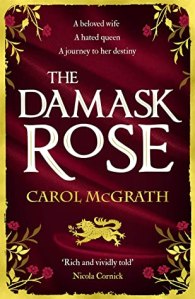
The Damask Rose by Carol McGrath

This is the second book in Carol McGrath’s She-Wolves trilogy, telling the story of three medieval queens of England who have all been given the label ‘she-wolf’ at various times. I enjoyed the first novel, The Silken Rose, about Henry III’s wife, Eleanor of Provence, so I was looking forward to this one, which moves on to Eleanor of Castile, the first wife of Edward I.

I’ve read other books set during Edward I’s reign, so presumably I’ve come across Eleanor of Castile before, but I mustn’t have been paying attention as I couldn’t have told you much about her before reading The Damask Rose (except that she was commemorated by the Eleanor Crosses which were erected in several English towns in her memory). It’s always good when you can learn something new from historical fiction and in this case, almost the entire story was new to me.

The novel begins in 1264 when Henry III is still alive and on the throne of England, but only just – he and his son, Prince Edward, have been captured by the forces of Simon de Montfort at the Battle of Lewes. Edward’s wife, Lady Eleanor, is at Windsor Castle awaiting news of her husband when Gilbert de Clare, one of de Montfort’s supporters, arrives and forces her to relinquish the castle. This traumatic incident instils in Eleanor a lifelong hatred of de Clare as well as a determination that she will never put herself in such a vulnerable position again. Once the threat of Simon de Montfort has been removed at the Battle of Evesham, Edward and Eleanor travel to the Holy Land on crusade. It is during this journey that they learn of the death of Henry III and return to England to take their place as king and queen.

I enjoyed learning more about Eleanor, but although I don’t think she deserved to be described as a ‘she-wolf’ (the term seems to have mainly referred to her unpopular methods of acquiring land and properties, which were seen as greedy and ruthless), she’s not a character I liked or managed to warm to either. It seems that the real Eleanor was also accused of being ‘unmaternal’, which McGrath suggests could be due to the fact that she lost so many children she was afraid to get too close to the ones who survived, but it still irritated me that Eleanor complained constantly about her children’s relationships with other adults while at the same time saying she was far too busy to spend time with them herself.

Part of the novel is written from the perspective of Olwen, a herbalist whom Eleanor introduces into the royal household to provide advice on plants and healing. Olwen is a fictional character but her story complements Eleanor’s very well; in fact, I think I preferred her sections of the book as I found her much easier to like and I enjoyed the different point of view she brings to the novel. I cared about Olwen and wanted her to be happy, whereas I felt that some parts of Eleanor’s story, particularly towards the end, became too factual, too concerned with just describing things that had happened rather than providing any real emotional depth.

The third book in the series is going to be about Isabella of France; I am much more familiar with Isabella than with the previous two queens and I think she will be a fascinating subject to bring the trilogy to an end!

Thanks to Headline for providing a copy of this book for review via NetGalley.

Book 18/50 read for the 2021 Historical Fiction Reading Challenge.

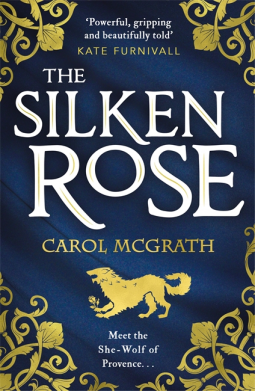
The Silken Rose by Carol McGrath

The Silken Rose is the first in a new trilogy of novels telling the stories of three medieval queens who have been referred to at one time or another as ‘she-wolves’ because of their unpopularity or because they managed to wield power or influence in a period dominated by men. The second and third books in the series are going to focus on Eleanor of Castile and Isabella of France, but this first novel is about Eleanor of Provence. Carol McGrath uses the alternative spelling of Ailenor, so I will do the same throughout the rest of this post.

Ailenor of Provence is not a queen I’ve ever read much about; I think it’s safe to say that she and her husband, King Henry III of England, are not the most popular subjects for historical fiction! They appear in Sharon Penman’s Falls the Shadow, but otherwise I’m struggling to think of other books I’ve read about them and that’s a good thing because it means that the story which unfolds in The Silken Rose feels fresh and different. It begins in 1236 with Ailenor, at the age of only thirteen, arriving in England from France for her wedding to Henry, a man more than twice her age. Although her new husband treats her with kindness and their marriage is not an unhappy one, Ailenor finds it difficult adjusting to life in a strange country and values the friendships she forms with two very different women.

One of these women is Henry’s sister, Eleanor, known as Nell, who has taken a vow of chastity after being widowed. Ailenor quickly discovers that Nell is in love with Simon de Montfort, one of the most powerful noblemen at Henry’s court, and she decides to help her sister-in-law break free from her oath and marry Simon. However, this marriage will eventually have serious repercussions for Henry and for England. The other friend Ailenor makes is Rosalind, a talented embroideress who is brought to court to teach Ailenor and her ladies to embroider intricate new patterns. Unlike most of the other characters in the novel, Rosalind is a fictional character, but she plays an important part in the story, providing a link between the nobility and the merchant classes.

Although Ailenor is the main focus of the novel, there are some sections written from Rosalind’s perspective (and occasionally from Nell’s), which helps to build up a full picture of the events that take place during this period, rather than only being limited to things that Ailenor experiences herself. The story Carol McGrath builds around Rosalind feels believable and fits seamlessly into Ailenor’s story – but despite this, I didn’t find her as interesting or engaging to read about as Ailenor and although I did understand the reasons for her inclusion in the book, I would have preferred it if the novel had stuck solely to the real historical characters. Apart from that, I really enjoyed The Silken Rose; there’s not a huge amount of drama, but I was never bored.

You may be wondering why Ailenor has been described as a ‘she-wolf’; well, it seems that this was partly due to the fact that she brought a large number of her relatives to England with her, where they were given positions of power and were able to influence the king. These included several of her uncles (the ‘Savoyards’), one of whom was made Archbishop of Canterbury, and her sister, Sanchia, who married the king’s younger brother. This and some of the other reasons for Ailenor’s unpopularity are explored in the novel, yet she remains a sympathetic character and one I very much enjoyed getting to know. I am looking forward to reading the other two books in the trilogy.

Thanks to Headline for providing a copy of this book for review via NetGalley.

This is book 3/20 from my 20 Books of Summer list.