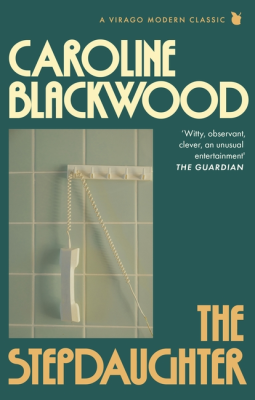
 I’ve never read anything by Caroline Blackwood, but decided to try this book as I was intrigued by the comparisons to authors like Shirley Jackson and Patricia Highsmith. Although she wrote several novels, short story collections and works of non-fiction, Blackwood, who was a Guinness heiress, seems to have been better known as a socialite and muse (she inspired the art of Lucian Freud and the poetry of Robert Lowell, two of her three husbands). She really deserves to be known for her own work as well as her influence on other people’s and I’m glad to see that some of her books, including this one, have been reissued recently.
The Stepdaughter was first published in 1976 and is novella length, which is a perfect way to try out a new author without having to commit to something longer. The book is narrated by a woman referred to only as J, and takes the form of letters she is ‘writing’ in her mind to an imaginary friend. J has been deserted by Arnold, her husband, who has gone to live in Paris with his French girlfriend, leaving her behind in an expensive Manhattan apartment with their four-year-old daughter and an au pair, whom she dislikes. There’s also a fourth member of the household – Renata, her husband’s teenage daughter from a previous marriage. It seems clear to J that Arnold will only allow her to go on living in the apartment if she continues to look after Renata. The only problem is, she hates the girl, resents her presence and can’t even bear to look at her.
The narrator’s attitude towards Renata is horrible. It’s obvious to the reader that Renata, who is still just a child, is desperately unhappy and in need of love and affection. However, this doesn’t seem to occur to J (or maybe it does, but she doesn’t care). She sees her stepdaughter as someone to be despised – an awkward, overweight, unattractive girl whose only interests are baking and eating cakes and sitting in her bedroom watching television. J uses her imaginary letters as an outlet to express her feelings about Renata and as the book progresses she becomes more and more fixated on her hatred of the girl, blaming her for everything that’s wrong in her life.
The situation in the apartment sounds unbearable, for J but particularly for poor Renata, so it’s not surprising that eventually things do inevitably reach a turning point. It’s not a happy ending and not what I would have preferred, but at least J manages to redeem herself a tiny bit, gaining a deeper understanding of both herself and Renata and regretting that things have happened the way they have. Although J’s sheer nastiness and cruelty make this book an uncomfortable and unsettling read, it’s also a very compelling one. It wouldn’t feel right to say that I ‘enjoyed’ it, but I was gripped by it and read it in one day. It would be a good choice for Novellas in November, if anyone is planning that far ahead!
Thanks to Virago for providing a copy of this book for review via NetGalley.

Book 2/20 for 20 Books of Summer 2025.
 She Reads Novels