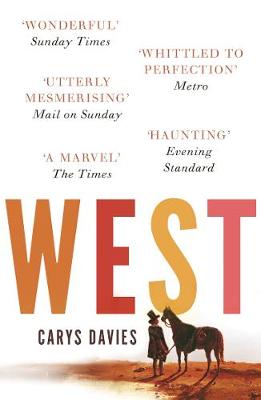
 This month Karen of Booker Talk and Kathryn of Nut Press are hosting Reading Wales, celebrating the work of Welsh authors. I have chosen a book by Carys Davies, an author born in Llangollen, North Wales. Last year I read and enjoyed her most recent book, Clear, which is set in Scotland during the Highland Clearances. West, published in 2018, was her first novel and the setting and subject matter are very different, but the two books do share some similar themes.
West is set in America in the early 19th century, a few years after the famous Lewis and Clark Expedition, and revolves around Cy Bellman, a widowed mule breeder who lives in Pennsylvania with his ten-year-old daughter, Bess. Inspired by stories of the expedition and by an article he reads in the newspaper describing the discovery of huge animal bones found in a Kentucky swamp, Cy decides to set out on a journey west to find the giant animals he believes must still be roaming in the wild. Everyone else thinks he’s a fool, including his sister Julie, but Cy is determined to prove them all wrong.
As well as following Cy Bellman’s journey into the wilderness, Davies explores the effects his departure has on Bess, left behind on the mule farm with Aunt Julie as her father rides off into uncharted territories. He tells her he’ll back in a year, or maybe two, but that’s a very long time for a ten-year-old girl and she thinks about her father daily. Unlike the others, Bess doesn’t think he’s being foolish – she’s proud of him and thinks of him as a brave, noble figure. She has no doubt that he’ll find the animals he’s searching for and will return safe and well. Her own wellbeing, however, is a different matter, as in Bellman’s absence, their scheming neighbour Elmer Jackson has set his sights on the farm and the women who live there.
Davies writes from the perspectives of both Cy and Bess, with occasional sections from other characters’ points of view. The passages describing the landscape Cy passes through as he travels west are vivid and feel authentic, stressing the vastness of the land, the harshness of the winters and the sense of isolation as he moves further away from civilization. Along the way he acquires a guide, a Shawnee boy with the unflattering name of Old Woman from a Distance, who helps him hunt for food and navigate dangerous river crossings in return for gifts of ribbons, beads and other small items. Cy’s attitude towards his guide is as you would expect, given the time period, and now and then we also get a glimpse of the guide’s thoughts about Cy. The fact that neither speaks the other’s language adds another obstacle to their relationship and despite spending so much time in each other’s company, neither makes the attempt to learn. Instead, they communicate through looks and gestures and through showing emotion. This idea of communication without a common language is explored in more depth in Davies’ later book, Clear.
West is novella-length, which makes it a quick read, but it’s also a powerful, gripping story and I don’t think it needed to be any longer. I’m looking forward to reading Davies’ other novel, The Mission House, and her two short story collections.


 She Reads Novels