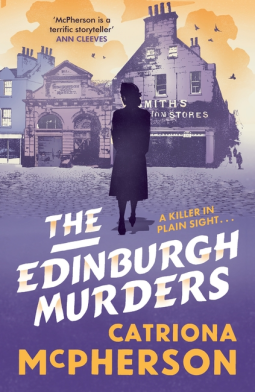
The Edinburgh Murders by Catriona McPherson

This is the second book in Catriona McPherson’s new mystery series set in 1940s Edinburgh, but if you haven’t read the first one (In Place of Fear) it shouldn’t be a problem as both books also work as standalone novels. Those of you who have read In Place of Fear will remember that it introduced us to Helen Crowther, a welfare officer (formally a ‘medical almoner’) in the newly formed National Health Service. This second novel again follows Helen as she carries out her duties for the NHS and becomes embroiled in another mystery.

The novel opens with Helen taking a patient to the public bath house on Caledonian Crescent. As she helps the woman to wash herself, they become aware of a disturbance in one of the men’s cubicles. A man has been found boiled to death in a bath of scalding hot water – but how? Why would he continue to lie there as the water got hotter and hotter? And how could it have reached such a high temperature anyway? Even more worrying for Helen is the fact that she has spotted her father, Mack, at the baths, but when she speaks to him at home later, he tries to deny that he was there. As the bodies of more men are found around Edinburgh, all killed in equally unusual, gruesome ways, Helen becomes convinced that her father knows more about the deaths than he’s admitting to.

When I reviewed In Place of Fear, I mentioned that the mystery only formed a small part of the book, with more focus being on the historical element and the work of an almoner in the NHS. This book is the opposite – the mystery is much stronger, with the first murder discovered in the opening chapter and several more following soon after. The murders are carried out using imaginative methods and are obviously linked in some way, so Helen needs to decide exactly what the link is in order to identify the killer. It’s quite a dark book, but although the descriptions of the murders are unpleasant, they’re not too gory or graphic.

As with the first novel, there’s a great sense of time and place, bringing the atmosphere of Edinburgh’s Fountainbridge area to life. McPherson uses a lot of dialect and there’s a glossary at the front for those readers who need help with the Scottish words and phrases. I found that there was less time spent describing Helen’s welfare work, though, which was one of the things I thought was particularly interesting in the first novel. Still, I enjoyed meeting her again, as well as the other recurring characters such as the two doctors she works for and her younger sister, known as Teenie. There’s also the beginnings of a possible romance for Helen with her friend Billy, who works at the morgue and helps her investigate the mystery and I’ll look forward to seeing how this develops in the next book.

I still haven’t read any of Catriona McPherson’s other novels, although she seems to have written a lot of them! I should probably investigate while I’m waiting for a third Helen Crowther book.

Thanks to Hodder & Stoughton for providing a copy of this book for review via NetGalley.
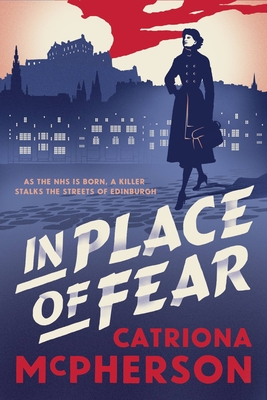
In Place of Fear by Catriona McPherson

Catriona McPherson is an author I’ve wanted to try for a while; I keep seeing her books on other blogs I follow and they always sound interesting. Her latest novel, In Place of Fear, turned out to be a good one for me to start with; it’s a fascinating historical mystery set in Edinburgh just after World War II.

It’s 1948 and Helen Crowther is about to start a new job as medical almoner for the newly formed National Health Service. Working alongside two doctors, Dr Deuchar and Dr Strasser, Helen will be making home visits to patients, giving them advice and ensuring that they get the help they need – a role similar to a modern-day social worker. She’s looking forward to the new job, but at the same time she knows there are going to be difficulties: first of all, she will have to convince the disbelieving public that healthcare under the new NHS really is free and they no longer need to worry about paying for their treatment; she also has to contend with the disapproval of her mother, who wishes she would get a job in a factory like other working class women. It comes as a relief when Dr Strasser offers Helen the upstairs flat in an empty building he owns, so that she and her husband, Sandy, can move out of her parents’ overcrowded house at last.

Helen’s marriage has not been a particularly happy one so far; Sandy has spent several years in a POW camp and since returning to Scotland has been struggling to cope with married life. Helen hopes the situation will improve now that they can be alone together, but just as she and Sandy are beginning to settle into their new home, she discovers the body of a young woman in the air raid shelter in the garden! The doctor is summoned and after examining the body he decides that it was suicide, but Helen is not convinced. Who is this young woman and how did she die? Helen is determined to find out, even though everyone else seems equally determined to cover up what has happened.

The mystery aspect of this novel takes a while to get started and never really becomes the main focus of the book until near the end when Helen begins to uncover some secrets that have remained hidden for several years. However, I thought it was a very intriguing mystery and although I had my suspicions as to who the culprit might be, I was unable to guess the other parts of the solution. Looking at other reviews of the book, it seems that a lot of readers were disappointed that the crime element wasn’t stronger but this didn’t really bother me as I was finding it so interesting to read about life in 1940s Edinburgh and the beginnings of the NHS. There’s also a heavy use of Scottish dialect which I suppose people will either like or they won’t, but I thought it added to the strong sense of time and place and I found it easy enough to follow what was being said.

A lot of time is spent on Helen’s visits to people in the community, particularly young mothers and those who are hoping to become mothers, so that she can advise them on diet and hygiene and make sure they are receiving the medical care they’re entitled to. I wasn’t familiar with the role of medical almoners before reading this book, so I found it fascinating to learn about what the job involved. Before 1948, the almoner would assess patients to decide how much they could afford to pay, but with the birth of a health service that was ‘free at the point of use’ this became unnecessary and the almoner could devote more time to actually helping the patients with their medical and welfare needs. However, Helen sometimes goes above and beyond what is required and sometimes she makes mistakes or is seen as interfering in things that are none of her business. It was watching her going about her daily work and trying to decide how to handle each difficult situation that I found particularly enjoyable, so it didn’t matter to me that the mystery was so slow to develop.

I would like to try more of Catriona McPherson’s books. If you’ve read any of them, please let me know which one I should read next!

Thanks to Hodder & Stoughton for providing a copy of this book for review via NetGalley.

This is book 24/50 read for the Historical Fiction Reading Challenge 2022.