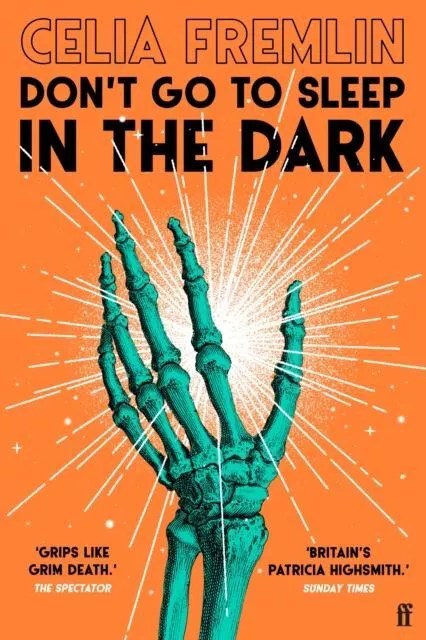
Don’t Go to Sleep in the Dark by Celia Fremlin – #1970Club

Today is the first day of 1970 Club, hosted by Kaggsy’s Bookish Ramblings and Stuck in a Book, and I’ve decided to begin with a book by an author who is rapidly becoming a favourite. I’ve read two of Celia Fremlin’s novels, Uncle Paul and The Long Shadow, and loved both, so I was curious to see what I would think of her short stories. Don’t Go to Sleep in the Dark is a collection first published by Gollancz in 1970 (although some websites say 1972, most say 1970 as do the copyright page and preface of the edition I read) and contains thirteen stories. While some are stronger than others, I can honestly say that they are all excellent.

The stories in this collection all have domestic settings, dealing with topics such as marriage, adultery, motherhood, and ageing, and all of them rely on the power of imagination to create a sense of unease. Although some of the stories hint at the supernatural, they are still grounded in reality. Fremlin has a real talent for taking ordinary, everyday situations and using them to build tension and fear.

The book gets off to a great start with The Quiet Game, the story of Hilda Meredith, a woman living in a flat in a high tower block who is struggling to keep her two young children quiet. Faced with constant complaints from the neighbours who claim they can hear every sound the children make – every shout, every laugh, every footstep – Hilda’s mental health begins to suffer as she desperately searches for games that can be played in silence:

From the point of view of the neighbours, it was she who was the cause and origin of all the stresses. She wasn’t the one who was being driven mad, Oh no. That’s what they would all have told you.

But madness has a rhythm of its own up there so near to the clouds; a rhythm that at first you would not recognise, so near is it, in the beginning, to the rhythms of ordinary, cheerful life.

I won’t tell you what happens to Hilda, but this story sets the tone for the rest of the book. Although the thirteen stories are all different and memorable in their own ways, they could all be described as psychological suspense, taking us deep inside the characters’ minds. At the same time, they have perfectly crafted plots, often with a surprise twist in the final paragraph that changes the way we think about everything that came before.

One of my favourite stories was The Baby-Sitter, in which a mother is persuaded to leave her young daughter with a babysitter for the first time so that she and her husband can spend the evening at the theatre. However, she’s not convinced that the tall, stern-looking Mrs Hahn is the right person to be left in charge of little Sally, who has been having nightmares about a ‘Hen with Great Big Eyes’. Her misgivings about Mrs Hahn grow stronger throughout the evening, but is she worrying about nothing? Yet another parent/child story – and another highlight – is Angel-Face, where a woman becomes exasperated by her stepson’s insistence that he is being visited by an angel every night. Things take a more sinister turn when it emerges that he thinks angels have beaks…

Celia Fremlin was in her fifties when this collection was published and three of her stories share the theme of growing older. In For Ever Fair, a story with a humorous twist, a middle-aged wife becomes jealous of her husband’s infatuation with a younger woman, while The Last Day of Spring and Old Daniel’s Treasure are both poignant tales with elderly protagonists and touch on the subject of dementia. Yet Fremlin writes equally convincingly about young characters: in The Hated House, sixteen-year-old Lorna has been left at home alone for the first time and is looking forward to a night without her father’s shouting and her mother’s obsessive cleaning and tidying. Then the telephone begins to ring continuously and an unexpected visitor arrives at the front door:
It was a light, a very light footstep on the garden path that next caught at her hearing; lightly up the steps, and then a fumbling at the front door. Not a knock; not a ring; just a fumbling, as of someone trying to unlock the door; someone too weak, or too blind, to turn the key.

“Be sure you bolt all the doors…” In her head Lorna seemed to hear these boring, familiar instructions not for the fiftieth time, but for the first… “Be sure you latch the kitchen window…Don’t answer the door to anyone you don’t know…”

There are still another six stories that I haven’t mentioned, but I think I’ll leave you to discover those for yourself if you read the book (which I hope you will as it’s such a great collection). As well as 1970 Club, I’m counting this towards the RIP XIX challenge as many of the stories are very unsettling and perfect for the time of year!
The Long Shadow by Celia Fremlin

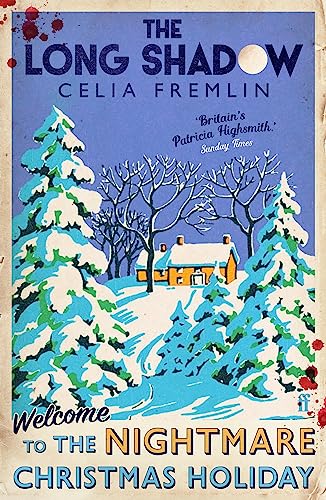
With its snowy cover welcoming us to ‘The Nightmare Christmas Holiday’, I wondered if I had left it too late to read this book and should have waited for December to come around again, but I needn’t have worried – there’s actually very little mention of Christmas and the cover is clearly just a marketing device by the publisher. It worked perfectly for me as an early January read and has helped my 2024 get off to a great start. It’s not really surprising that I enjoyed it as Fremlin’s earlier novel, Uncle Paul, was one of the best books I read last year.

First published in 1975, The Long Shadow opens two months after Imogen Barnicott’s husband, Ivor, is killed in a car accident. As a renowned Professor of Classics, Ivor’s death causes an outpouring of grief from students, academics and colleagues from around the world – in fact, Ivor seems to be mourned more by people who barely knew him than by members of his own family. Imogen’s own feelings certainly appear to be mixed; she can’t help reflecting on how much Ivor would have loved the attention that comes with being dead and how annoyed he must be that he’s not around to enjoy it! While she misses Ivor’s presence around the house, she also welcomes having the freedom to do whatever she wants at last. However, this freedom is very short-lived because, as Christmas approaches, her adult stepchildren descend upon the house with their partners and children in tow, as does one of Ivor’s ex-wives, who has just arrived from Bermuda.

Imogen just wants to move on with her life, but that’s going to be difficult with so many uninvited guests. And when she receives a late night telephone call from a stranger accusing her of Ivor’s murder, it seems that someone else is determined to stop her from moving on as well. As New Year comes and goes, there are more unexplained incidents: one of Ivor’s books is found open on the arm of his chair, the grandchildren insist they’ve seen a ‘wizard’ in Grandpa’s room…and Imogen’s anonymous caller refuses to leave her alone. Does Imogen know more about her husband’s death than she’s prepared to admit?

The Long Shadow is a slower paced book than Uncle Paul and although there’s plenty of dark humour, it’s not quite as funny either. However, like Uncle Paul, it has a wonderfully unsettling atmosphere and a sense of increasing suspense and tension. Fremlin does an excellent job of making the reader question everything we are being told. Is Imogen being completely honest with us or could she be an unreliable narrator? Is there a logical explanation for what is happening or a supernatural one? And is Ivor even really dead? Fremlin leads our thoughts in first one direction and then another until we’re not really sure what to think or believe.

Although there are elements of mystery, this is not really a ‘crime novel’ – we don’t even know whether a crime has actually been committed; ‘psychological thriller’ is a better description, but even then it’s not a conventional thriller either. What it is more than anything is an examination of widowhood, the process of grieving and all the little complexities that follow a death in the family. Imogen finds it particularly difficult to cope because she isn’t given the space to mourn alone; not only does she have letters of condolence to answer from all corners of the globe (How he would have loved to watch the letters pouring in, day after day, by every post, in their tens and in their dozens, each one a tribute to himself…), she also has her neighbour Edith constantly regaling her with tales of her own late husband, Darling Desmond, as well as a house full of lodgers and family members all outstaying their welcome.

The plot becomes quite gripping towards the end, when it seems that the truth is about to be revealed – but although we do get answers to most of our questions, the final sentence provides one last, surprising twist! I’m glad I picked such an enjoyable book to start the year with and I see my library has The Hours Before Dawn, so I could be tempted to read more Celia Fremlin soon.

Uncle Paul by Celia Fremlin

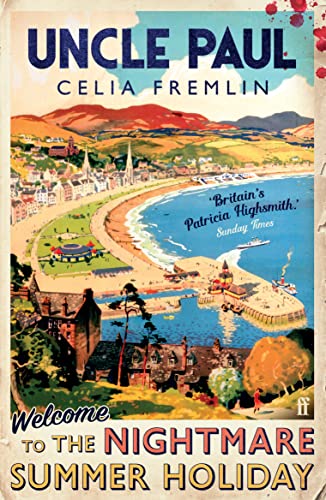
I know they say never to judge a book by its cover, but I have to confess, the cover is what made me want to read this book before I even knew what it was about! Luckily, the story lived up to the cover and you can expect to see Uncle Paul on my books of the year list in December, without a doubt.

First published in 1959, this is a recent reissue by Faber. It’s Celia Fremlin’s second novel but the first I’ve read and I was delighted to find that she wrote fifteen more. If any of them are even half as good as this one then I have some great reading ahead of me!

Uncle Paul is written from the perspective of Meg, the youngest of three sisters but in many ways the most mature. She is leading her own independent life in London with a job, a flat and a new boyfriend, Freddy, a pianist who is both charming and secretive. The novel opens with Meg receiving a telegram from her older sister Isabel, who is spending the summer holidays in a caravan at the seaside with her family. Isabel is concerned about their half-sister Mildred, who is twenty years older and helped to bring them up as children. Mildred has left her husband and come to stay at a nearby cottage – the same cottage where she spent her honeymoon with her first husband, Paul, fifteen years earlier.

Meg and Isabel had been very young at the time of Mildred’s marriage to Paul – they knew him as ‘Uncle Paul’ – but they remember the scandal that occurred when it emerged that he was guilty of both bigamy and attempted murder. Paul was given a long prison sentence after Mildred went to the police, but she is convinced that he has now been released and is coming to take his revenge. Believing that her sisters are panicking about nothing, Meg sets off for the coast intending to tell them to stop being foolish, but when she finds herself spending the night at Mildred’s cottage listening to footsteps moving around in the dark she begins to wonder whether Uncle Paul really has come back after all.

Uncle Paul is an excellent psychological thriller, but I think what I actually loved most about it was the setting – the portrayal of a typical British seaside holiday in the 1950s. Fremlin does a great job of bringing to life Isabel’s rickety caravan, trips to the beach and walks along the pier, the challenges of keeping children amused on a wet day and the friendships that inevitably begin to form with the other guests – in this case, the gallant old Captain Cockerill and a mother with her son, Cedric, an irritating little boy who thinks he knows everything (and often does). The characters are all very well drawn, even the minor ones like these, but I found the three sisters particularly interesting, with their very different personalities: the sensible, level-headed Meg who, despite being the youngest, is the one the others rely on to take control of every situation; the rich, dramatic and often irrational Mildred (her decision to stay on her own in an isolated cottage where she could easily be found by Paul being one example of her illogical behaviour); and the nervous, anxious Isabel, the sort of person who worries about anything and everything.

The psychological elements of the story are very well done, so that we can never be quite sure whether the strange occurrences and the noises in the middle of the night are real or just a figment of our characters’ imaginations. Even when one alarming incident is proven to have an innocent explanation, the suspense begins to build all over again, convincing us that this time Meg and her sisters really are in danger! Similarly, Fremlin creates enough mystery around the characters of Isabel’s husband and Meg’s boyfriend that neither we nor Isabel and Meg themselves know whether they really are who they claim to be.

Having been kept guessing all the way through this wonderful novel, I found the ending both unexpected and clever. Definitely one of my favourite books of the year so far and I can’t wait to try another one by Celia Fremlin.