White Corridor by Christopher Fowler

This is the fifth book in a series I started over a decade ago. My slow progress doesn’t mean I’m not enjoying the books, because I am, but I do feel ashamed that when I reviewed the fourth book, Ten-Second Staircase, I claimed that I would “be continuing soon with book number five, White Corridor” – and that was in 2016!

Anyway, the series follows the investigations of Arthur Bryant and John May, a pair of octogenarian detectives who work for London’s Peculiar Crimes Unit. Some of the books have contemporary settings while others deal with cases from earlier in the careers of Bryant and May. White Corridor is one that’s set in the present day (around 2007, when the book was published). At the beginning of the novel, Raymond Land, the Unit Chief, has decided to close the unit for a week in February due to a lack of work and because the team had worked throughout the Christmas holiday period. Bryant has chosen to spend his time off attending a spiritualist convention in Dartmoor and May finds himself agreeing to accompany him.

As the two elderly detectives set off by car on their journey, heavy snow begins to fall and they quickly become stranded in a blizzard along with lots of other drivers. Meanwhile, back at the PCU, pathologist Oswald Finch has been found dead in his own locked mortuary. Four other PCU members have keys to the door, so all four become suspects, but the investigation is made difficult by the fact that the unit is temporarily closed and their two best detectives are miles away, trapped in a snowstorm. Bryant and May must try to solve the mystery by phone, but first, they have another killer to catch – one who is hiding somewhere within the snowy ’white corridor’ of abandoned cars.

This second killer is on the trail of a woman and her young son in another car, having pursued them all the way from France. Now he’s finally caught up with them and thanks to the snow they’re not going to be able to escape. Throughout the book, the perspective switches between the mother and child, desperately trying to evade their pursuer, Bryant and May, trying to solve both crimes while avoiding freezing to death, and the PCU staff back in London. With Bryant and May not around, Detective Sergeant Janice Longbright takes charge of things and it was good to see her coming to the forefront of the story and developing as a character.

Compared to the first four books in the series, this one has quite a different feel, with Bryant and May taken out of their usual environment and the rest of the unit left on their own. Some things never change, however, such as Arthur’s arcane knowledge and useful friendships with the most unexpected people, in this case a white witch, and of course, the PCU being threatened with closure yet again! This time they are facing a royal visit, so needless to say, their pathologist being murdered is not exactly the best way to prepare.

This isn’t one of my favourite books in the series, as I think I prefer to see Arthur and John on home ground and working with the rest of the team, but it was still quite entertaining. I’m looking forward to reading the next book, The Victoria Vanishes, and will try not to leave it so long this time!
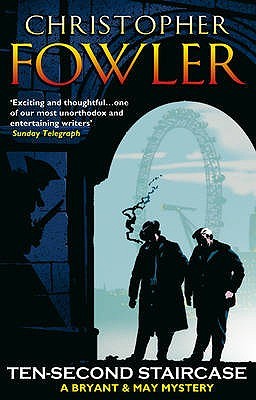

Ten-Second Staircase by Christopher Fowler

What a wonderful imagination Christopher Fowler has! This fourth novel in the Bryant and May mystery series involves the bizarre deaths of several minor celebrities, a mysterious highwayman complete with horse, cape and tricorn hat, gangs of feuding schoolchildren and a possible link to the Knights Templar. It’s just the sort of case the Peculiar Crimes Unit was created to deal with, and this is one of the most peculiar yet.

Ten Second Staircase As the novel opens, we learn that yet again the PCU is facing the threat of closure, with Bryant and May’s outdated methods of detection coming under attack. Bryant and May – Arthur and John – are the two elderly detectives around whom the rest of the unit revolves. John May is logical, methodical and more open to modern technology, but his partner prefers to rely on his tried-and-tested network of historians, clairvoyants, witches and psychics. Their different personalities and different approaches to crime-solving are the reasons why the two of them have had so much success over the years, right from the very first case they worked on together during the Second World War (described in Full Dark House). Among the successes, however, there has been one failure: the identity of the serial killer known as the Leicester Square Vampire, which has remained unknown since the 1970s.

Bryant and May’s latest mystery begins when a controversial modern artist is drowned in the display case of one of her own art installations. The only witness is Luke Tripp, a twelve-year-boy from nearby St Crispin’s Boys’ School, who claims to have seen a figure resembling Dick Turpin ride into the gallery on horseback and throw the artist into the tank. No sooner have the detectives begun to investigate than the Highwayman strikes again, his second murder as strange and inexplicable as the first. As Bryant and May dig deeper, they uncover some similarities between the Highwayman and the Vampire; if only they can find a way to solve both mysteries at once, the future of the PCU could be secured.

I enjoyed Ten-Second Staircase as I’ve enjoyed all of the previous books in this series, but this is probably my least favourite of the four. The Peculiar Crimes Unit seems to have been facing closure in every book so far and that aspect of the story is starting to feel repetitive, especially as with another nine (at least) books to follow, it was obvious that it would be allowed to stay open. I also couldn’t help feeling that the author was using Bryant and May in this book to voice his own views and opinions on society; this meant that the dialogue sometimes felt more like a lecture rather than a natural conversation between friends.

The things that I did love in this book were the same things I loved in the first three: the unusual and imaginative mystery (which, as usual, I failed to solve), Arthur’s unorthodox detection methods, and the fascinating historical facts and pieces of trivia which are incorporated into the plot. The real attraction of this series, of course, is the partnership of Bryant and May themselves, but we do get to know other members of the PCU as well and some of these characters are developed further in this novel, particularly May’s agoraphobic granddaughter, April, who I’m sure we’ll see more of in future books.

I’ll be continuing soon with book number five, White Corridor!

My commonplace book: February 2016

commonplace book
Definition:
noun
a notebook in which quotations, poems, remarks, etc, that catch the owner’s attention are entered

Collins English Dictionary

~

A summary of this month’s reading, in words and pictures.

~

Every sound of the quiet evening came clearly to her ears with an unnatural distinctness; but now each one possessed a different and terrifying meaning. The muffled shouts and laughter of the few remaining bathers from the indoor swimming bath were the cries of fleeing, panic-stricken people. The whisper of the breeze through the pine needles was a frightened man whispering orders in the shadow of fog-shrouded whin bushes. A passing car was the drone of an enemy bomber and the faint lap of water against the sea-green tiles at the far side of the wide pool was the lap of waves against a pebble beach.

Death in Berlin by M. M. Kaye (1955)

~

“The promise of the day!” said Visconti, dreamily and sadly. “Hath it never struck thee how that promise never is fulfilled? Day after day, since the world began, something in the mystery of the dawn is promised – something the sunset smiles to see unfulfilled – something men have ever been cheated of – something men will never know – the promise of the dawn!”

The Viper of Milan by Marjorie Bowen (1906)

~

Louis X

Uncertain health, a clever but overbearing father whose authority had crushed him, an unfaithful wife who had scoffed at him, an empty treasury, impatient vassals always ready to rebel, a famine in the first winter of his reign, a storm which threatened the life of his second wife – beneath what disastrous conjunction of the planets, which the astrologers had not dared reveal to him, must he have been born, that he should meet with adversity in every decision, every enterprise, and end by being conquered, not even nobly in battle, but by the water and mud in which he had engulfed his army?

The Poisoned Crown by Maurice Druon (1956)

~

She looked up as the train passed, and I was almost near enough to catch her eye. She had a round pale face, the usual exhausted face of the slum girl who is twenty-five and looks forty, thanks to miscarriages and drudgery; and it wore, for the second in which I saw it, the most desolate, hopeless expression I have ever-seen. It struck me then that we are mistaken when we say that ‘It isn’t the same for them as it would be for us,’ and that people bred in the slums can imagine nothing but the slums. For what I saw in her face was not the ignorant suffering of an animal. She knew well enough what was happening to her — understood as well as I did how dreadful a destiny it was to be kneeling there in the bitter cold, on the slimy stones of a slum backyard, poking a stick up a foul drain-pipe.”

The Road to Wigan Pier by George Orwell (1937)

~

Flag of Iowa

After all no fledgling had it easy, farmer or crow. Hadn’t he known since he was a boy the way the fledglings had to fall out of the nest and walk about, cheeping and crying, until they grew out their feathers and learned to fly on their own? Their helpless parents flew above them, and maybe dropped them a bit of food, but flying or succumbing belonged to them alone.

Some Luck by Jane Smiley (2014) – review to follow

~

“I must insist upon it,” she continued, “that you shall take me now as I really am — as your dearest friend, your sister, your mother, if you will. I know what I am. Were my husband not still living it would be the same. I should never under any circumstances marry again. I have passed the period of a woman’s life when as a woman she is loved; but I have not outlived the power of loving.”

Phineas Redux by Anthony Trollope (1873)

~

“There is no other way, Robert,” James said quietly, watching the emotions shift across his face. “If Balliol returns you lose everything. At least this way you have a chance to make sure you and your family are protected. Our best hope is that Edward will be able to keep Balliol from the throne. If he succeeds, God willing, you may one day still claim it.”

Renegade by Robyn Young (2012)

~

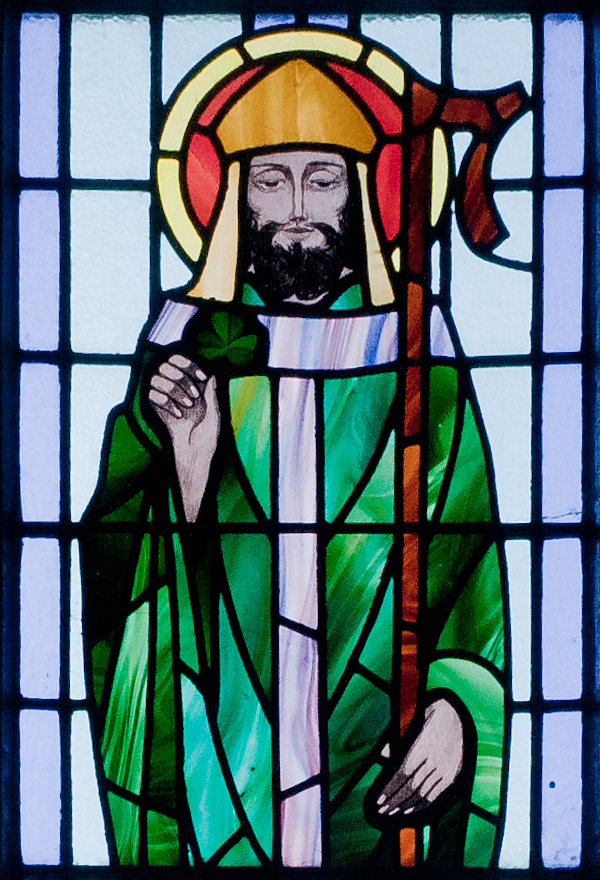
St Patrick

And so it came to be that they carried me away into bondage, slung over the shoulder of the black-beard while the girl walked, roped behind. I cannot tell you of the voyage, nor of the faces of the many who were taken into captivity with us. I can only say that on that day “…the Lord brought over us the wrath of His anger and scattered us among many nations, even unto the utmost part of the earth, where now my littleness is placed among strangers” in the land known as Eire.

The Lion and the Cross by Joan Lesley Hamilton (1979) – review to follow

~

Everybody was bowing, sliding on to one knee as Henry came into the chamber, leaning on his staff and smiling…Here comes the King, and with the coming of the King, all life must stop, the very air must thicken as if congealed in awe of this gross man who hobbled painfully on his tall staff, nodding and smiling, blinking every second.

Here Comes the King by Philip Lindsay (1933)

~

In a country where so many desire status and wealth, petty annoyances can spark disproportionately violent behaviour. We become frustrated because we feel powerless, invisible, unheard. We crave celebrity, but that’s not easy to come by, so we settle for notoriety. Envy and bitterness drive a new breed of lawbreakers, replacing the old motives of poverty and the need for escape. But how do you solve crimes which no longer have traditional motives?

Ten-Second Staircase by Christopher Fowler (2006) – review to follow

~

Favourite books this month: Phineas Redux and The Viper of Milan

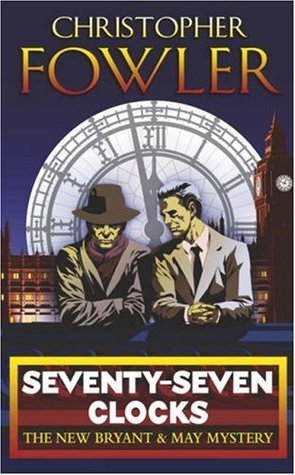
Seventy-Seven Clocks by Christopher Fowler

This is the third book in Christopher Fowler’s Bryant and May series following the investigations of two elderly detectives, Arthur Bryant and John May, who work for London’s “Peculiar Crimes Unit”. The first in the series, Full Dark House, looked back at their first mystery in the unit’s early days during World War II, while the second, The Water Room, was a fascinating mystery set in the present day and involving London’s system of underground rivers. This third instalment takes us back to 1973, when Britain was facing a winter of strikes and blackouts.

Seventy-Seven Clocks begins with two unusual incidents. The first is the death of a lawyer in the lobby of the Savoy Hotel, believed to be caused by a snake bite, and the second involves a man dressed in Edwardian clothing who runs into the National Gallery and damages a valuable painting. When more bizarre murders, accidents and abductions follow, Bryant and May discover that most of the victims are members of a large, rich family, the Whitstables. As they begin to investigate, the two detectives uncover a connection between the family and a Victorian secret society. Meanwhile, the receptionist at the Savoy Hotel, a seventeen-year-old girl called Jerry Gates decides to do some detective work of her own – but it seems that Jerry might have reasons of her own for disliking the Whitstables.

The solution to the mystery is both ingenious and completely ridiculous, but that has been the case with all three of the Bryant and May mysteries I’ve read and I’ve found that it doesn’t matter to me. In fact, the unusual and implausible plots are one of the reasons this series is so much fun to read and so different from anything else I’ve read. The other reason, of course, is that Bryant and May themselves are such wonderful characters. I find myself liking the character of Arthur Bryant more and more with every book. I love the way he refuses to leave no stone unturned or discount any possible theory, however unlikely it might seem. John May, being Bryant’s opposite in so many ways, is his perfect complement. One of the big differences between the two detectives is that May is willing to move forward and embrace new technology, while Bryant in many ways is still living in the past. As May says, “You find comfort in darkness. I prefer the world brightly lit; there’s so much more to see”.

The role of darkness and light is one of the themes explored during the story, but there were so many other things involved in this book I was slightly overwhelmed by it all! Pre-Raphaelite art, Gilbert and Sullivan societies, Victorian guilds (the Worshipful Company of Watchmakers), the British class system, the invention of electric light, and lots of other interesting topics and pieces of trivia. Christopher Fowler’s knowledge of London’s history is so impressive. Every time I come to the end of a Bryant and May book I feel that I’ve really learned something new.

If I have a criticism of this book, it’s that at nearly 500 pages it felt longer than it really needed to be, and I didn’t find Jerry’s storyline very interesting. It didn’t add much to the main plot in my opinion and could almost have been left out entirely. I thought the story was complex enough without it.

Oh, and if you’re new to Bryant and May and wondering if you need to read the series in the correct order, I would say it’s not necessary at all. It’s my personal preference to read a series in order if possible, but with these books each of the three mysteries I’ve read so far stand alone and are complete stories in themselves. I didn’t like this one quite as much as Full Dark House or The Water Room but I still enjoyed it and am looking forward to reading more Bryant and May soon.

The Water Room by Christopher Fowler

The Water Room is the second in a series of novels about two elderly detectives, Arthur Bryant and John May, who work for the Peculiar Crimes Unit, a branch of the London Metropolitan Police specialising in unusual cases. Bryant and May have been working together since the 1940s and have formed a strong and effective partnership, combining Bryant’s eccentricity and lateral thinking with May’s common sense and more logical approach.

When Mrs Singh is found drowned in the seemingly dry basement of her home in Balaklava Street with her mouth full of river water, her brother, who is an old friend of Arthur Bryant’s, asks the Peculiar Crimes Unit for help. But no sooner have Bryant and May begun to investigate than another bizarre incident occurs in the same street. Meanwhile, the new owner of Mrs Singh’s house is being plagued by the sound of rushing water in the basement and damp patches appearing and disappearing on the walls. What is going on?

I read the first book in this series, Full Dark House, a couple of months ago and loved it, but I thought this one was even better. This is a series that I would particularly recommend to people who love London. I’m not familiar enough with London to fully appreciate everything in these novels, but Christopher Fowler’s love and knowledge of the city is obvious on every page. Full Dark House looked at the city’s theatrical world; in this book the focus is on the underground rivers that run under the streets of London. During the course of Bryant and May’s investigations we learn lots of little facts about these lost rivers and the mythology surrounding them. The historical information is woven into the plot throughout the book and I thought the balance between education and entertainment was just right.

This is not a very fast-paced book and does require some concentration, but the story moves along steadily and has a few surprising twists. The mystery plot was quite a good one, with plenty of clues and red herrings that seemed to implicate almost everybody in the street at one point or another. But the highlight of these books for me is the partnership of Bryant and May themselves and the dialogue between them.

As well as being part of a series, The Water Room is a complete mystery novel in itself and it’s not necessary to have read Full Dark House first. However, if you’re concerned about coming across spoilers it would be a good idea to start at the beginning of the series. After enjoying the first two books so much I’m sure I’ll be reading the others and am looking forward to meeting Mr Bryant and Mr May again in Seventy-Seven Clocks.

I received a copy of this book for review from Transworld as part of the Transworld Book Group.

Full Dark House by Christopher Fowler

One of the books I hope to be reading soon for the Transworld Book Group challenge is The Water Room, the second in Christopher Fowler’s Bryant and May series. As I already had a copy of the first in the series waiting to be read and I would prefer not to read them in the wrong order, I decided to read Full Dark House first. And I’m glad I did, because Full Dark House definitely has a ‘first in the series’ feel about it.

Arthur Bryant and John May are two elderly detectives who work for the Peculiar Crimes Unit, a branch of the London Metropolitan Police created to deal with unusual cases. When the PCU office is destroyed in an explosion, Bryant, who was inside the building, is presumed dead. His partner, May, who has worked with him for over sixty years, is determined to find out who killed Bryant and why.

In order to understand who may have been responsible for Bryant’s death, we are taken back in time to November 1940, when Bryant and May worked together on their very first case during the London Blitz. While bombs fell on the city night after night, the two young detectives were investigating the murders of several cast members of a controversial new play at the Palace Theatre. As the story moves backwards and forwards between 1940 and the present day, May searches for a connection between the ‘Palace Phantom’ and Arthur Bryant’s death.

With their different strengths and weaknesses, Arthur Bryant and John May complement each other perfectly and each of them approaches the investigation in his own way. Bryant has unconventional ideas, an active imagination and an interest in the paranormal, whereas May is the more logical and methodical of the two. Setting the story in two time periods sixty years apart was a good idea because it allowed us to watch the two detectives meeting each other for the first time in 1940 and to see how their relationship had developed over the intervening years. I liked both of them and am looking forward to getting to know them better throughout the rest of the series.

I loved the descriptions of black-outs, bomb shelters, rationing and other aspects of daily life in London during the Blitz – it all felt very convincing and realistic. In fact, of all the books I’ve read recently set in wartime London, this is probably the one that evokes the era best, which was something I hadn’t expected. I can tell Christopher Fowler must have researched every part of his book very thoroughly, because as well as all the little details that make his portrayal of London so believable, there are also some very detailed descriptions of the backstage layout of the theatre and lots of information on Greek mythology too.

Apart from a section in the middle of the book where the plot moved forward very slowly and nothing seemed to happen for a while, I really enjoyed my first introduction to Bryant and May. With two mysteries to solve, lots of plot twists, and a large cast of colourful characters both within the Peculiar Crimes Unit and at the theatre, Full Dark House is a great opening to the series.