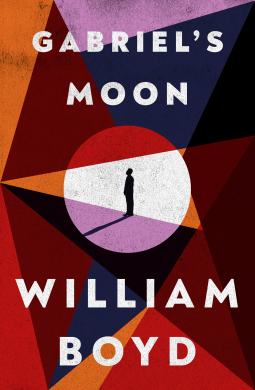
 William Boyd’s The Romantic was one of my books of the year in 2022, so I was excited about reading his new one, Gabriel’s Moon – although it did sound very different. Unlike The Romantic, which follows the entire life story of its hero, this book is a spy novel set over a much shorter period of time.
It’s 1960 and travel writer Gabriel Dax is visiting what is now the Democratic Republic of the Congo, where he has the opportunity to interview the new Prime Minister, Patrice Lumumba. During the conversation, which Gabriel captures on tape, Lumumba explains that he has enemies who want him dead and he provides the names of the three people he thinks are plotting to kill him. On his return home to London, Gabriel is convinced somebody has been inside his house in his absence and has been searching for something. It seems that somebody wants Gabriel’s tapes of the Lumumba interview – and their attempts to obtain them become more desperate once news emerges that Lumumba has been executed by a firing squad.
His accidental involvement in the Lumumba conspiracy brings Gabriel into contact with the mysterious Faith Green, an MI6 intelligence officer who sends him on a series of missions, the purpose of which Gabriel doesn’t fully understand. In a secondary storyline – which explains the title of the novel – Gabriel decides to consult a psychoanalyst, Dr Katerina Haas, in an attempt to get to the bottom of the mental health issues that have plagued him all his life, ever since his mother was killed in a house fire when he was six years old. The official cause of the fire was given as Gabriel’s night light, a candle inside a moon-shaped globe, but Gabriel’s memories of what actually happened that night are very different.
I enjoyed this book overall, but I found it a bit slow at times and, as a thriller, not particularly thrilling. There’s a lot of travel to various locations in Europe and Africa (all beautifully evoked), with a lot of sitting around in bars drinking and talking, but I never really felt that Gabriel was in much danger. Having said that, I was never bored and became fully drawn into the world of espionage, spies and double agents that Boyd creates, all set against a backdrop of the Cold War. I found it slightly unbelievable that the spies Gabriel meets all speak to him so openly, readily sharing secret information with him – but then, Gabriel doesn’t always know how to interpret that information and it’s his very innocence and gullibility that makes him so useful to Faith Green and MI6. As the story progresses, he eventually decides it’s time to stop being the self-described ‘useful idiot’ and try to take control of his own destiny.
Faith Green remains a bit of a shadowy, enigmatic character throughout the book and because I felt I never really got to know her, I became irritated by Gabriel’s obsessive infatuation with her, particularly as he already has a girlfriend, Lorraine – whom he looks down on because of her working-class background, while at the same time admitting that he’s only with her because he finds working-class women sexually attractive. Although I didn’t dislike Gabriel in general, some of his attitudes leave a lot to be desired!
One of the most interesting aspects of the novel for me was seeing Gabriel work through his hazy memories and his feelings of guilt about the tragic fire that took his mother’s life. Through his psychoanalysis sessions with Dr Haas, Gabriel is inspired to carry out his own investigations into the night of the fire and begins to uncover the truth. I thought this storyline worked well alongside the espionage one and gave us some more insights into Gabriel’s character.
Although Gabriel’s Moon works perfectly as a standalone, there were some loose threads left at the end that made me think this could be the first in a series – and I was pleased to find that William Boyd is indeed working on a second book. I’ll be looking out for it, but I also have lots of Boyd’s earlier novels still to read. I would be happy to hear your recommendations!
Thanks to Viking for providing a copy of this book for review via NetGalley.

Book 53 for the Historical Fiction Reading Challenge 2024
 She Reads Novels