Penitence by Kristin Koval

Penitence is a beautifully written novel, tackling one of the darkest subjects imaginable: the murder of a teenage boy by his own younger sister.

It happens in the small town of Lodgepole, Colorado in 2016 and the murderer is thirteen-year-old Nora Sheehan, who calls the police herself to confess that she has just shot and killed her brother Nico. Before the incident, Nora had seemed depressed and withdrawn, which may or may not have been related to Nico, who was less than a year older, being diagnosed with Huntington’s disease. Huntington’s is a degenerative condition with no cure, so it’s possible that Nora may have thought she was helping her brother avoid a terrible fate – but is this true or is there another reason for what she did?

Martine Dumont, a seventy-two-year-old lawyer, is looking forward to her retirement when Nora’s parents, David and Angie Sheehan, ask her to take on one last case and defend their daughter. Martine accepts, but knows she is out of her depth and contacts her estranged son, Julian, whose speciality is criminal law. Julian has lived in New York for many years, but Angie was once his girlfriend, which makes the situation awkward. Although he agrees to return to Lodgepole and help with Nora’s case, being around Angie again brings back difficult memories for both of them.

When I first started to read, I was expecting this to be a crime novel, but that’s not really how I would describe it. The murder of Nico Sheehan is actually a relatively small part of the story; there’s never any doubt that Nora did it deliberately and it’s quite obvious why she did it, so there’s no mystery involved. We do get a lot of information on the laws surrounding the prosecution of child murderers, how they can sometimes be tried as adults rather than juveniles, and the sentences they can expect. We’re also given some insights into what life is like for Nora in the juvenile detention facility she is sent to while she’s awaiting trial.

The main focus of the novel, though, is on the topic of forgiveness and the various questions that arise from this. Why do we feel we have to assign blame when something tragic happens? How can we move on from this and find forgiveness for ourselves and others? How much penitence is enough? These things are explored not just through the story of Nico’s murder – in fact, I felt that relatively little time was spent on showing how David and Angie truly felt about one of their children killing the other – but also on the relationship between Julian and Angie and how it was affected by another tragedy decades earlier. This second storyline plays out in another timeline set in the 1990s/early 2000s and alternates with the Nora/Nico thread. However, I thought too many pages were devoted to this backstory and it made the whole book feel longer and slower than it really needed to be.

I did love the portrayal of Lodgepole, a small Colorado ski resort, and the way life there differed from Julian’s (and for a while, Angie’s) life in New York. An interesting setting, then, and an interesting subject – if only it had been more tightly plotted, it would have been an excellent book. I did like it, though, and found it quite thought-provoking. It’s Kristin Koval’s debut novel and I’ll be happy to read more.

Thanks to Simon & Schuster UK for providing a copy of this book for review via NetGalley.
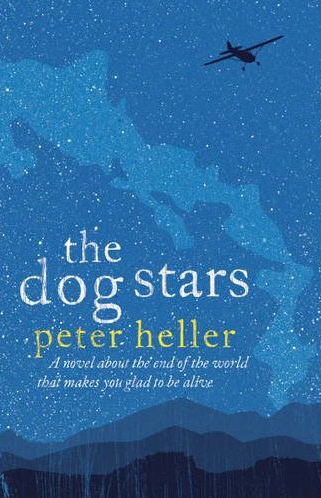
The Dog Stars by Peter Heller

The Dog Stars is a post-apocalyptic novel set nine years after life on earth was almost entirely wiped out by a flu-like illness. Among the few survivors is Hig, a pilot from Colorado who lost his beloved wife Melissa to the disease and has been left alone with his dog Jasper and his Cessna plane. He spends a lot of his time flying over the mountains surveying the area and searching for food for himself and his nearest neighbour, Bangley, a tough, aggressive man who is obsessed with guns and killing.

Under normal circumstances, Hig and Bangley would have had little in common, but to survive in this new world they have decided to work together to protect the abandoned airport compound they both call home. Then one day Hig hears a voice on his radio and is intrigued. He wants to find out who else might be out there, but there’s one big problem – if he flies too far he might not have enough fuel to get back…

I have read very few novels in this genre so The Dog Stars was not the type of book I would normally choose to read and at first I didn’t think I was going to like it, especially when I discovered it was written in an unusual, disjointed, almost stream-of-consciousness style. I expected to pick up the book, read a few pages then put it down again – so I was surprised to find how completely I was drawn into Hig’s world and although I didn’t love the book it was certainly an interesting experience.

The writing style is very different and it took me a while to get used to it. The sentences are short and often incomplete and don’t seem to follow the normal rules of grammar or punctuation. I usually hate this kind of experimental writing and often I can’t see any reason for it, but with this book it did seem to suit the story and I think I do understand why the author chose to write it in this way. I can accept that a man spending most of his time alone with only his dog for company, rarely interacting with other humans, may eventually begin to think differently; another possibility is that Hig’s command of language has been affected by the illness he suffered from (and was lucky enough to recover from, unlike most of the population). Either way, Hig’s story probably wouldn’t have been nearly as effective or memorable if it had been written in normal prose. However, it did make the book much more challenging to read than it would otherwise have been!

I found it depressing that almost all of the other characters who appear in the book are so mindlessly brutal and violent. If you’re living in isolation and come across another survivor, why not talk to them and see if you can help each other, instead of immediately attacking them or stealing from them without even trying to make contact first? I realise that people were competing for dwindling resources and worried about running out of food, but it was hard for me to understand their behaviour. It could be realistic, I suppose, but it seemed such a sad and pessimistic outlook. That’s why I liked Hig, who even in this lonely, desolate world manages to retain some of his compassion and humanity. He kills when he needs to in order to protect himself or when he is threatened by intruders, but he doesn’t take the pleasure in it that Bangley does. He also pays regular visits to some families of Mennonites nearby who have become infected with the disease, and takes them food and supplies.

We are only given brief descriptions of how the flu and the blood disease that followed led to the destruction of most of the world’s population – I would have liked to have learned more about what happened, but that was not the focus of the novel. Instead this is a story about people trying to survive in the wilderness that remains. And in the end, the novel does take a more positive, optimistic view and leaves us feeling more confident that there might still be hope for the human race.

The Dog Stars has been compared to The Road by Cormac McCarthy which I haven’t read so can’t comment on how similar or different they are. With my very limited knowledge of dystopian/post-apocalyptic fiction I would recommend that fans of the genre give this one a try, but I think it was a bit too far out of my comfort zone for me!

I received a copy of The Dog Stars from Headline for review