‘Not all of us are made for the dust. Those who are destined to rise will rise one way or another.’
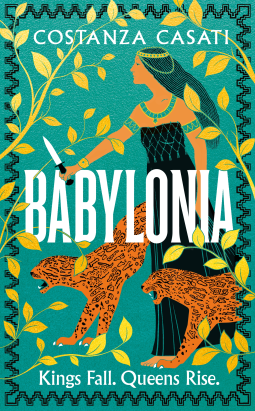 Babylonia was something slightly different for me. Although I read a lot of historical fiction, I’m not often drawn to ancient history and I think this could possibly be the first novel I’ve read set at the time of the Assyrian Empire. I enjoyed Costanza Casati’s previous book, Clytemnestra, though, so I decided to give this one a try.
Babylonia is set in the 9th Century BC and tells the story of the legendary Semiramis, thought to be based on the historical Assyrian queen, Sammuramat. I had heard of Semiramis before beginning the book, but knew almost nothing about her or the legends surrounding her.
Semiramis, at least in this version of the story, is the daughter of Derceto, who kills her lover after he denies being the father of her child and then drowns herself. The orphaned Semiramis is taken in by a shepherd, Simmas, who raises her along with his own son. However, Simmas is not a loving father and treats Semiramis so badly that as she grows into a woman she begins to plan her escape from the village. She finally gets her chance to move on and start a new life when she marries Onnes, the new governor of Eber-Nari. Onnes is the illegitimate half-brother of King Ninus and through marriage to him, Semiramis becomes close to the royal household. Still not content with how far she has come, Semiramis sets her sights on the throne, but when it comes to politics she may have met her match in the King’s mother, Nisat.
Much of the focus of the novel is on the relationships between Ninus, Onnes and Semiramis and the different kinds of love and hate each one of them has for the other two. It’s a fascinating triangle to read about with the dynamics shifting and changing throughout the book and the use of multiple perspectives helps us to see that there’s more than one side to the story. These three are not the only interesting characters in the novel – I’ve already mentioned Nisat, but two others who stood out for me were Sasi, the King’s spymaster, and Ribat, a young slave who serves as Semiramis’ eyes and ears in the palace, while dreaming of becoming a scribe.
Because of my lack of knowledge of Semiramis and this period of history in general, I can’t really comment on how this novel compares to other retellings of the same legends. I suppose one of the advantages of writing about a mythical figure is that it does allow the author a lot of freedom in how they choose to approach the story. As for the Assyrian world Casati builds around Semiramis, it feels real, believable and rooted in historical research, from the descriptions of food and clothing to the accounts of battles and political intrigue. Casati writes so beautifully this novel really was a pleasure to read.
If any of you have read any other books about Semiramis/Sammuramat or the Assyrian Empire, I would love to hear your recommendations.
Thanks to Michael Joseph, Penguin Random House for providing a copy of this book for review via NetGalley.

This is book 8/20 of my 20 Books of Summer 2024.

Book 26/50 for the Historical Fiction Reading Challenge 2024
 She Reads Novels