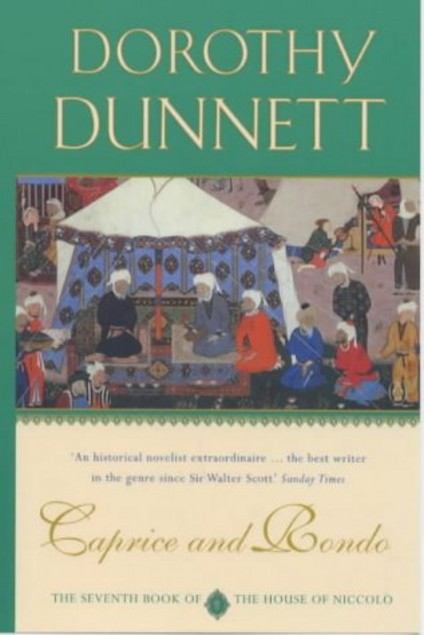
 The seventh in the House of Niccolò series and another one I enjoyed, although it was actually one of my least favourites so far. I know other readers will disagree, but in an eight-volume series it’s inevitable that there are going to be some that I don’t love as much as others and this was one of them. Before I try to explain why, I’ll repeat my usual warning that if you have not read the previous six Niccolò novels, you will encounter some spoilers below – it’s impossible to avoid them at this stage in the series!
*
At the beginning of Caprice and Rondo, we find Nicholas in exile following the revelations at the end of the previous book, To Lie with Lions. After allowing his rivalry with his wife, Gelis, to cause financial problems for his bank and almost destroy the nation of Scotland, it seems that his friends and colleagues may not be able to forgive him this time. Spending the winter drinking with the pirate Paúel Benecke in Danzig, Poland, Nicholas appears to be without aim and direction, until the opportunity arises for him to travel to Caffa on the Black Sea in the company of the mysterious Anna von Hanseyck. He is also still searching for the African gold that was stolen from his ship in Scales of Gold, as well as trying to protect Gelis and their son, Jodi, from their numerous enemies who include the former Vatachino agent, David de Salmeton.
I think part of the problem I had with this book was that we are taken to such a lot of different geographical locations and yet none of them really came to life for me as vividly as the settings in the previous books. I realise the cold, subdued atmosphere of the Danzig chapters was probably intended to match Nicholas’s mood and the state of mind he had found himself in, rather as the frozen landscapes of Russia matched Lymond’s in The Ringed Castle, but for me, this was probably the least successful of all the settings in any of the Dunnett novels I’ve read. Caffa is beautifully described, but I couldn’t help thinking the whole section of the book that took place in the Crimea felt a bit irrelevant, though maybe that’s partly because I was finding it difficult to really get interested in the intricacies of Tartar politics. I was much more interested in the other main thread of the story which involved Gelis, with the help of Tobie, visiting Thibault de Fleury and trying to unearth the truth about Nicholas’s parentage. I found myself liking Gelis again in this book after being so frustrated and confused by her since the end of Scales of Gold. I had never doubted that she and Nicholas loved each other and it’s so sad that they had wasted all those years when they could have been together as a family.
We also get a new villain in this book: Julius’s wife, Anna. I was suspicious of Anna from the beginning having learned not to trust characters who seem too good to be true, though I hadn’t guessed who she really was (or not until Adelina’s background was discussed, after which it was quite easy to make the connection) so that was a surprise. I was a bit disappointed though that our established villains, Jordan de Ribérac and Simon de St Pol, never appeared in this book.
While some new questions were raised – the identities of the six children, for example – it also felt as though a lot of things were being tied up in this book in preparation for the final one, such as the death of Nicholai Giorgio de’ Acciajuoli and the end of the mercenary company led by Astorre (I thought Astorre’s death at Nancy was one of the most moving scenes in the book). And of course, the Duchy of Burgundy itself was thrown into disarray with the Duke also losing his life in the battle of Nancy. I also, like Nicholas, finally began to have a better understanding of Ludovico da Bologna who seems to have popped up all over the place in whichever obscure corner of the world Nicholas has been visiting.
“Josaphat Barbaro, speaking of him in Persia, had said, ‘One meets him everywhere, does one not, as one might expect to see the ubiquitous God? But what one meets is not God, but one’s own conscience’.”
Although I started this post by saying this was one of my least favourite Niccolo books, ironically I also found it one of the quickest and easiest to read and I flew through it in a few days over Christmas. I’m reading Gemini now and can’t wait to see how the series concludes!
 She Reads Novels