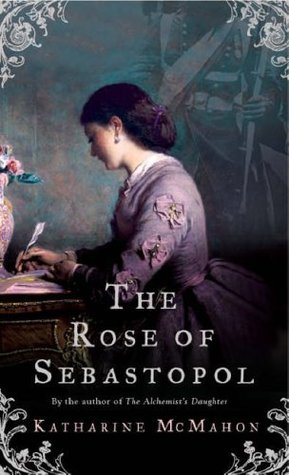
 When I put my list together for this year’s 20 Books of Summer, I tried to include a mixture of new releases I was excited about reading and older books that had been on my TBR for a long time. The Rose of Sebastopol is one that I bought back in 2010 from my favourite bookshop, Barter Books, and has been waiting on my shelf for twelve years! If I’d known I was going to enjoy it so much I would certainly have made time for it before now.
The novel opens in 1855 with our narrator, Mariella Lingwood, arriving in Italy to visit her fiancé, Henry Thewell, a surgeon who has recently been stationed in Crimea where war is continuing to rage between Russia and the allied forces of France, Britain, Turkey and Sardinia. Having become seriously ill, Henry has left the battlefields and is recuperating in the Italian town of Narni. Their reunion doesn’t go as planned, however, when the feverish Henry mistakes Mariella for her cousin, Rosa – and she discovers that throughout his illness he has been calling Rosa’s name.
Rosa had left England for the Crimean peninsula several months earlier hoping to join Florence Nightingale’s team of nurses. At first she had kept her family informed as to her whereabouts, but then her letters stopped coming. Unable to learn any more from Henry other than that he and Rosa had met in the Crimea and that Rosa is now missing, Mariella sets off for the war zone herself, determined to find her lost cousin and to hear the truth about her relationship with Henry.
Mariella is an unlikely heroine to be undertaking such an epic journey. Coming from a comfortable middle class background, she has led a very sheltered life and so far her only involvement in the war has been sticking maps and newspaper cuttings into a scrapbook. She represents the Victorian ideal – quiet, obedient, devoted to her parents and conforming to society’s expectations in every way – but for most of the book, I found her very unlikeable. Not only does she lack personality, she’s also quite selfish – probably a product of her upbringing as she has never been encouraged to show any real empathy for people less fortunate than herself.
In contrast, Rosa is a much more engaging character – strong, courageous, determined to achieve her ambition of becoming a nurse and making a difference to people’s lives. I think most authors would have chosen to tell Rosa’s story rather than Mariella’s, so I was intrigued by Katharine McMahon’s decision to write from the perspective of the boring, uninteresting Mariella who, until Rosa disappears, seems content to sit at home with her needlework. Of course, there’s some character development eventually and the journey across Europe does begin to gradually change Mariella’s outlook on life, but it’s always Rosa who drives the plot forward despite being physically absent for most of the novel. Similarly, it seemed at first that Henry would be the main male love interest in the book, but the real hero turns out to be someone unexpected. I was impressed by the way McMahon has us thinking we know which characters we’re supposed to like or dislike, then turns everything around and makes us think again.
This is possibly the first novel I’ve read with the Crimean War as the setting. I’ve read other books set in that time period where the war has been referred to, but I can’t think of any that have actually taken us to the heart of the action – Florence Nightingale’s base at the hospital in Scutari, the sites of the Battle of Balaclava and the Battle of Inkerman, and the besieged city of Sebastopol (or Sevastopol as we would normally call it now). McMahon doesn’t try to portray the war in any kind of romantic way, concentrating instead on the mistakes made by the British and French commanders and the terrible human cost, with large numbers of deaths and casualties. The idea of allowing women to nurse wounded soldiers was very new at that time and we see how some of the women volunteering to join Florence Nightingale were turned down because they were too young or too attractive; they had to meet a strict set of criteria because everything they did would be reported in the British media and Nightingale wanted nothing to damage the reputation of the nursing team she had put together.
I really enjoyed this book and if any of you have read any others set during the Crimean War I would love to hear about them.

This is book 18/20 from my 20 Books of Summer list.

This is book 46/50 read for the Historical Fiction Reading Challenge 2022.
 She Reads Novels