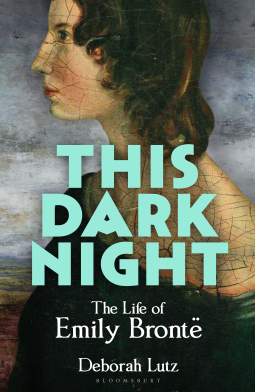
 My favourite of the three Brontë sisters has always been Emily; although I love Charlotte’s Jane Eyre and Anne’s The Tenant of Wildfell Hall, I love Wuthering Heights more and I also find Emily herself the most interesting and intriguing person of the three. When I came across this new biography by Deborah Lutz, then, I knew I wanted to read it. I’ve read other books about the Brontës – mainly fictional ones such as Dark Quartet by Lynne Reid Banks and The Taste of Sorrow by Jude Morgan (see my Top Ten Tuesday post for a full list) – but I liked the idea of one with a specific focus on Emily.
The book takes us through Emily’s entire life, beginning with her birth in 1818, the fifth of six children. When Emily was three, her mother died, leaving the children to be raised by their aunt and their father, Patrick Brontë, an Irish clergyman. Growing up in a parsonage in Haworth, West Yorkshire, Emily and her younger sister Anne developed their writing skills with a series of poems and stories set in the imaginary world of Gondal. Although most of this material has been lost, some of Emily’s Gondal poems still exist and Lutz uses them to explore what they can tell us about Emily as a person and how they provided the foundation that led to the writing of Wuthering Heights.
Emily’s early life was marked by various tragedies – just a few years after her mother’s death, her two eldest sisters also died of tuberculosis, having fallen ill at Cowan Bridge School (the model for Lowood School in Jane Eyre). As Patrick was reluctant to let his three surviving daughters attend school after this, Charlotte, Emily and Anne were largely educated at home. Rarely mixing with people outside the family, Emily didn’t make friends easily and was seen as a quiet, reclusive, fiercely private person. As an adult, although she briefly worked as a teacher and studied in Brussels with Charlotte, Emily continued to spend most of her time at home, managing the household and caring for her father and brother, Branwell, who was descending into alcoholism, having failed in his attempts to establish a literary career of his own.
Emily died in December 1848 at the age of thirty, just three months after Branwell and five months before Anne, all probably of tuberculosis. Charlotte, the only sibling to marry, died seven years later from complications during a pregnancy. It’s thought that the insanitary conditions in the village of Haworth, including a water supply contaminated by the nearby graveyard may have contributed to the poor health of the Brontë family.
As Emily left so little of her own work and correspondence behind, most of what we know of her comes from letters written by Charlotte and her friend, Ellen Nussey. Because we don’t have much insight into what Emily herself may have been thinking or feeling, a lot of this biography is based on speculation – ‘Emily probably thought’ or ‘it’s possible that Emily felt’ – as well as a general overview of the world in which Emily lived and how things she saw or experienced may have influenced her character and work. It also seems that almost as much attention is given to Charlotte and Anne, although that’s understandable as the lives and careers of the three sisters are so closely connected.
Something that comes across strongly is how exceptionally talented Emily was. Obviously, her writing is discussed in detail: her poems including the Gondal poetry; Wuthering Heights, the difficulty she had in getting it published and the way it was reviewed at the time; and the second novel she was working on at the time of her death, which has sadly never been found. However, Emily was also an accomplished pianist and a gifted artist – some of her artwork is reproduced in the book, including her wonderful drawings of her dogs. Her achievements are particularly impressive when you remember that she spent very little time at school and was mostly self-educated.
Although I can’t say that I learned a lot from this book (maybe because, as I’ve mentioned, there’s simply not that much we can learn due to the limited information available), I did enjoy reading it. It doesn’t feel too academic and is an easy book to read. For those who want to dig deeper, there are notes, references and a bibliography at the end of the book, but otherwise I think this would probably be a good introduction to the lives of Emily and her siblings.
Thanks to Bloomsbury Continuum for providing a copy of this book for review via NetGalley.
Book 5/20 of 20 Books of Summer

