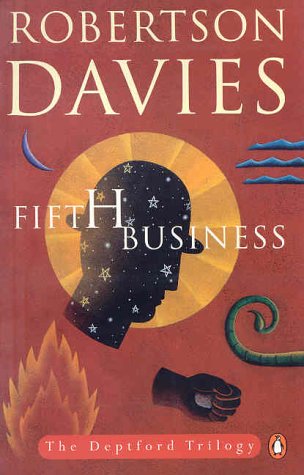
 Robertson Davies is a Canadian author best known for his four trilogies – the Salterton Trilogy, the Deptford Trilogy, the Cornish Trilogy and the unfinished Toronto Trilogy. As someone completely new to Davies’ work it was hard to know where to start, but as it didn’t seem necessary to read these trilogies in any particular order, I decided to begin with the one that sounded most appealing to me, the Deptford Trilogy, of which Fifth Business is the first book. I think it was a good choice! I actually started to read it last August for a reading week hosted by Lory, but got distracted during a house move and didn’t go back to it until just after New Year, when I was able to give it the attention it deserved.
Fifth Business is narrated by Dunstable (later renamed Dunstan) Ramsay in the form of a long letter written to the headmaster of the school from which he is retiring, having taught there for many years. In the letter, he looks back on his life, beginning in 1908 when, as a boy growing up in the small Canadian town of Deptford, an incident occurs that will shape his future: Percy Boyd Staunton, his friend and rival, throws a snowball containing a stone; Dunstan – the intended target – jumps aside; and instead the snowball hits a pregnant woman, who goes into premature labour with the shock. This incident means nothing to Percy, but it will haunt Dunstan for the rest of his life.
Many of the things that happen to Dunstan from this point on – the sort of man he becomes, the interests he develops, the career path he follows and the relationships he forms – could be traced back to the day of the snowball. His life-long obsession with the study of saints, for example, comes about because of his feelings of guilt and responsibility towards the pregnant woman, Mrs Dempster, and her son, Paul, the baby born prematurely. He convinces himself that she is a saint who has performed miracles, including saving his life when he is wounded at Passchendaele during the First World War. Illusions, deceptions and the unexplained are important themes running throughout the book, not just in the form of miracles but also magic tricks, conjuring and fortune telling.
I think this is the sort of book that probably needs to be read more than once to be able to fully appreciate all the different layers and ideas it contains. I’m not sure I enjoyed the book enough to want to read it again (although I did like it very much), but I’m certainly interested in reading the other two parts of the trilogy, The Manticore and World of Wonders.
Finally, if you are wondering about the title of the novel, it describes the role Dunstable/Dunstan Ramsay plays throughout his life and throughout the story:
“And you must have Fifth Business because he is the one who knows the secret of the hero’s birth, or comes to the assistance of the heroine when she thinks all is lost, or keeps the hermitess in her cell, or may even be the cause of somebody’s death if that is part of the plot. The prima donna and the tenor, the contralto and the basso, get all the best music and do all the spectacular things, but you cannot manage the plot without Fifth Business! It is not spectacular, but it is a good line of work, I can tell you, and those who play it sometimes have a career that outlasts the golden voices. Are you Fifth Business? You had better find out.”
 She Reads Novels