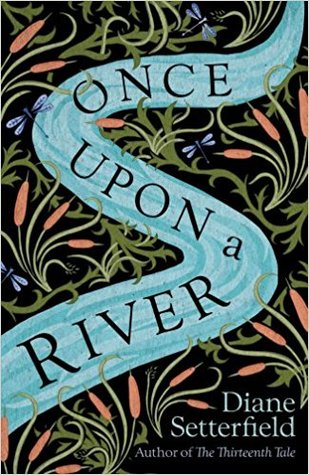
Once Upon a River by Diane Setterfield

The Swan Inn at Radcot on the bank of the Thames is a place famous for its storytelling. Every night the people of the village gather there to drink, to listen to tales of local folklore, myth, magic and history and to entertain their friends with stories of their own. But the old stories are growing stale and the listeners are ready for something new…

On the night of the winter solstice in 1887, a man appears in the doorway of the Swan – injured, wet from the river, and carrying the seemingly lifeless body of a young girl. Rita Sunday, who has some medical knowledge and acts as nurse and midwife for Radcot, is called to the inn and, unable to find a pulse, concludes that the girl is dead. Hours later, after attending to the man’s injuries, Rita looks at the child again and is amazed to find that she has started to breathe. It seems that the little girl will survive after all, but she can’t or won’t speak and tell anyone who she is or where she came from.

For the drinkers at the Swan, the girl’s apparent death and miraculous return to life is a wonderful story in itself, but it also provides a starting point around which many other stories begin to unfold and entwine. What is the girl’s name? Who are her parents? How did she end up in the river? Questions are raised and answers are searched for, theories are suggested and people come forward to claim the child as their own – but what is the truth? Will we ever know? As Rita grows closer to Henry Daunt, the man who pulled the girl from the water, they try to find a solution to the mystery and uncover yet more stories as they do so.

I am tempted to discuss some of those stories here and to talk about the characters who feature in them, but I’m not going to because I would risk spoiling some of the surprises Once Upon a River contains. Instead I’m going to stay on safer ground and discuss the role the river plays in the novel, both physically and metaphorically. The river is a constant presence right from the first chapter and the people in the story live and work on or around it – gravel-diggers, cressmen, bargemen and boat-menders. Their favourite folk tales revolve around the river too, including the legend of Quietly the ferryman who guides people in trouble either to safety or to ‘the other side’. The river and its surroundings give the novel a strong sense of place, although the sense of time is less clear – we are told that it has been five hundred years since the Battle of Radcot Bridge in 1387 but, apart from some references to photography, I felt that the story could have been set at a much earlier time in history.

The story itself flows like a river, carrying the characters – and the reader – gently along with the current. And like the tributaries of a river, there are other stories which began months or years before the girl’s arrival at the Swan and we go back to explore those stories too. This can make the novel feel slow at times and some patience is needed while the backgrounds of the various characters are explored, but I never felt bored. I was prepared to wait and see where the river took me and who the little girl would turn out to be. I was happy with the ending, although I do have one small criticism which is that I thought the way Rita’s story ended was very predictable and I would have preferred her to do have done something different.

I enjoyed Once Upon a River much more than Diane Setterfield’s previous novel, Bellman and Black; possibly more than The Thirteenth Tale too, as I didn’t love that one as much as most people seemed to. If you’ve never read any of her books before, though, I would recommend trying any or all of them to see what you think.

Thanks to Doubleday for providing a copy of this book for review via NetGalley.
Bellman & Black by Diane Setterfield

Bellman and Black William Bellman is ten years old when he hits a rook with his catapult and kills it. He and his friends had expected the bird to fly away before the stone hit it and are surprised to see it die. Just a small incident and William quickly moves on with his life, but as he grows older it seems that this brief moment of cruelty was much more significant than it seemed at the time.

William joins the family mill and through hard work and dedication he begins to rise in the world. As a rich, successful businessman with a wife and children he loves, life is perfect – but not for long. Soon, a series of tragic deaths start to destroy William’s happiness and he finds himself entering into partnership with a mysterious stranger dressed in black…

I found plenty of things to like about Bellman & Black but compared to Diane Setterfield’s first book, The Thirteenth Tale, it was disappointing. Although I didn’t love The Thirteenth Tale the way a lot of other readers did and consequently my expectations for this one weren’t too high, I definitely found her first book much more enjoyable than the second. Bellman & Black is packed with great, original ideas but I don’t think she was quite as successful at bringing all of these ideas together to form a satisfying story as she was with The Thirteenth Tale.

I think part of my problem with this book may have been that I just didn’t like William and felt somehow detached from him, so that even when he was going through times of tragedy and disaster I didn’t really care. And being able to care about William would have been a big advantage in a book where William was the only character who felt fully developed. Other characters come and go without the reader having a chance to get to know them properly; I thought William’s daughter, Dora, had potential but her character was never fleshed out enough for me to be able to warm to her.

Anyway, let’s move on to the things that I loved in Bellman & Black. Diane Setterfield has chosen to write about some fascinating aspects of Victorian culture and society! The first half of the book revolves around the running of a mill and we have the chance to learn about all the different areas of the textile industry, from the processes of producing and dyeing cloth to the benefits Bellman introduces to improve the welfare of his workers. In the second half of the book we explore the mourning business and the emporium William establishes in London as part of his deal with Mr Black (I kept being reminded here of Zola’s The Ladies’ Paradise).

Interspersed with William’s story are some shorter passages which discuss rooks and ravens – their appearance and behaviour, their roles in history and mythology, and every other aspect of rooks and ravens that you could possibly imagine. I’m not sure if these sections really added anything to the plot, but I liked the concept and enjoyed reading them.

Bellman & Black is described as a ghost story, though despite the Gothic touches and the foreboding atmosphere, I don’t really think I would agree with that description. William Bellman is certainly haunted, but it’s more of a psychological haunting than a physical one, so if you’re looking for a traditional ghost story you won’t find one here. This is the sort of book that will make you think and look below the surface for hidden meanings – and when you reach the final page you’ll be left to draw your own conclusions from what you’ve read.

I received a copy of this book for review via Netgalley.

The Thirteenth Tale by Diane Setterfield

The last book I read in 2010 was The Thirteenth Tale by Diane Setterfield. This is a book that has been hugely popular with book bloggers over the last few years and as usual, I appear to be one of the last to read it. I don’t have any excuse for this other than that certain books just seem to pass me by!

The Thirteenth Tale is the story of the reclusive and secretive Vida Winter, the world’s most popular author. Despite Winter’s fame, her past is shrouded in mystery; every time a new book is published she agrees to be interviewed – and every time she gives the journalist a different version of her life story. Now that she’s approaching the end of her life, she decides it’s time to tell the truth and summons Margaret Lea to write her biography.

Margaret is surprised by the request – after all, she’s just an amateur biographer who works in her father’s bookshop – but she agrees to visit Miss Winter and listen to what she has to say. As the story of Winter’s childhood unfolds, Margaret discovers what it is they have in common and why she was chosen to write the biography.

The Thirteenth Tale borrows elements of classic novels such as Wuthering Heights, The Woman in White, Jane Eyre, and The Turn of the Screw and it felt instantly familiar to me: the Yorkshire moors, twins, mistaken identities, ghosts and governesses all play a part in the story. I’m not saying this book was unoriginal or an exact copy of any other novel – it wasn’t – but Diane Setterfield was obviously trying to capture the overall mood of those gothic classics. Not only are the books I just mentioned referred to over and over again in the story, but they are cleverly incorporated into the plot.

Yet despite the familiarity, I didn’t guess everything that was going to happen. When the solution to the mystery (or one of the mysteries, as there are a few) was revealed, it surprised me – although the clues had been there all along and I’m sure if I read the book again it would be obvious.

One thing that struck me while I was reading this book was that we are never told when the story was supposed to be set. There are no historical references to suggest when the events of the book are taking place. Even Margaret’s timeframe, although obviously fairly recent, is still vague. I’m sure this was deliberate and it does help to give the story a timeless feel, but I’m one of those readers who likes to know when a story is set!

I can see why The Thirteenth Tale has been so popular because it really is a book for book lovers, with lots of great quotes like this:

Do you know the feeling when you start reading a new book before the membrane of the last one has had time to close behind you? You leave the previous book with ideas and themes – characters even – caught in the fibers of your clothes, and when you open the new book, they are still with you.

And this:

Do they sense it, these dead writers, when their books are read? Does a pinprick of light appear in their darkness? Is their soul stirred by the feather touch of another mind reading theirs? I do hope so.

While I didn’t love this book as much as I hoped I would (which I suspect might just be because I’ve read too many books of this type recently), it was fun, entertaining and very quick to read for a book with over 450 pages. It was also a perfect read for late December – a book to curl up with indoors while it’s cold and dark outside.