 “I suppose at one time in my life I might have had any number of stories, but now there is no other. This is the only story I will ever be able to tell…”
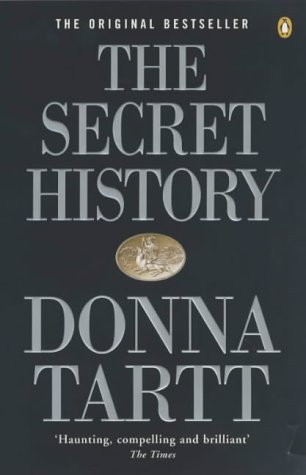
The Secret History is not exactly a mystery novel, in the usual sense. We are told right at the beginning of the book, in the prologue in fact, that our narrator Richard Papen and his friends have murdered a fellow student, Edmund ‘Bunny’ Corcoran. What we don’t know is why.
To explain the events leading up to the murder, Richard then takes us back to his first day at Hampden College in Vermont where he resolves to join the Classics department, an elite group of five students and their enigmatic professor, Julian Morrow. Despite being warned that Julian is very selective about the students he admits to his class and that taking Classics would leave him isolated from the rest of the college, Richard persists and is accepted into the group. His new friends – Henry, Bunny, Francis, Camilla and her twin brother, Charles – are rich, eccentric and secretive, and as Richard gets to know them better, he learns something shocking about them. But by now he has been drawn into their inner circle and it’s too late to walk away…
The Secret History is divided into two parts and as I read Part 1 and learned more about the build-up to Bunny’s death I found myself completely agreeing with the general opinion that this was a great book. Although we know from the start who is going to be murdered and who will be responsible for his death, the story is still compelling as there are still a lot of secrets to be revealed and a lot of questions to be answered. The story had a timeless feel, which I’m sure was intentional, and I couldn’t work out exactly when it was supposed to be set. I finally decided it must be the late 80s/very early 90s though due to some confusing cultural references for a long time I thought it might be earlier than that. It’s also a wonderfully atmospheric book, a combination of the elegant writing and the insular setting of a small college in a small community. The cold, harsh winter Richard spends alone in Hampden, virtually homeless and trying to stay warm, particularly stays in my mind after finishing the book, although I’m not sure what significance that episode had in the context of the rest of the story.
So, The Secret History is definitely a page-turner and only took me a few days to read, despite the length. Somewhere in Part 2, though, I thought the story started to lose some of its impetus. There was still plenty of suspense as right until the end of the book the reader is kept wondering how things will resolve for Richard, Henry, Francis and the twins, and how they will cope with the consequences of what they did. But I felt that this was dragged out for too long and I quickly got bored with the various excesses of the characters (were there any students in that entire college who didn’t have a drug or alcohol problem? I could accept that some of them might have done, but surely not all of them!) I’m glad to have finally read The Secret History – I was starting to feel that I was the only person in the world who still hadn’t read it – but although I did enjoy it I was not as enamoured with it as so many other people have been. I wonder if maybe I would have liked it more if I’d read it when I was younger and closer to the age of the characters in the story.
One final thing I want to mention is that almost as soon as I started reading The Secret History I started to get the feeling I already knew the story. And then I remembered what it reminded me of – The Secret Diaries by Janice Harrell, a trilogy of young adult novels I read and loved as a teenager. I managed to find my old copy of the final book in the trilogy, Escape, and couldn’t believe the number of similarities with The Secret History, which was published two or three years before Harrell’s books. It was not just the general plot that was the same (a group of students covering up a dark secret, a narrator who is a newcomer and desperate to be accepted by the group, etc.), but some of the finer details as well – the personalities of some of the characters, the consequences of their actions, the weekend trips to a cabin in the woods, even the fact that two of the characters in The Secret History were twins (one male and one female) while in The Secret Diaries we’re constantly being told that Stephen and his girlfriend Tessa look like twins. I can’t find any more information about this online, apart from one or two bloggers who have said they noticed the same thing, but it has made me curious! Has anyone else read both The Secret History and The Secret Diaries?
 She Reads Novels