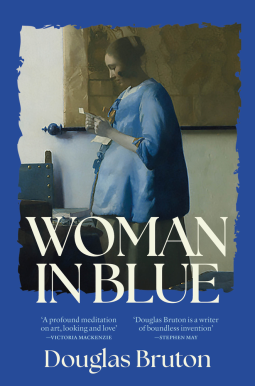
 There’s clearly something about the paintings of Johannes Vermeer that inspires novelists; first, Tracy Chevalier’s Girl With a Pearl Earring and now Douglas Bruton’s excellent Woman in Blue, which is published today. This is the second of Bruton’s books I’ve read, the first being 2021’s Blue Postcards and apart from the shared word in the title (Bruton certainly seems to like the colour blue!) and the shared theme of art and artists, I found this one very different in style and structure.
The novel begins in the present day with our unnamed narrator, referred to only as ‘a man in Amsterdam’, visiting the Rijksmuseum to look at a painting. Just one painting, which he has become so obsessed with that he barely notices any of the others. The painting is Vermeer’s Woman in Blue Reading a Letter and the narrator returns to the museum day after day to study the colours and the composition, but most of all just to spend time in the woman in blue’s company and to imagine the human being who inspired the picture. He’s transfixed by this particular painting for its own sake, but also because the woman reminds him in subtle ways of both his wife and another woman he once loved.
In 17th century Delft, we meet the woman in blue herself – or rather, the young woman who sits for Vermeer as he paints her portrait. Her chapters alternate with the present day ones, slowly building up a history of the woman in blue, her life in Delft and her relationship with the artist. In reality, the true identity of the sitter has never been confirmed (Vermeer’s wife, Catharina Bolnes, has been suggested as a likely candidate, but it seems there’s no actual evidence to prove it), so Bruton has the freedom to create his own fictional story for the woman, whom he names Angelieke.
Although the book is set in two different time periods and narrated by two different characters, the lines dividing the two are blurred. Angelieke is a real woman in 1663, but in the modern day sections, she’s aware that she is a painting in a museum and that the male narrator comes to see her every day. She looks forward to his visits and feels a connection with him, just as he feels one with her. This is not the first novel to give a painting a mind of its own (I, Mona Lisa by Natasha Solomons does the same and I’m sure there must be others) but I really liked the way Bruton handles that element of the story, giving it a dreamlike feel and merging the two narratives so that they don’t feel too separate or disconnected.
With it being a real painting rather than a fictional one, it’s easy to google it so you can refer to the picture itself as you read. The narrator’s observations, made during his repeated viewings, helped me to see things in the painting that I probably wouldn’t have noticed for myself. With each chapter, he finds new details to study and focus on – the map on the wall, the letter in the woman’s hand, the blue bed jacket she’s wearing and the question of whether or not she could be pregnant. At times, Bruton returns to a theme he also touched on in Blue Postcards: the idea that a painting offers something different to each individual who views it and that the viewers themselves can almost ‘become’ part of the painting:
What I like about the painting – one of the many things I like – is how cleverly the artist has included me in it and made me complicit in the looking. It is an intimate and private moment and Vermeer intrudes on it without at all breaking it, and we – Vermeer and me – stand silent, breath held, just looking at this young woman turned in on herself.
For a short book – a novella at 144 pages – there’s so much packed into it that I’ve probably only scratched the surface in this review. I would recommend Woman in Blue to anyone who loves art, but even if you don’t, there’s still a lot here to enjoy.
 Thanks to Fairlight Books for providing a copy of this book for review via NetGalley.
As this is an independent publisher, I am counting Woman in Blue towards this year’s #ReadIndies event hosted by Kaggsy’s Bookish Ramblings and Lizzy’s Literary Life. You can find out more about Fairlight Books by visiting their website here.


 She Reads Novels