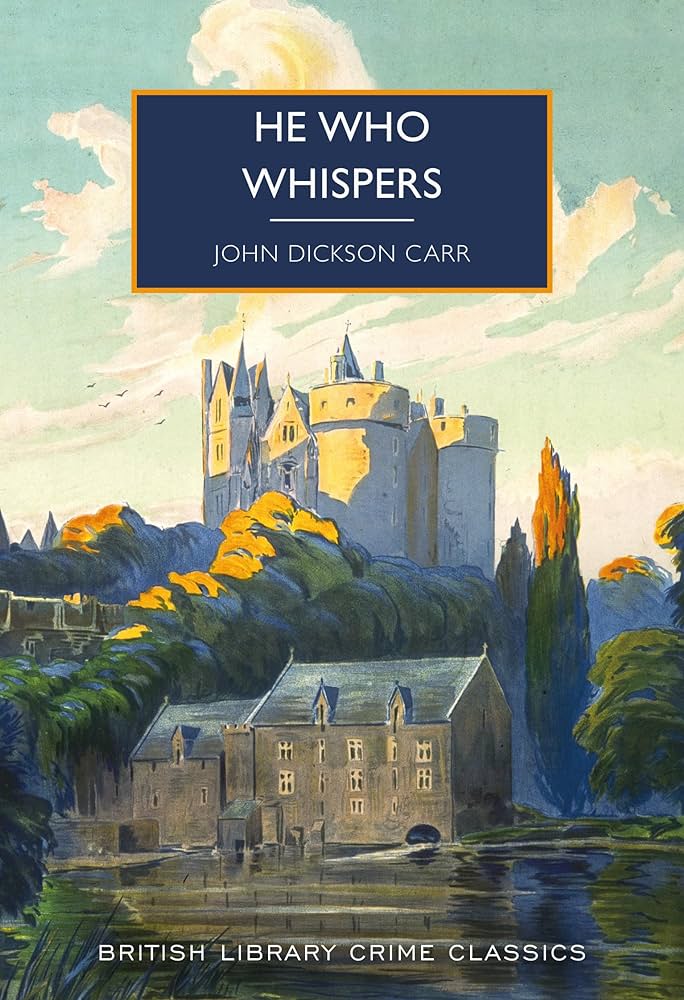
 He Who Whispers is one of John Dickson Carr’s Dr Gideon Fell mysteries, originally published in 1946 and recently reissued as a British Library Crime Classic. I read another in the series, The Black Spectacles, earlier this year and loved it, so I had high hopes for this one.
The book is set in the aftermath of World War II and is written from the perspective of Miles Hammond, a Nobel Prize winning historian who has just inherited his uncle’s estate, which includes a house in the New Forest containing a large collection of books. As the novel opens, Miles is in London looking for a librarian to assist with his uncle’s collection, and while there he accepts an invitation to attend a meeting of the Murder Club, a group who get together regularly to try to solve true crime cases. On arriving at the venue, Miles is surprised to find that nobody else is there apart from a young woman, Barbara Morrell, and tonight’s speaker, Professor Rigaud.
Despite only having an audience of two, Rigaud proceeds to tell them the story of a crime which took place in France before the war and is both unsolved and seemingly impossible. It involves the murder of a wealthy Englishman, Howard Brooke, found stabbed with his own sword-stick while apparently alone on top of a high tower with witnesses on three sides and the fourth unreachable as it overlooks the river. Fay Seton, Brooke’s secretary, is suspected of the crime for the dubious reason that she is believed to be a vampire – and only a creature that can fly through the air could have reached the top of the tower!
Miles is intrigued by Rigaud’s story and when Fay Seton turns up in London, he offers her the job of librarian so that he can find out more. Heading for his uncle’s house in the New Forest with Fay and his sister Marion, Miles finds that he is becoming increasingly fascinated by the suspected vampire – but when Marion has a terrifying experience while alone upstairs in her bedroom, does this mean Fay has struck again or is there another explanation for the strange occurrences? Luckily, Gideon Fell arrives that same night and begins to investigate!
I enjoyed He Who Whispers, but not nearly as much as I enjoyed The Black Spectacles and I’m not really sure why this particular book is considered one of Carr’s best (apparently even by Carr himself). Yes, the solution is very clever, but I felt that we, the reader, are given very little chance of solving it ourselves, particularly as we don’t really see any of Fell’s thought processes during the novel. He reveals everything in the denouement at the end, but until then we’re as much in the dark as Miles Hammond. There was also too much focus on the vampire storyline for my taste; I thought the mystery was interesting enough without the supernatural element, but I expect other readers will love that aspect of the plot.
Carr captures the feel of post-war Britain very well; a surprising number of 1940s crime novels barely refer to the war at all, but in this one it’s an integral part of the story. Several of the characters in the novel have served in the war, there are mentions of rationing and bombed-out streets and of the effect all of these things have had on people’s mental health. There’s quite a small cast of characters and Carr takes the time to flesh each of them out, but I never really warmed to our protagonist, Miles – he has two possible love interests throughout the novel and although his final decision could have gone either way, I felt that he made the wrong choice in the end!
I want to read more of the Gideon Fell mysteries, so if you’ve read any of them please let me know which ones you particularly enjoyed.
 She Reads Novels