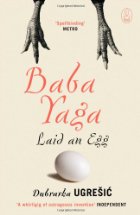
Baba Yaga Laid an Egg is part of the Myths series by Canongate Books, in which authors retell traditional myths from around the world in a new and original way. This book by Croatian author Dubravka Ugresic takes a fresh and unusual approach to the Slavic myth of Baba Yaga.
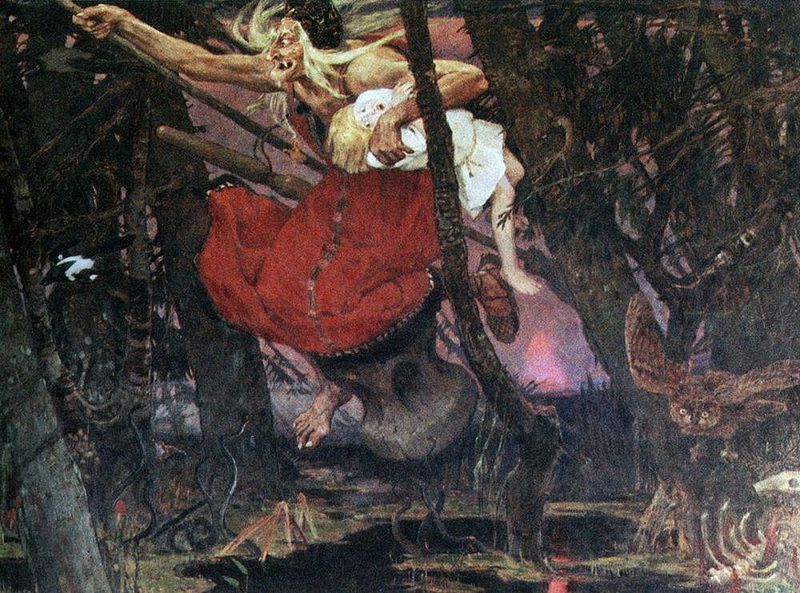 Baba Yaga (shown here in a painting by Viktor Vasnetsov – picture from Wikipedia in public domain) is usually portrayed as a hag or witch who lives in a log cabin mounted on a pair of chicken legs. She uses a giant mortar and pestle to fly through the air, kidnapping and threatening to eat small children. Although she has a terrifying appearance, Baba Yaga is also said to possess great wisdom and will sometimes give help and advice to anyone brave enough to ask.
Rather than simply reiterating this myth, Ugresic relates the myth to the lives of modern women and explores a large number of topics including ageing, feminism, love and loneliness. The book does not follow the format of a conventional novel and is divided into three separate and seemingly unconnected stories.
In the first story, the narrator travels to Varna in Bulgaria, the childhood home of her mother who is now old and ill. In the second story, we meet Beba, Pupa and Kukla, three old women who are staying together at a spa in the Czech Republic. But what is the connection between these two stories and what do they have to do with Baba Yaga? I have to admit, by this point I was starting to feel slightly confused. Yes, I had learned a lot about growing old, but how did all of these things relate to the myth of Baba Yaga? Luckily, I found the answers to my questions in the third and final section of the book.
Part 3 is presented as if a folklore expert was responding to a request for information about Baba Yaga and had been asked to explain the meaning of the first two sections. This part of the book was fascinating but began to feel like a very, very long encyclopedia entry. I previously knew almost nothing about Baba Yaga though, so it was good to learn something about the myth. I was also pleased at how well this final section pulled all the threads of the book together and helped me understand the significance of everything I had just been reading.
This book should appeal to anyone who has ever worried about growing old or anyone with an interest in mythology as it relates to feminism. I can’t honestly say that I loved this book or even that I particularly enjoyed it, but it was a very interesting concept and I’m glad I decided to give it a try.
Has anyone read any of the other Canongate Myths books. Are they similar to this one?
 She Reads Novels