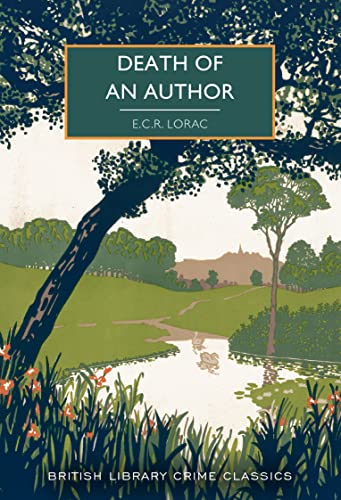
 E.C.R. Lorac’s Death of an Author, first published in 1935, begins with the novelist Michael Ashe persuading his publisher to arrange a dinner party so that he can meet another of their authors, the crime writer Vivian Lestrange. Despite being famously secretive and reclusive, Lestrange accepts the invitation – but to Ashe’s surprise, a young woman arrives at the party rather than the man he had expected. Vivian, of course, could be either a man’s name or a woman’s, and Lestrange seems amused by Ashe’s assumptions. She engages Ashe in a debate on gender equality and whether it’s possible to tell a man’s writing from a woman’s – and naturally, she comes out of the argument on top.
Three months later, the same young woman approaches the police to report a crime and introduces herself as Eleanor Clarke, secretary to the author Vivian Lestrange. She admits that Lestrange really is a man, although she has impersonated him at parties a few times for fun. Her reason for contacting the police is that Mr Lestrange has disappeared along with his housekeeper, Mrs Fife, and Eleanor is unable to gain entry to his house, her place of work. She is concerned about him and wants the police to investigate. Inspector Bond, however, is convinced that Eleanor herself is Vivian Lestrange and that some sort of deception is taking place. His Scotland Yard colleague, Inspector Warner, on the other hand, believes what Eleanor has told them and accepts that she and Lestrange are two separate people. But which of them is correct – and if Eleanor is telling the truth, what has happened to the real Vivian Lestrange?
This is the first book I’ve read by Lorac, although I’ve been intending to try one for a long time as I know she’s one of the most popular authors in the British Library Crime Classics series. It was maybe not the best one to start with (it has just been reprinted in January, and I would imagine the British Library have been publishing her stronger books first), but I found it enjoyable enough, with one or two reservations. It certainly has a fascinating plot, with the police trying to investigate a crime without being sure who the victim is or even whether a crime has been committed at all. It was interesting to watch the two detectives, Warner and Bond, working together to come up with different possible scenarios and trying to decide which was the most likely.
As an author who wrote under her initials (her real name was Edith Caroline Rivett) and other pseudonyms including Carol Carnac (Lorac is Carol backwards), the arguments Eleanor Clarke makes to defend women’s writing and to refute the assumption that only men could write a certain kind of book must have been close to Lorac’s own heart. And yet, the way the story develops after this seems to contradict some of the points that were being made at the beginning and I was left feeling slightly confused as to what Lorac was actually trying to say.
Although I couldn’t quite manage to love this one, it was still an entertaining read and I’m sure I’ll try more of Lorac’s books. I know some of you have read a lot of them, so I would like to hear which ones you would recommend!

I’m counting this towards #ReadIndies, a month celebrating books from independent publishers hosted by Kaggsy’s Bookish Ramblings and Lizzy’s Literary Life.
 She Reads Novels