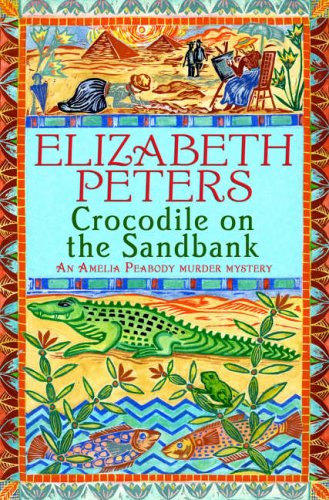
Crocodile on the Sandbank by Elizabeth Peters

Crocodile on the Sandbank is the first of Elizabeth Peters’ Amelia Peabody books, a series of historical mystery novels set in Egypt and following the adventures of a Victorian lady with a passion for archaeology.

When we first meet Amelia at the beginning of the novel, she has recently inherited a fortune following her father’s death and is planning to use some of her money to visit Egypt. Passing through Rome on her way to Cairo, Amelia rescues a young woman, Evelyn Barton-Forbes, who has been abandoned by her lover and the two become friends and travelling companions. After they arrive in Egypt, Amelia and Evelyn meet archaeologist Radcliffe Emerson and his younger brother Walter, who are working on a dig at Amarna. The two women soon team up with the Emerson brothers to tackle a mysterious mummy who seems to be stalking them at night!

Amelia is the book’s first person narrator, but I wasn’t sure at first if I was going to like her. She has a very sharp, witty narrative voice and for the first few chapters I found her alternatively amusing and irritating. Luckily though, after I got to know her better I started to warm to her. As well as being outspoken and sarcastic she’s also brave, intelligent and loyal to her friends – and definitely not a conventional Victorian woman! Emerson is a very strong character too and I enjoyed watching his relationship with Amelia develop.

Although I am interested in history, Ancient Egypt has never been one of my favourite subjects to read about, but Amelia and Emerson are so enthusiastic about Egypt and archaeology that I ended up with more enthusiasm for the subject too. The adventures they have exploring tombs, discovering mummies and deciphering hieroglyphics all sound so fascinating!

The mystery itself wasn’t one of the novel’s strong points though. It was hard to believe that someone as intelligent as Amelia wasn’t able to immediately work out what was happening and who the villain was. But like Alan Bradley’s Flavia de Luce mysteries, I think the charm of this book was in the setting and the characters (or Amelia and Emerson, at least – the other characters didn’t have a lot of depth) rather than the mystery.

The overall tone of Crocodile on the Sandbank is light and entertaining and although I’m not completely convinced about this series yet, I did like this book enough to want to read the second one. I’ll remember to pick up The Curse of the Pharaohs next time I want to relax with another fun Egyptian adventure.

Moon Tiger by Penelope Lively

The famous historian Claudia Hampton is dying. From her hospital bed she tells the nurse that she is going to write a history of the world: “A history of the world…and in the process, my own”.

Penelope Lively’s Moon Tiger won the Booker Prize in 1987 and yet it’s not a book that I’ve ever heard much about. Maybe it’s a good thing I didn’t know anything about it, as I would otherwise probably have felt too intimidated by the thought of reading it and might never have picked it up. And that would have been a shame because although it was certainly a complex, challenging book, it was also one that I found very rewarding and I didn’t regret the time and effort I put into reading it.

I really wanted to love Moon Tiger. And I did love parts of it. The whole book is beautifully written (I particularly liked the final chapter) and I found myself constantly marking passages I wanted to remember. The only problem I had was that the story was too fragmented for me. The narration jumps from third person past tense to first person past tense to third person present tense – as well as back and forth in time. Eventually I began to really appreciate how well-structured the story actually was, but unfortunately it didn’t start to work for me until I was halfway through the novel.

As Claudia explains at the beginning of the book she is taking a ‘kaleidoscopic’ view of history. One idea leads to another with only very tenuous connections between them. The most tiny and innocent things that happen in the hospital (a conversation with the nurse about God, a poinsettia plant brought in by her sister-in-law) trigger memories which lead to other memories and then other memories…

Sometimes the narrator also changes very abruptly, so that we see the same scene from two different perspectives. This made things even more confusing, but did help build up a full, balanced picture of Claudia. And Claudia is not the most likeable of people. I loved her as a character – she’s fascinating and unconventional – but not as a person. At first I couldn’t understand her animosity towards her sister-in-law, Sylvia, and I was frustrated that she wasn’t more loving to her daughter, Lisa. The reasons for her behaviour are revealed only very slowly as the story progresses and the secrets of Claudia’s past come to light. This gave the novel some suspense and mystery, as not everything was obvious from the beginning and a lot of things didn’t fall into place until near the very end. I still couldn’t actually like Claudia, but at least I could understand her better.

I did like the way Claudia talked about history and how she was able to relate historical events to events from her own past. To Claudia, history is a personal subject – she writes her history books for the general public, in language that they can understand. And just as it would be difficult to write a history of the entire world in strictly chronological order, the story Penelope Lively tells in Moon Tiger is not chronological either.

Where the book really comes into its own is in Claudia’s recollections of Egypt when she was working in Cairo as a war correspondent during World War II. The descriptions of Egypt are vivid and realistic, the type that could only be written by someone familiar with the country (as Penelope Lively was). It’s in these sections that we begin to see a softer side of Claudia – and in case you were wondering, this is also when we finally learn what a Moon Tiger is!

I still find it hard to say what I thought about this book. I was impressed by it, but did I actually enjoy it? No, not really – but it was certainly one of the most interesting and unusual books I’ve read this year.