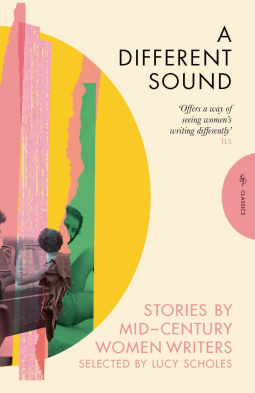
A Different Sound: Stories by Mid-Century Women Writers edited by Lucy Scholes

This is a fascinating collection of short stories, all written by women and originally published in the 1940s and 50s. When I saw the list of authors included in the book, there were several I’d already read, others I’d heard of but never read, and a few that were completely new to me. There are eleven stories in total and as always when writing about collections like this, I’ll have more to say about some of them than others!

There’s only one story in this collection that I’ve read before – and that’s The Birds by Daphne du Maurier. As she’s one of my favourite authors, I decided to read it again and found it just as wonderful and atmospheric as I did the first time. Rather than discuss it again here, I’ll direct you to my previous review and will just add that even if you’ve seen the Hitchcock film, I would still recommend reading the story which is quite different in several ways.

Elizabeth Jane Howard is an author I’m familiar with through her Cazalet Chronicles (I’ve read the first two books in the series and am planning to read the others) and she is represented here with Three Miles Up, an eerie story in which two men are taking a trip through the countryside on a canal boat when they encounter a young woman called Sharon. Once Sharon joins them on the boat, things begin to go wrong and they find themselves sailing up a canal that doesn’t appear on any maps. I loved this one, although I wasn’t aware that Howard wrote ghost stories so it wasn’t what I’d expected at all.

The other two authors I’ve read previously are Stella Gibbons and Elizabeth Taylor. The Gibbons story, Listen to the Magnolias, is set during the war and involves an elderly widow nervously awaiting the arrival of five American soldiers who will be billeted in her home, while Taylor’s The Thames Spread Out follows a woman who is trapped upstairs in her house during a flood while swans swim at the bottom of her staircase. I liked both of these, particularly the second.

Apart from The Birds, my favourite story in the book turned out to be The Skylight by Penelope Mortimer, in which a woman and her young son rent a house in a remote area of France but arrive to find the doors all locked and no sign of the owners. The only point of access is an open skylight in the roof and the mother makes a decision she quickly comes to regret. Mortimer creates a real sense of fear and tension in this story and I couldn’t wait to reach the end to find out if everything was going to be okay!

Considering the publication dates, the Second World War naturally plays a part in many of these stories – I’ve already mentioned the Stella Gibbons, but another is Diana Gardner’s wonderful story, The Land Girl, about a young woman placed on a farm as a Land Girl who takes an instant dislike to the woman whose home she is staying in and decides, out of spite and jealousy, to cause trouble for her.

The stories above are the ones that really stood out for me in this collection, but I enjoyed all of them to some extent, apart from maybe Elizabeth Bowen’s Summer Night which I found well written but confusing due to the structure and changing perpectives. I was also slightly disappointed by Sylvia Townsend Warner’s Scorched Earth Policy about an elderly couple preparing for a wartime invasion, simply because it was too short for any real plot or character development. It was nice to discover some authors I’d never come across before, though: Frances Bellerby, who in The Cut Finger tells the story of a little girl learning some important lessons about the world; Inez Holden whose Shocking Weather, Isn’t It? follows a woman who visits her cousin in various different places over the years; and Attia Hosain who explores the feelings of a newly married woman struggling to fit in with her husband’s friends in The First Party.

I can definitely recommend this collection; I found something to interest me in every story, even the ones I didn’t enjoy as much. I also now have a list of authors I need to explore further!

Thanks to Pushkin Press Classics for providing a copy of this book for review via NetGalley.

Marking Time by Elizabeth Jane Howard

This, the second in Elizabeth Jane Howard’s Cazalet Chronicles, continues the story begun in The Light Years, taking us through the early stages of the Second World War. It’s been almost exactly a year since I read the first book, but I found that I could still remember the characters and storylines and jump straight back into the story. If I’d needed a reminder, though, the book opens with a useful family tree, character list and summary of the previous novel.

Marking Time begins just as Britain declares war on Germany in September 1939 and ends just two years later, in 1941. The Cazalet family – who include ‘the Brig’ and his wife ‘the Duchy’; their daughter, Rachel; their three sons, Hugh, Edward and Rupert, with their wives and children; and an assortment of other relations, friends and servants – are gathered again at Home Place in the Sussex countryside and this is where most of them will be based during the two years the novel covers. As an upper middle class family, they are sheltered from some of the worst deprivations of the war, but eventually it does begin to affect each of their lives in all sorts of ways.

One of my criticisms of The Light Years was that the number of characters was overwhelming and the constant changes from one perspective to another made it difficult to focus. Marking Time has a slightly different format. There are still several chapters which deal with the whole family, spending a few pages with one family member, then a few pages with another, but there are also some longer sections which concentrate on one character at a time.

The characters who are given their own chapters are the three teenage girls – Louise, Polly and Clarissa (Clary) – who happen to be three of the characters I singled out as favourites in my review of The Light Years. I was delighted to have the opportunity to spend a more substantial period of time with each of the girls, getting to know them better. Louise, the eldest child of Edward and Villy, is an intriguing mixture of sophistication and innocence. In Marking Time, we see her leave home to become an actress, fall in love for the first time, and make an unwelcome discovery about another family member. Clary’s chapters are written partly in the form of diary entries and this gives her a particularly strong and distinctive voice. Clary receives some bad news quite early in the war – although we don’t yet know exactly how bad – but there are some positives to come out of this, such as an improvement in her relationship with her stepmother, Zoe. Meanwhile, Polly – Hugh and Sybil’s daughter – overhears a private conversation which throws her life into turmoil.

Despite all the problems various family members are experiencing, the novel isn’t entirely depressing; there are some funny scenes too, mainly involving the younger children, Neville and Lydia, and we see the beginnings of a touching romance between two of the Cazalet servants. Although the lifestyle of the Cazalet family is entirely different from my own – partly because of the time period in which they live, but also because of their class – I still feel that they are people I understand and care about. I enjoyed this book much more than the first and am pleased I still have another three Cazalet novels to read. The next one is Confusion and I’m looking forward to finding out how the family fare throughout the rest of the war.

This is book 14/20 of my 20 Books of Summer.

The Light Years by Elizabeth Jane Howard

This is the first of the five volumes which form The Cazalet Chronicles, Elizabeth Jane Howard’s series about an upper-middle class English family and how their lives are affected by World War II. Everyone seemed to be reading these books a year or two ago (if they hadn’t already read them at the time of publication), so I’m coming to them late as usual!

First published in 1990, The Light Years opens in the summer of 1937 with three generations of the Cazalet family gathering at Home Place, the Sussex home of ‘the Brig’, now an elderly man but still in charge of the family business, and his wife, affectionately known as ‘the Duchy’. The Brig and the Duchy have three sons; two of these, Hugh and Edward, work in the business and are able to provide comfortable lifestyles for their wives and children, but the third brother, Rupert, has chosen a different path in life – as an artist who is yet to find any success, he is struggling financially, much to the disappointment of his second wife, the beautiful and much younger Zoe. There is also a sister, Rachel, who is unmarried but, unknown to the rest of the family, in love with her friend, a woman called Sid.

After being introduced to each of the Cazalets, their spouses, children, servants and friends, we then jump forward a year to 1938 when the same people – and several more – are beginning to gather together again. On the surface it looks like being another idyllic summer of relaxing in the garden, playing tennis and board games and visiting the beach, but in reality, few if any of the characters are truly happy. There are cracks appearing in Rupert and Zoe’s marriage, and in Edward and Villy’s, Rachel dreads being separated from Sid, and the children face a series of dramas ranging from chickenpox and the loss of beloved pets to the fear of being sent away to school. Meanwhile, the approaching war casts a shadow over everything, as the possibility of conflict with Germany, which at first seemed so remote, begins to look more and more likely.

I didn’t get off to a very good start with this book; it took me a while to get into it, but I think part of the problem was that with so many characters, and the perspective switching from one to the other every few pages, it made it difficult to find someone to identify with and focus on. Somewhere around the middle of the book, though, things changed. I felt that I was starting to get to know some of the characters at last, and to feel sympathy for the situations they were in. I went from wondering whether to continue reading to knowing that I would not only be finishing this book, but almost certainly reading the second one, Marking Time, as well!

I particularly enjoyed spending time with the younger generation of the family. The relationships, friendships and rivalries between three of the girls – Louise, Polly and Clary – and three of the boys – Teddy, Simon and Christopher – were very well written and I’m looking forward to seeing them continue to develop as they grow up. Sometimes when you read a novel with child characters, it feels as though the author has forgotten what it was like to be a child; that was not the case in this book – I felt that Elizabeth Jane Howard had remembered exactly how a child’s mind works and the things that are important to them.

I did end up feeling very positive about this book overall and can understand now why so many people love this series so much. The last thing I need at the moment is to be adding four more long novels to my TBR, but I think I’ll have to as I can’t imagine not finding out what happens next to the Cazalets!