My Commonplace Book: March 2016

commonplace book
Definition:
noun
a notebook in which quotations, poems, remarks, etc, that catch the owner’s attention are entered

Collins English Dictionary

~

A summary of this month’s reading, in words and pictures.

~
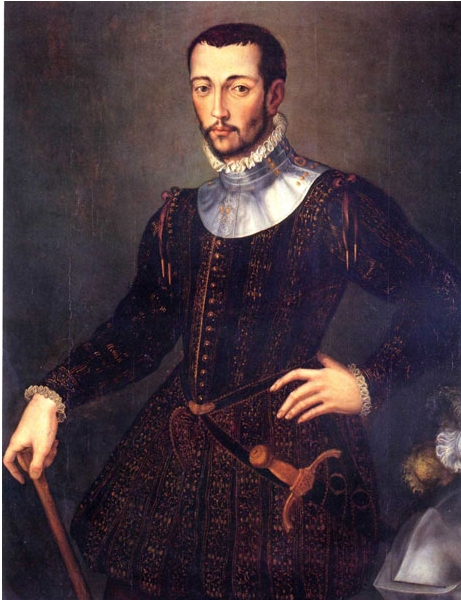
He had a narrow, swarthy face with a high forehead, so high he had his cropped dark hair brushed forward – he was losing his hair, then. His eyes slanted downward, sensual, melancholic and secretive. Saints in the churches, painted on panels and murals, had halos of light around their heads and bodies; the prince seemed to have a tracing of darkness, as if he was standing in front of a prince-shaped hole that led into something terrible, and you could just catch glimpses of it when he moved…

The Red Lily Crown by Elizabeth Loupas (2014)

~

Do you keep time in the same place that you save it? If so why is it so difficult to find? It must be in a very safe place.

Human Croquet by Kate Atkinson (1997)

~

Miss Rebecca was not, then, in the least kind or placable. All the world used her ill, said this young misanthropist, and we may be pretty certain that persons whom all the world treats ill, deserve entirely the treatment they get. The world is a looking-glass, and gives back to every man the reflection of his own face. Frown at it, and it will in turn look sourly upon you; laugh at it and with it, and it is a jolly kind companion; and so let all young persons take their choice.

Vanity Fair by William Makepeace Thackeray (1847)

~

Buddhist caves, two hundred and fifty BC…? It was the Emperor Ashoka who had ordered them to be made, he felt almost sure about that. But there was something else, something to do with the shape of the caves, that escaped him. Was it about meditation? He hadn’t been paying close attention, his mind had been preoccupied, and now their purpose remained a mystery – as it seemed so much in this country was destined to, at least for him.

Arctic Summer by Damon Galgut (2014)

~

The children of Dynmouth were as children anywhere. They led double lives; more regularly than their elders they travelled without moving from a room. They saw a different world: the sun looked different to them, and so did Dynmouth’s trees and grass and sand. Dogs loomed at a different level, eye to eye. Cats arched their tiger’s backs, and the birds behind bars in Moult’s Hardware and Pet Supplies gazed beadily down, appearing to speak messages.

The Children of Dynmouth by William Trevor (1976)

~

Days lived, whether full or empty, whether busy or serene, are but days gone by, and the ashes of the past weigh the same in every hand.

The Royal Succession by Maurice Druon (1957)

~

As for the cold, he had never experienced anything like it: a dry, iron clamp upon the land, like death itself, full of unexpected beauty, like the hard crystals that formed on the inside of the windows. The cold did something strange to the quality of sounds around the farm, deadening all background noise so that the smallest scratching or whisper was emphasised. It was easy to see how the unwary settler could die in such a scene, lulled into marvelling at its deadly beauty even as his blood began to freeze.

A Place Called Winter by Patrick Gale (2015)

~
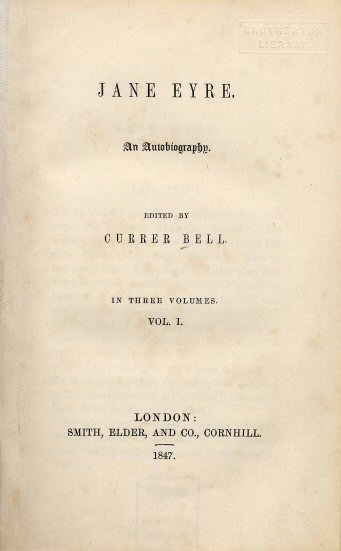
Jane_Eyre_title_page

Under Dad’s philosophy, books were not shape-shifting constructions of a reader’s imagination. Novels, he said, offered the specific clues, maps and guidelines necessary for their own evaluation. By clues, he did not mean metaphors and he did not mean symbolism. He meant actual clues. To him, every book was its own treasure map. A good novel, he said, left the close reader with a useful souvenir. All you needed to do was learn to see what was right under your nose.

The Madwoman Upstairs by Catherine Lowell (2016)

~

“Robert has been led most of his life by his ambition – our family’s ambition – for him to be king. All of us have paid a price, for some the highest price, for him to fulfil that desire, but we have done so because we see in him something that lifts him above most other men; something that makes us hope. He has the iron will of our grandfather and, yes, the hot blood of our father, though he’ll not hear the latter said, but he also has the heart of our mother. It is a true heart. A good heart. You must keep faith, my lady.”

Kingdom by Robyn Young (2014)

~

Sitting at her bureau a short time before, Frances had been picturing her lodgers in purely mercenary terms – as something like two great waddling shillings. But this, she thought, shuffling backward over the tiles, this was what it really meant to have lodgers: this odd, unintimate proximity, this rather peeled-back moment, where the only thing between herself and a naked Mrs Barber was a few feet of kitchen and a thin scullery door.

The Paying Guests by Sarah Waters (2014)

~

“I think you’ll find most women in pursuit of a husband share an interest in appearing less educated than they really are,” said Beatrice. “It is why I have a low opinion of them.”

“Of women, miss?” said Abigail.

“No, of husbands,” said Beatrice.

The Summer Before the War by Helen Simonson (2016)

~
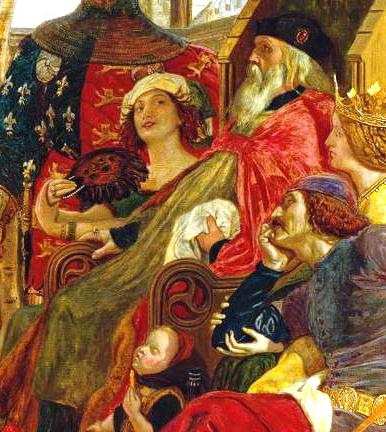
Knighthood’s not for the likes of these people; for Madame Perrers’ brood. He thought she knew her place. But she’s overreached herself; she’s as grasping as the rest of them, after all. Do these people think they can buy or steal everything?

The People’s Queen by Vanora Bennett (2010)

~

Favourite books this month: The Red Lily Crown and The Summer Before the War.
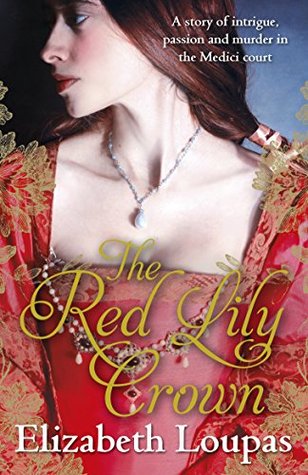
The Red Lily Crown by Elizabeth Loupas

The Red Lily Crown Nearly two years ago I read The Second Duchess by Elizabeth Loupas, a fascinating novel set in Renaissance Italy which told the story of Barbara of Austria, the second wife of Alfonso d’Este, Duke of Ferrara. In The Red Lily Crown we revisit the same time period, but this time we are in Florence, where Barbara’s sister, Giovanna of Austria, is married to Francesco de’ Medici, a member of the ruling Florentine family. The novel opens in 1574 when Grand Duke Cosimo de’ Medici is about to die and his son Francesco is preparing to inherit the red lily crown of Tuscany.

Fifteen-year-old Chiara Nerini is the orphaned daughter of a bookseller and alchemist. Desperate for money to support her grandmother and little sisters, Chiara attempts to sell some of her father’s old equipment to Francesco, who is also known to have an obsession with alchemy. However, Chiara gets more than she bargained for when she finds herself being initiated as Francesco’s soror mystica, the female partner believed to be necessary for the creation of the legendary Philosopher’s Stone. Her new role brings her into the heart of the Medici household where she witnesses first-hand the corruption, intrigue and danger of Francesco’s court.

I loved The Red Lily Crown. I wasn’t sure about it at first, because books about alchemy tend not to appeal to me, but actually the alchemy was only one part of the story. What I found much more interesting was the wonderful portrayal of the Medici court and the people Chiara meets during her time there. Francesco de’ Medici himself is the perfect villain: coldly intellectual, clever and calculating, and with a terrifying knowledge of poisons. His only weakness appears to be his love for his Venetian mistress, Bianca Cappello – although their relationship is not a healthy one. Bianca is as scheming and ruthless as Francesco himself but she is also another victim of his cruelty and can only truly please him when pretending to be something she is not.

Chiara does make some friends too and becomes close to Francesco’s poor wife, the Grand Duchess Giovanna, who has been unable to provide her husband with the healthy male heir he so badly wants. There’s also the possibility of romance for Chiara with a mysterious English alchemist known as Ruanno, but knowing little about him and his previous life in Cornwall, she must decide whether or not he can be trusted. As for Chiara herself, I found that, as with Barbara in The Second Duchess, our heroine is both a strong woman and one whose actions and attitudes are believable in the context of the time period.

All of these characters have their role to play in a fast-moving plot packed with murder, magic, power struggles and poisonings. The setting is a great one too. The Medici palaces, the Nerini bookshop and the streets and squares of sixteenth century Florence are all vividly described – and there are some particularly memorable scenes set in the Grand Duke’s labyrinth in the Boboli Gardens. Not everything that happens in the story is entirely accurate, but Elizabeth Loupas explains in her author’s note what is true and what is fictional. Of course, there is a lot that we still don’t know for sure about the Medici, which leaves plenty of scope for an author to use his or her imagination.

I think I liked The Second Duchess slightly more than this one, but both books I’ve read by Loupas are excellent. I need to get hold of a copy of her other novel, The Flower Reader, as soon as I can!

The Second Duchess by Elizabeth Loupas

The Second Duchess The Second Duchess is a fascinating historical novel set in Renaissance Italy and narrated by Barbara of Austria, the second wife of Alfonso d’Este, the Duke of Ferrara. The recent tragic death of the Duke’s first Duchess, Lucrezia de’ Medici, has never been satisfactorily explained and many people think she may have been murdered by the Duke himself. Listening to these rumours, Barbara doesn’t know what to believe. Determined to discover the truth she decides to investigate, but it seems that whoever killed Lucrezia doesn’t like Barbara asking questions. Will Alfonso’s second duchess meet the same fate as his first?

Although the back cover of this book promised “conspiracy, intrigue and murder”, I was still surprised that the story had such a strong mystery element. I have never read anything about Lucrezia de’ Medici’s death before and enjoyed watching Barbara trying to piece the facts together. Despite the gossip suggesting that Lucrezia was poisoned by the Duke, Barbara soon discovers that there are plenty of other people at court and beyond who may also have wanted the first duchess dead. With lots of possible suspects and clues that are only revealed slowly throughout the novel, it’s not easy to guess the truth. Today historians believe Lucrezia probably died of natural causes, but the mystery Elizabeth Loupas weaves around her death feels plausible and makes a great story!

I think another of the things I liked about this book was that the ‘romance’, if you can even call it that, is very subtle and understated. At twenty-six, Barbara has a mature and realistic outlook on life and she is aware that her marriage has been made for political reasons. She doesn’t expect to instantly fall in love with Alfonso and is prepared to work at their relationship, trying to get to know and understand him. Of course, this would be a lot easier if she could just find out whether or not he’s a murderer! Barbara is portrayed as an intelligent and courageous woman, not beautiful like Lucrezia but with a grace and dignity of her own, and never seeming too modern or out of place in a sixteenth century setting.

Alfonso, Duke of Ferrara is an intriguing character and I could never quite decide whether I liked him or not. He commits an act of violence near the beginning of the book that made me think not, but as the story progressed I started to have more respect for him. Both Barbara and the Duke feel like realistic people of their time period and don’t always behave as we might like them to behave, but I actually found that very refreshing as so many authors try to give modern day sensibilities to their historical characters. As for Lucrezia, although she is dead before the novel begins, she is still a very strong presence and we do have the opportunity to hear her point of view – in a very unconventional way. Lucrezia’s passionate, vengeful voice contrasts nicely with the style of Barbara’s narration and gives us a different perspective on the story.

I also loved all the descriptions of the court of Ferrara: the clothes, the food, the interiors of the churches and palazzi, the hunts, banquets and pageants – I particularly liked reading about the Festival delle Stelle with costumes and mechanical devices representing the signs of the Zodiac. Finally, I should mention that this novel is inspired by Robert Browning’s poem, My Last Duchess. The poem is included at the end of the book and I recommend reading it as it adds another layer to the story. I also found it interesting to search for more information and pictures of the main characters in the novel after I finished reading, as they are all historical figures I previously knew nothing about. Portraits of the beautiful young Lucrezia, the dark, enigmatic Duke, and our heroine Barbara can all easily be found online.

I enjoyed The Second Duchess and really liked the way Elizabeth Loupas writes, which is maybe not surprising as she lists two of my favourite authors (Mary Stewart and Dorothy Dunnett) among her influences. This is the first of her books that I’ve read but I’ll certainly be looking out for her others.

I received a copy of this book from the publisher for review.

New book arrivals

I’ve acquired some new books recently and thought I would share them here with you:

New books May 2014

The first three books were bought last week on a trip to my favourite book shop, Barter Books:

The Heaven Tree by Edith Pargeter – I’ve wanted to read this for years and was so pleased to find a copy. It’s the first in a trilogy and set during the reign of King John.

The Last Light of the Sun by Guy Gavriel Kay – I’m looking forward to reading this as I enjoyed the other two Guy Gavriel Kay books I’ve read.

Bellarion by Rafael Sabatini – I don’t know anything about this book but I love Sabatini so of course I had to pick this one up!

The next book is a review copy received from Random House:

The Second Duchess by Elizabeth Loupas – The story of Barbara of Austria and her marriage to the Duke of Ferrara. I can’t wait to read this.

I won the final two books in Goodreads giveaways.

The Shining by Stephen King – I’ve read this before, as a teenager, and thought it might be fun to read it again. I didn’t really expect to win it!

The Walls of Byzantium by James Heneage – The first of a new series, The Mistra Chronicles, set in the final decades of the Byzantine Empire.

Have you read any of these books? What did you think of them?