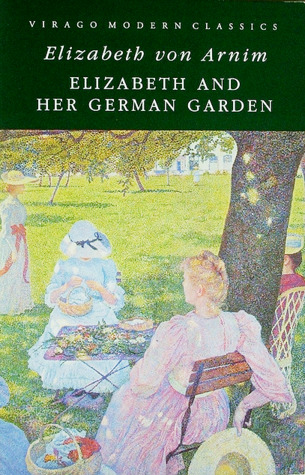
 Today would have been Elizabeth von Arnim’s birthday and she is the next author to be celebrated in Jane from Beyond Eden Rock’s Birthday Book of Underappreciated Lady Authors. Having previously read only The Enchanted April, I had plenty of von Arnim books to choose from, but as my experience of her work is so limited, it seemed sensible to pick another of her better known ones to read next. I hoped Elizabeth and Her German Garden would be a good choice…and it was.
Published in 1898, the book has an autobiographical feel and is written in the form of a diary in which the narrator, Elizabeth, takes us through a year in her life, describing her love for the garden of her home in northern Germany and the changes she sees as the seasons go by. At the beginning of the book Elizabeth knows little about gardening, so there is a sense that she is learning by trial and error as she goes along, discovering which flowers will grow in the soil and climate and which won’t, and trying out different colours and arrangements in different beds. Of course, due to her gender and class, she doesn’t do the hard work herself – she has gardeners to dig and plant for her – but this is a source of frustration to Elizabeth, as the gardeners never seem quite able to bring her visions to life!
Elizabeth is the sort of person who is perfectly happy on her own, as long as she can be outdoors, surrounded by the beauty of nature, and she doesn’t at all regret the city life she has left behind. And in any case, she rarely has time to feel lonely as she has her three young daughters for company. We never learn their names as Elizabeth refers to them simply as the April baby, May baby and June baby (although at five, four and three they are no longer really babies), but it is obvious that she loves them very much – even if she does despair of them at times! The babies provide a lot of the humour in the book, as children often do. Her feelings for her husband are slightly less tender; she calls him ‘The Man of Wrath’, which probably says a lot about their relationship!
Despite her love of peace and quiet, Elizabeth does find herself entertaining visitors now and then, including two who come to stay for the winter: Irais, who shares Elizabeth’s dislike of convention and becomes a good friend, and Minora, a young woman from England who is writing a book on the German way of life and spends most of the winter irritating Elizabeth and Irais with her questions and observations. The women also have some interesting discussions with The Man of Wrath, in which he makes it clear that he thinks a woman’s place is in the home. I suppose The Man is a man of his time, while Elizabeth is a woman ahead of hers.
Although my lifestyle is very different from Elizabeth’s, I liked and understood her almost as soon as I began to read. I’m not much of a gardener myself but, like Elizabeth, I do enjoy sitting outside and reading in the garden on a warm summer’s day and I have always envied those women from years gone by who lived on large country estates with huge gardens to wander in. Elizabeth and Her German Garden is a lovely read; I found it light, entertaining and often funny, with a similar feel to Diary of a Provincial Lady by E.M. Delafield. I will be reading the sequel, The Solitary Summer.
This is the last book I will have time to finish and review for my 20 Books of Summer this year. I have managed 15/20 and will post a full summary of the challenge next week.

 She Reads Novels