 When King Edward VI dies unmarried and childless in 1553, there are several claimants to the throne. One of these is Lady Jane Grey, who has Tudor blood through her mother, Frances Brandon, a niece of Henry VIII’s. Finding herself at the centre of a plot by her parents and the Duke of Northumberland (the father of her husband, Guildford Dudley), Jane becomes Queen of England…but only for nine days. Deposed by Edward’s Catholic half-sister, Queen Mary, Jane is imprisoned in the Tower of London and eventually beheaded. The story of Jane’s short reign and tragic fate forms part of this historical fiction novel by Ella March Chase, but this is not just Jane’s story – it’s also the story of her two younger sisters, Katherine and Mary.
On the same day that Jane married Guildford Dudley, Katherine was married to Henry Herbert, son of the Earl of Pembroke, but after Jane’s downfall the Herberts want to break their ties with the Grey family, so Katherine and Henry’s marriage is annulled. Later, Katherine falls in love with Edward Seymour but their secret romance incurs the wrath of the new queen, Elizabeth I, and Katherine finds that her own life could be in danger. Although the youngest Grey sister, Mary, is not such a central part of her parents’ plotting (possibly because she suffers from what sounds like a severe form of spinal curvature), she is still affected by Jane’s death and Katherine’s misfortunes. This fictional account of the Grey sisters is a great introduction to Mary and Katherine for those of us who know very little about them!
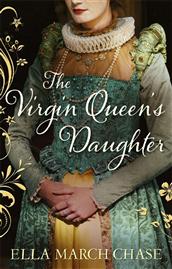
I had a good idea of what I could expect from The Nine Day Queen, having read another book last year by this author, The Virgin Queen’s Daughter, which I enjoyed. I knew it wouldn’t be a particularly ‘literary’ historical novel (you can probably guess that from the cover, though it’s not always fair to make assumptions) but not as light and fluffy as some. I can’t really say much about the accuracy of the book as I’ve only read one other novel about Lady Jane Grey (Innocent Traitor by Alison Weir) and no non-fiction beyond the few brief paragraphs she is usually given in books about the Tudors. As far as I could tell the story does stick to the basic facts, with some obvious inventions, as you would expect in a book that is fiction rather than non-fiction – and the author does use her Author’s Note at the end to explain where she has deviated away from the known facts.
The sisters are given such different personalities – Jane is sensible, studious and a devout Protestant, Katherine warm, compassionate and pretty, and Mary outspoken and impulsive – and with each girl narrating her own chapters of the book, the opportunity was there for the author to develop a different narrative voice and style for each of them. I was disappointed that she didn’t make the most of this opportunity and the voices of the three girls were very similar, so much so that there were times when I found it hard to tell who was narrating the chapter I was reading and had to look back at the chapter heading to remind myself.
I did like the fact that the story was told from the perspective of all three Grey sisters, though, and I was surprised to find that Jane’s death comes not near the end of the book as you might expect, but in the middle. The focus is then on Katherine and Mary for the remainder of the novel and I thought this was good because while Jane’s story is well known, the other two sisters have been largely forgotten by history and it was nice to have an opportunity to learn more about them both. Another thing that was surprising was the portrayal of the two queens, Mary I and Elizabeth I. In a reversal of what you would usually expect, Mary is portrayed as kind and considerate whereas Elizabeth comes across as spiteful and vindictive. They both felt more like caricatures than realistic characters to me, but it was interesting to see such a different perspective!
Are there any other books anyone can recommend on Lady Jane Grey and her sisters, either fiction or non-fiction? I’ve just received a copy of the new Elizabeth Fremantle novel, Sisters of Treason, from Netgalley so will be interested to see how that one compares.
Note: This book has also been published under the title Three Maids for a Crown.
 She Reads Novels