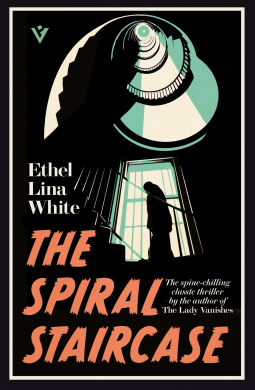
The Spiral Staircase by Ethel Lina White

Originally published as Some Must Watch in 1933, this is a reissue by Pushkin Vertigo under the title The Spiral Staircase – the name of the 1946 film adaptation. I’ve previously read two other novels by Ethel Lina White – The Wheel Spins and Fear Stalks the Village – and enjoyed both, although I found the former slightly disappointing in comparison with Alfred Hitchock’s wonderful The Lady Vanishes, which is based on it. This book has turned out to be my favourite of the three!

Almost the entire novel is set within the walls of the Summit, a lonely country house near the Welsh/English border. Adding to the sense of tension and claustrophobia, the main events of the story also take place over the course of a single evening. As the novel opens, we learn that four murders have recently been committed – the first two in the nearest town, which is over twenty miles away, the next slightly closer, and the fourth in another country house just five miles from the Summit. All four victims were young women and their deaths are on Helen Capel’s mind as she returns to the Summit after her afternoon off and is convinced that she sees a man hiding behind a tree in the dark.

Helen has just started a new job as ‘help’ to the Warren family – Miss Warren and her brother, known as the Professor, and their elderly, bedridden stepmother, Lady Warren. At the start of the novel, the Professor’s son and his wife are staying at the house, as is a student of the Professor’s, Stephen Rice. The rest of the household is made up of two more domestic servants, Mr and Mrs Oates, and the newly arrived Nurse Barker, who has been employed to look after Lady Warren.

When news of another murder, closer than ever this time, reaches the family, the Professor orders that all the doors are locked and everyone stays inside until morning. These should be easy enough instructions to follow, yet for a variety of reasons, one person after another leaves the house or becomes otherwise incapacitated. As a storm rages outside and the tension builds inside, Helen is forced to confront the idea that one of the remaining people in the house could be the murderer.

This book is good fun, but you do need to be able to suspend disbelief now and then (Helen is one of those heroines typical of this genre of book, who, despite knowing there’s a murderer on the loose, tries to open the front door every time someone knocks and spends most of the night wandering around the house on her own, along dark passageways and up and down dimly-lit staircases). Still, Ethel Lina White does a great job of creating an atmosphere of foreboding and fear, not just through stormy weather and shadows, but also through hints that various characters may not be as they seem. Is Lady Warren really unable to walk – and why does she have a gun in her room? And what if Nurse Barker isn’t really a nurse?

I found this a quick, entertaining read, let down slightly by the ending because the killer’s identity wasn’t particularly surprising and their motive was unconvincing. If you’re looking for a cleverly plotted mystery, I think you’ll be disappointed as I would describe this as much more of a psychological horror/suspense novel than a crime novel. It reminded me a lot of Benighted by J.B. Priestley and I think if you enjoyed one there’s a good chance you would enjoy the other. After finishing this book, I watched the film for the first time (it’s currently available on YouTube) and while it’s worth watching in its own right, I didn’t feel that it had much in common with the book!

Thanks to Pushkin Vertigo for providing a copy of this book for review via NetGalley.

Book 8/20 for 20 Books of Summer 2025.

Fear Stalks the Village by Ethel Lina White

The village was beautiful. It was enfolded in a hollow of the Downs, and wrapped up snugly — first, in a floral shawl of gardens, and then, in a great green shawl of fields. Lilies and lavender grew in abundance. Bees clustered over sweet-scented herbs with the hum of a myriad spinning-wheels.

With its Tudor cottages and cobbled streets, the village depicted in Ethel Lina White’s 1932 novel seems at first sight to be an idyllic place to live. There’s no poverty or unemployment, an endless round of tea parties and tennis games, and once settled there, people find that they never want to leave. Joan Brook is a relative newcomer to the village, having arrived to take up a position as companion to Lady d’Arcy, and she has already fallen under its spell.

When a novelist friend from London comes to visit, she entertains herself and Joan by imagining the secret scandals taking place behind closed doors. Perhaps the village doctor is poisoning his wife, she says, and the saintly Miss Asprey is bullying her companion; the Rector is leading a double life, and Miss Julia Corner, President of the local Temperance Society, is a secret drinker. The visit is a brief one and the friend soon returns to London, but when the inhabitants of the village begin to receive anonymous poison pen letters, it seems that the scenarios she had imagined were not so far from the truth after all.

Fear Stalks the Village is an unusual crime novel; although there are several deaths, it is not a murder mystery and the plot revolves entirely around finding out who is writing the spiteful letters threatening to expose the private lives of the villagers. Other reviews compare it to The Moving Finger by Agatha Christie, but as I haven’t read that one yet it reminded me most of Henrietta Clandon’s Good by Stealth. There’s lots of witty, satirical humour and a large cast of strongly drawn characters, all of whom appear at first to be happy, well-adjusted people…until the letters begin to arrive. The question the novel raises is whether the cracks have always been there beneath the surface or whether they have been created by the letters and the suspicion and anxiety they cause.

The mystery is quite a clever one, with some red herrings to throw us off the track, and I didn’t guess who was sending the letters. However, it took me a while to get into this book as the pace is quite slow and, despite the title, I didn’t feel that there was any real sense of fear or menace. Still, this is the second book I’ve read by Ethel Lina White, the first being The Wheel Spins (the book on which Alfred Hitchcock’s The Lady Vanishes is based) and I think it’s my favourite of the two – probably because with the other book I couldn’t help comparing it unfavourably to the film, which I love! I would be happy to try more of her books so let me know if there are any you would recommend.

The Wheel Spins by Ethel Lina White

I was re-watching one of my favourite films, Alfred Hitchcock’s The Lady Vanishes, a few weeks ago and it occurred to me that I should probably try reading the book on which it was based – The Wheel Spins by Ethel Lina White, published in 1936. Luckily, I was able to find a Project Gutenberg version available to download, so I could start it immediately while I was in the mood. Now that I’ve read it, I think it’s one of the few cases where, for me, the film is better than the book! I did enjoy reading it, but I was surprised by how different it was and by how many of the elements I love from The Lady Vanishes are not part of the novel.

The Wheel Spins begins with Iris Carr, a young Englishwoman, staying at a small hotel in an unspecified country somewhere in Europe. Her friends have already left but Iris has decided to stay on alone at the hotel for a few more days. On the day she is due to catch the train home, she briefly loses consciousness at the station and assumes she must be suffering from sunstroke. Managing to board the crowded train just in time, Iris finds herself sharing a carriage with several other people, including Miss Froy, an English governess who is also on her way home. Iris accompanies Miss Froy to tea in the dining carriage where she listens to her new friend talk about her recent teaching jobs. After returning to their seats, Iris falls asleep – and awakens to find Miss Froy gone. When the rest of the passengers all deny that Miss Froy ever existed, Iris begins to panic: has the sunstroke affected her more than she’d realised or is something more sinister taking place?

After a slow start in which the author takes her time introducing us to Iris and the other guests at the hotel, all of whom seem to end up on the same train home, things soon pick up with the disappearance of Miss Froy and the efforts Iris makes to try to find out what has happened to her. There are only really two possible scenarios: either Iris has imagined things or everybody on the train is lying – and if they are lying, why? This is where the significance of those early chapters becomes clear as Iris is not the most pleasant of people and makes herself so unpopular with her fellow travellers that it’s easy to see why they don’t feel like helping her. Some of them also have other motives for not wanting to get involved and although I thought this was handled better in the film, the book does still give us a sense of how unsettling all of this is for Iris and how she begins to doubt her own sanity.

As I’ve said, there are so many things I love in the film which don’t appear in the novel: the significance of music to the plot; Charters and Caldicott, the two cricket-obsessed Englishmen determined to get home in time to see the Test Match; the relationship between Iris and the musicologist Gilbert; and the performances of Margaret Lockwood (a much more likable Iris than the one in the book), Michael Redgrave and May Whitty in the leading roles. On the other hand, there are also some interesting aspects of the novel that Hitchcock didn’t include – for example, some occasional glimpses of Miss Froy’s elderly parents at home in England looking forward to their daughter’s return.

Although I think I might have felt more enthusiastic about the book if I had read it first, rather than the other way around, I still enjoyed it and am curious about Ethel Lina White’s other books now.