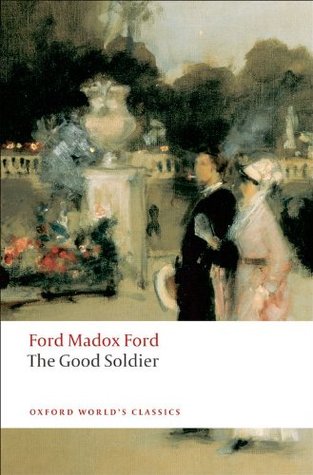
 I seem to have been under a bit of a misconception with this book; based on the title and the fact that it was published in 1915 I thought it would be a book about war. It isn’t, of course. I expect everyone else already knows that and I’ve just made myself sound stupid, but it’s really not a book I’ve ever considered reading or paid any attention to until recently. That’s my excuse! What is The Good Soldier actually about, then? Well, it’s a tale of marriage and adultery, of love and betrayal, and it reminded me of something F. Scott Fitzgerald might write (although Fitzgerald’s books would come several years later).
The Good Soldier is a deceptively simple story of two seemingly respectable couples who meet and get to know each other at a spa town in Germany in 1904. John Dowell, our narrator, is an American who has come to Bad Nauheim with his wife, Florence, whom he tells us has a weak heart. The other couple – Edward Ashburnham, another heart patient, and his wife Leonora – are British. Seen through John Dowell’s eyes, the story of these four people and the relationships between them slowly unfolds and we gradually discover that there is more to each of them than meets the eye.
I don’t think I really need to say much more about the plot – and to do so would run the risk of spoiling the book for future readers. This is a story built around lies, deceptions and secrets, things which are only revealed when John Dowell decides to reveal them. It’s an interesting structure, consisting of a series of memories and flashbacks told in non-chronological order, moving backwards and forwards in time. Interesting, but not very easy to follow, at least on a first read! This is the sort of book you would really need to read more than once to be able to fully appreciate it, but I don’t think I’ll be reading it again – at least not in the near future – because, although I did like the book, I didn’t like it enough for a re-read.
It’s a clever and intriguing novel, though, with a narrator who is certainly not a reliable one. We can never be sure how much of what Dowell says is true, as he often makes a statement or describes a sequence of events only to contradict himself later in the book. I was constantly having to change my mind about the characters and reassess what I thought I knew about them. The question is whether Dowell is deliberately trying to mislead us or whether he himself is deluded or confused. Even the opening line is curious: “This is the saddest story I have ever heard”. Why does he say it’s a story he’s ‘heard’ when he is one of the main participants in the story? This is a book that left me with many more questions than answers!
Have you read anything by Ford Madox Ford? I think I would like to try Parade’s End at some point.
 She Reads Novels