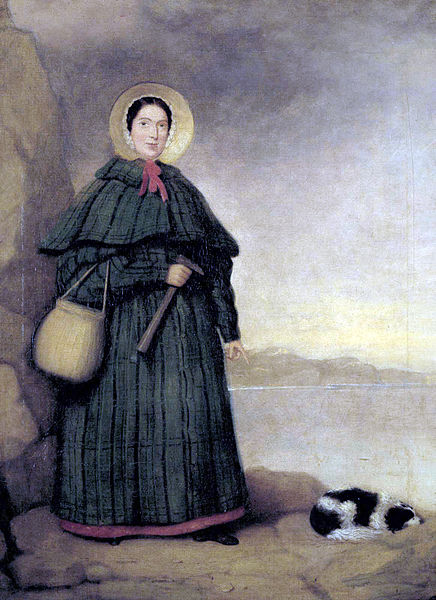
 The cliffs and beaches of Lyme Regis on the south coast of England are famous for their fossils, particularly the remains of dinosaurs and other prehistoric reptiles, some of which were discovered in the 19th century by the fossil collector and scientist, Mary Anning. In her new novel The Bone Hunters, Joanne Burn takes inspiration from Anning’s life and work to create the fictional story of another female fossil hunter, Ada Winters.
Ada is twenty-four years old when her story begins in 1824. Since her father’s death, she and her mother have been struggling to pay the rent and are at risk of losing their little cottage by the sea. Much to her mother’s frustration, Ada is reluctant to look for a job, instead spending her days wandering on the beach and insisting that the collection of bones and fossils she is acquiring will one day make their fortune. Ada receives a setback when her request to join the Geological Society of London is rejected, but her disappointment turns to excitement when she discovers what she believes to be the remains of a previously unidentified species.
When Ada meets another geologist, Dr Edwin Moyle, by the cliffs one day, she must decide whether to trust him with what she has found. Edwin’s support means she will be more likely to be taken seriously when she presents her discovery to the Society, but what if he tries to claim the skeleton for himself? Having come so close to achieving her dream, Ada is determined not to let anyone take it away from her!
The Bone Hunters is a beautifully written novel. I loved the descriptions of the landscape – the beach, the harbour, the cliffs of Black Ven with their ‘dark, forbidding crag face looming high above’ – and the town itself. The relationship between the people of Lyme and their natural environment is something that comes up again and again throughout the book: the dangers of landslides that can happen without warning; the severe flooding that can destroy homes and take lives. It’s one of those novels where the geographical setting takes on as much importance as the characters and the plot.
As I read, it was difficult not to make comparisons with Remarkable Creatures, Tracy Chevalier’s novel about Mary Anning, but I think I enjoyed this one more. Inventing a character based on Anning rather than writing about Anning herself allowed Joanne Burn to bring more drama into the story and to introduce other fictional characters and storylines. I particularly liked Josiah and Annie Fountain, an elderly couple who run a bookshop together and have taken Ada under their wing, and Isaac, a young man who has come to Lyme to collect local myths and legends. Ada herself frustrated me because of her single-mindedness and selfishness – I felt sorry for her mother who was making herself ill washing fleeces in a factory all day while Ada refused to go to work – but at the same time I could admire her ambition and determination as a woman trying to make a name for herself in a male-dominated field. As for Edwin, part of the story is written from his point of view which adds an extra angle of interest, but I won’t tell you whether he turns out to be hero or villain!
Joanne Burn is a new author for me. I haven’t read either of her previous novels, but I do now want to read The Hemlock Cure, based on the real life story of the village of Eyam during the Great Plague.
Thanks to Little, Brown Book Group UK for providing a copy of this book for review via NetGalley.

Book 5/50 for the Historical Fiction Reading Challenge 2024

 She Reads Novels